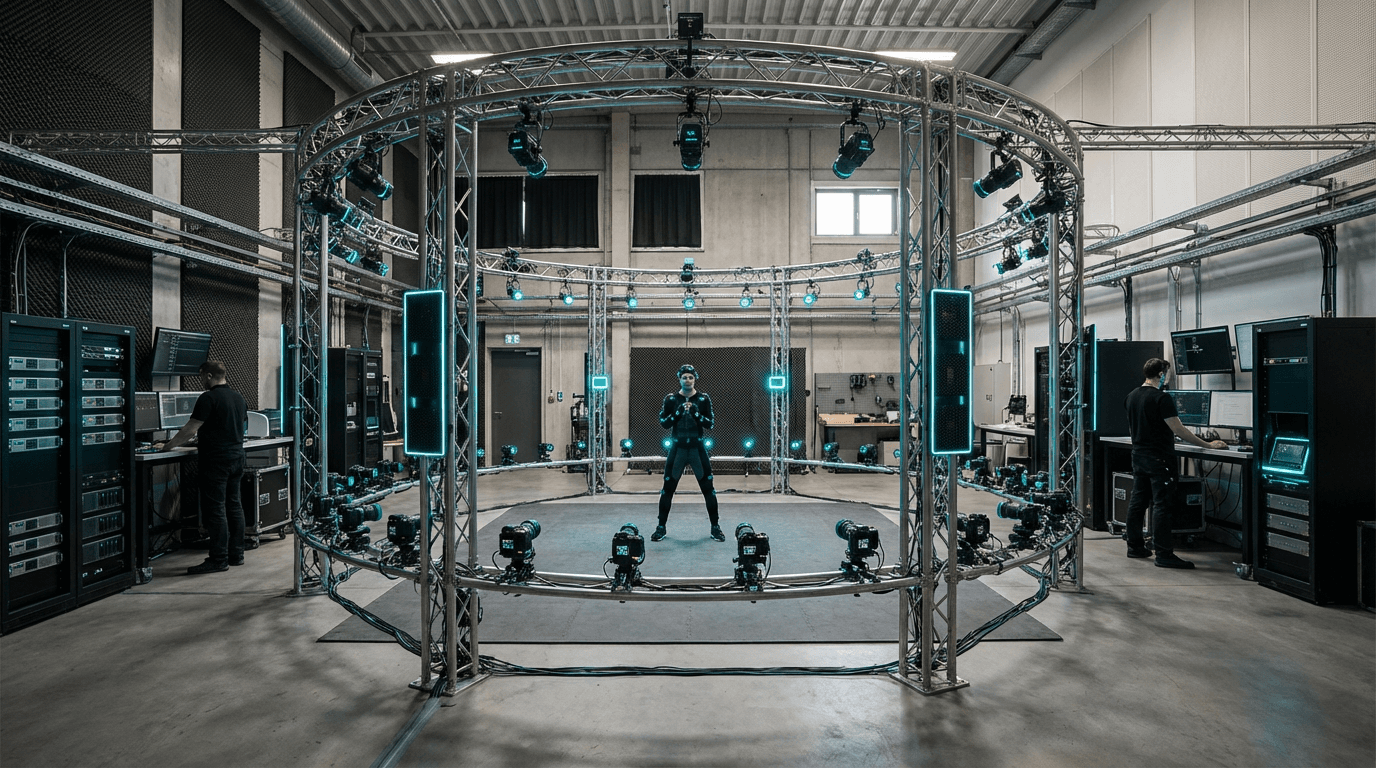
Volumetric Capture Stages
Volumetric capture stages represent a significant evolution in content production technology, employing arrays of synchronized cameras and depth sensors to record performers as complete three-dimensional digital assets rather than traditional flat video. These specialized studio environments typically feature dozens to hundreds of high-resolution cameras positioned in a spherical or hemispherical arrangement around a performance space, working in concert with infrared depth sensors, LiDAR systems, and sophisticated photogrammetry software. The captured data streams are processed in real-time or near-real-time to generate dynamic 3D models—often called volumetric video or holograms—that preserve not only the visual appearance of performers but also their spatial geometry, movement, and texture information from every angle. Unlike conventional motion capture that records skeletal movement data requiring manual animation, volumetric capture creates photorealistic digital representations that can be rendered from any viewpoint, effectively freezing performances in navigable three-dimensional space.
The entertainment and streaming industries face persistent challenges in creating immersive content that transcends the limitations of traditional flat video, particularly as audiences increasingly engage with virtual reality platforms, interactive gaming experiences, and mixed reality applications. Volumetric capture addresses the fundamental constraint of fixed camera perspectives, enabling content creators to produce performances that viewers can experience from any angle or distance, a capability essential for truly immersive storytelling. This technology solves the problem of integrating realistic human performances into fully interactive 3D environments without the uncanny valley effects often associated with computer-generated characters. For streaming platforms and content producers, volumetric assets offer unprecedented flexibility in post-production, allowing directors to choose camera angles and framing long after the performance has concluded. The technology also enables new revenue streams through virtual concerts, museum installations, and interactive experiences where audiences can move freely around performers in virtual space.
Early deployments of volumetric capture have already demonstrated commercial viability across multiple sectors. Music artists have utilized these stages to create virtual concert experiences that can be distributed globally and viewed in VR headsets, while sports broadcasters are exploring applications for creating interactive replays where viewers control their perspective. Gaming studios are incorporating volumetric performances to enhance narrative sequences with photorealistic human actors who seamlessly integrate into game environments. Several major technology companies and entertainment studios have invested in building dedicated volumetric capture facilities, though the technology remains resource-intensive and typically reserved for high-value productions. As processing capabilities improve and capture systems become more efficient, industry observers note a trajectory toward more accessible volumetric production workflows. This evolution aligns with broader trends in spatial computing and the gradual shift toward three-dimensional, interactive content consumption, positioning volumetric capture as a foundational technology for the next generation of entertainment experiences that blur the boundaries between live performance, gaming, and cinematic storytelling.
Related Organizations

A leading volumetric production studio that has produced high-profile volumetric experiences for fashion and music.

A premier volumetric capture stage in Los Angeles, utilizing Microsoft Mixed Reality Capture technology.

Manufactures the HOLOSYS volumetric capture system used by studios worldwide for high-fidelity 3D video.

Multinational corporation specializing in optical, imaging, and industrial products.

Creators of HoloSuite, a post-production and streaming platform for volumetric video, enabling adaptive streaming of 3D data.

Provides a software platform for the capture, rendering, and streaming of volumetric video.

Mantis Vision
Israel · Company
Develops volumetric capture technologies and 3D scanning hardware for live streaming applications.

Creators of Depthkit, a software tool allowing volumetric capture using accessible depth sensors.

AI-powered software that enables volumetric capture using standard smartphones rather than expensive studio rigs.
Supporting Evidence
Research this in Signals
Signals turns a topic into a sourced research record you can inspect and rerun. Your first scan is free, and this one starts with Volumetric Capture Stages already loaded, so edit it or scan as is.