Digital Human Animation Systems
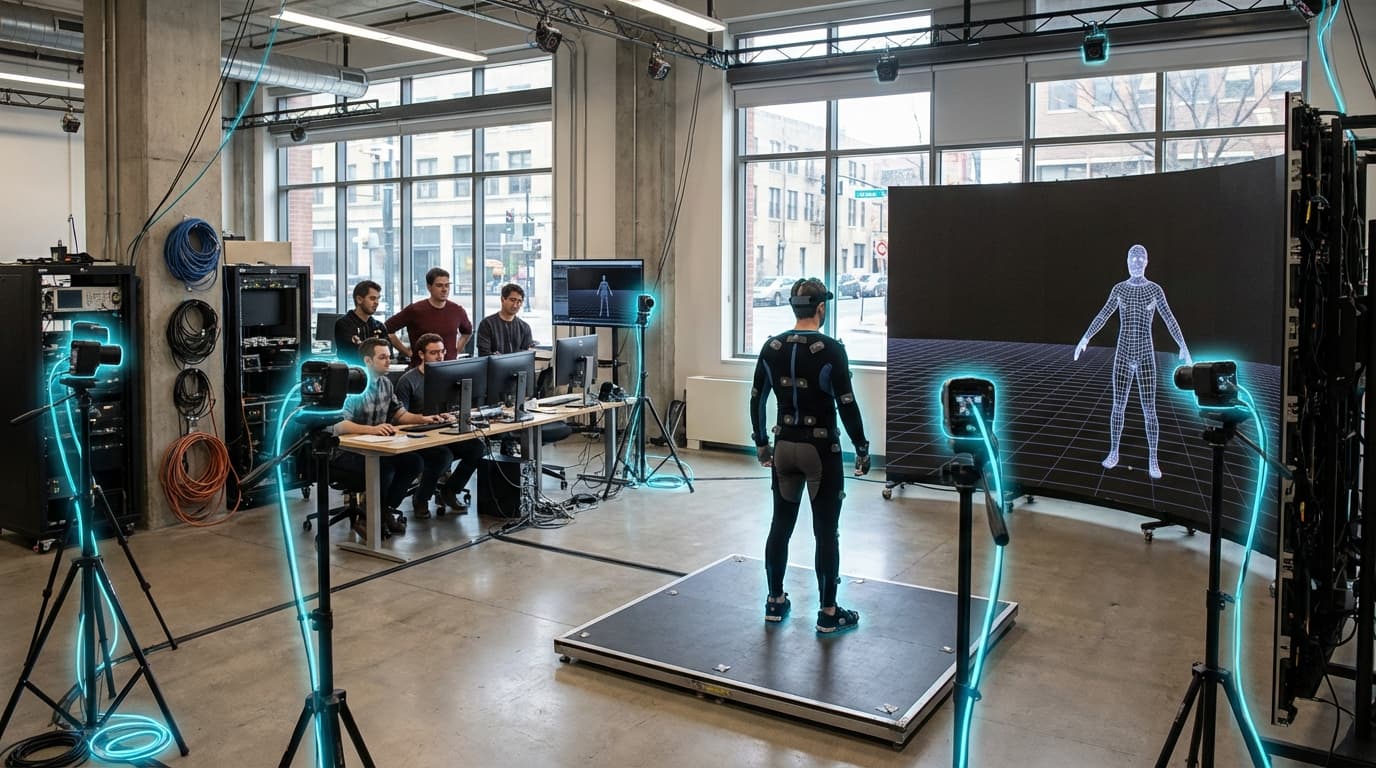
Digital Human Animation Systems represent a convergence of motion capture technology, facial performance tracking, and AI-driven generative animation to create photorealistic virtual characters capable of real-time interaction. These systems work by capturing human performances through arrays of cameras and sensors that track body movement, facial expressions, and subtle micro-expressions, then translating this data into digital skeletal rigs and blend shapes that drive 3D character models. Advanced pipelines incorporate machine learning models trained on vast libraries of human movement and expression, enabling the systems to interpolate natural-looking animations between captured poses, predict realistic secondary motion like hair and clothing physics, and even generate contextually appropriate gestures and expressions without direct human input. The technical architecture typically involves real-time rendering engines that can process this animation data with minimal latency, making it possible for digital humans to respond and perform live rather than requiring extensive post-production rendering.
The entertainment and streaming industries face mounting pressure to produce engaging content at unprecedented scale while managing production costs and talent availability constraints. Traditional animation and visual effects workflows are labour-intensive and time-consuming, often requiring months of work for minutes of final footage. Digital Human Animation Systems address these challenges by dramatically compressing production timelines and enabling new content formats that were previously impractical or impossible. Virtual influencers can maintain consistent presence across multiple platforms simultaneously, appearing in live streams, pre-recorded content, and interactive experiences without the physical limitations of human performers. For streaming platforms, these systems enable the creation of virtual hosts who can be localised for different markets, updated instantly to reflect current events or trends, and scaled to produce personalised content variations. The technology also solves critical problems in remote production, allowing performers to drive digital characters from anywhere in the world, reducing travel costs and enabling collaboration across time zones.
Early commercial deployments have already demonstrated the viability of digital humans in mainstream entertainment, with virtual influencers attracting millions of followers on social media platforms and virtual hosts appearing in live broadcasts and interactive gaming experiences. Music and entertainment companies are exploring digital performers for concerts and appearances that can occur simultaneously in multiple venues or persist beyond a human performer's career. The technology is also finding applications in corporate communications, where digital spokespersons provide consistent brand messaging, and in education and training, where virtual instructors can deliver personalised lessons at scale. As the systems become more sophisticated and accessible, industry observers note a trajectory toward increasingly seamless integration of digital humans into everyday media consumption, blurring the boundaries between virtual and physical performers. This evolution aligns with broader trends in synthetic media and the metaverse, where persistent digital identities and real-time interactive experiences are becoming central to how audiences engage with entertainment content.
Related Organizations

Developers of Unreal Engine 5, which features Lumen, a fully dynamic global illumination and reflection system designed for next-gen consoles and PC.

Creates autonomously animated 'Digital People' with simulated nervous systems.

Developers of Character Creator and iClone, software specifically designed for generating and animating 3D characters.

Leading developer of hyper-realistic generative AI avatars and de-aging technology for film and entertainment.

A platform for creating AI characters with distinct personalities, memories, and contextual awareness for games and virtual worlds.

Providers of markerless 3D facial motion capture hardware and software used widely in film and game production.

Provides 'Animate 3D', a cloud-based service that converts 2D video files into 3D animation for avatars and characters using AI.

A technology company that automatically generates high-fidelity 3D digital humans from user selfies for use in games and apps.

Originally a hardware suit manufacturer, Rokoko launched 'Rokoko Video', a browser-based tool for extracting motion data from webcam or uploaded video.

Develops AI software that extracts high-fidelity 3D motion data from standard 2D video footage (using iPhones or GoPros) without markers.
Supporting Evidence
Research this in Signals
Signals turns a topic into a sourced research record you can inspect and rerun. Your first scan is free, and this one starts with Digital Human Animation Systems already loaded, so edit it or scan as is.