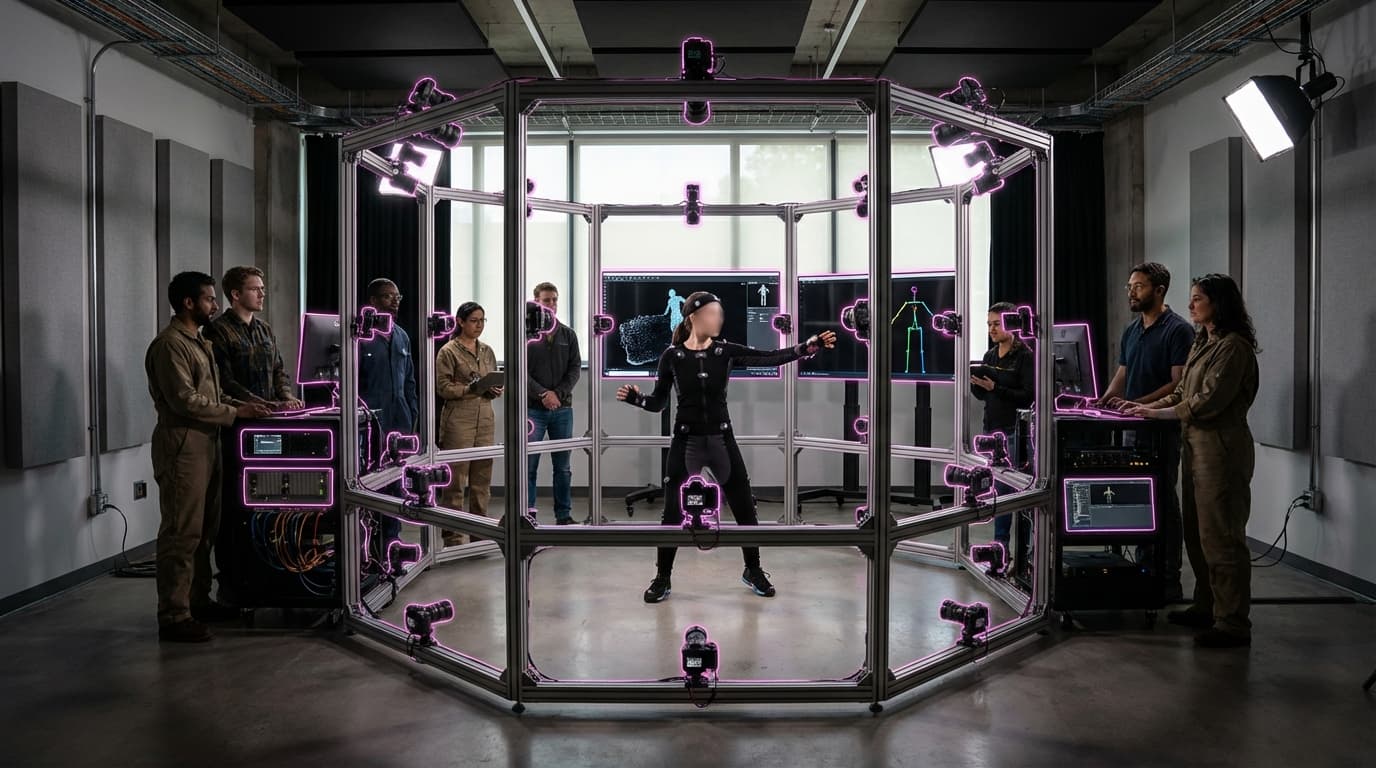
Volumetric Capture Arrays
Volumetric capture arrays represent a sophisticated approach to recording human presence and performance by surrounding subjects with dozens or even hundreds of synchronized cameras and depth sensors. Unlike traditional video or motion capture systems that rely on markers or single viewpoints, these arrays combine RGB cameras with depth-sensing technology—such as time-of-flight sensors or structured light systems—to capture the complete three-dimensional geometry of a person or space from multiple angles simultaneously. The resulting data streams are processed through advanced computer vision algorithms that reconstruct subjects as dynamic 3D meshes or point clouds, preserving not just appearance but also spatial volume, movement, and subtle details like facial expressions and fabric dynamics. This reconstruction happens in real-time or near-real-time, creating what are essentially living digital sculptures that can be viewed from any angle, even perspectives that no physical camera occupied during capture.
The technology addresses a fundamental limitation in how we preserve and transmit human experience: the flattening of three-dimensional reality into two-dimensional media. Traditional video captures only what the camera sees, losing depth information and constraining viewers to a fixed perspective. For industries ranging from entertainment to healthcare, this constraint has meant that nuanced physical performances, complex movement patterns, and spatial relationships remain difficult to fully document or analyse. Volumetric capture enables entirely new workflows in film and game production, where actors can be recorded once and their performances viewed from any angle in post-production. In clinical settings, researchers can analyse movement disorders or rehabilitation progress with unprecedented spatial precision. The technology also opens possibilities for remote collaboration that transcends conventional video conferencing, allowing participants to appear as three-dimensional presences in shared virtual spaces rather than as flat images on screens.
Early deployments of volumetric capture have emerged in professional entertainment production, with specialized studios offering services to major film and gaming companies seeking photorealistic digital humans. Museums and cultural institutions are beginning to explore these systems for preserving traditional dances, theatrical performances, and other embodied cultural practices that lose essential qualities when recorded through conventional means. The technology aligns with broader trends toward spatial computing and immersive media, where content is increasingly designed to be experienced in three dimensions rather than on flat screens. As sensor costs decrease and processing capabilities improve, volumetric capture is transitioning from specialized facility-based systems toward more accessible configurations, suggesting a future where three-dimensional human presence becomes a standard medium for communication, preservation, and creative expression rather than an exotic technical achievement.
Related Organizations

Manufactures the HOLOSYS volumetric capture system used by studios worldwide for high-fidelity 3D video.

A leading volumetric production studio that has produced high-profile volumetric experiences for fashion and music.

German research institute developing advanced algorithms for 3D Human Body Reconstruction and volumetric video coding.

A premier volumetric capture stage in Los Angeles, utilizing Microsoft Mixed Reality Capture technology.

Mantis Vision
Israel · Company
Develops volumetric capture technologies and 3D scanning hardware for live streaming applications.

Creators of HoloSuite, a post-production and streaming platform for volumetric video, enabling adaptive streaming of 3D data.

Provides a software platform for the capture, rendering, and streaming of volumetric video.

Creators of Depthkit, a software tool allowing volumetric capture using accessible depth sensors.

Multinational corporation specializing in optical, imaging, and industrial products.

Manufactures compact, high-speed video cameras (Volucam) specifically designed for synchronized volumetric capture arrays.
Supporting Evidence
Research this in Signals
Signals turns a topic into a sourced research record you can inspect and rerun. Your first scan is free, and this one starts with Volumetric Capture Arrays already loaded, so edit it or scan as is.