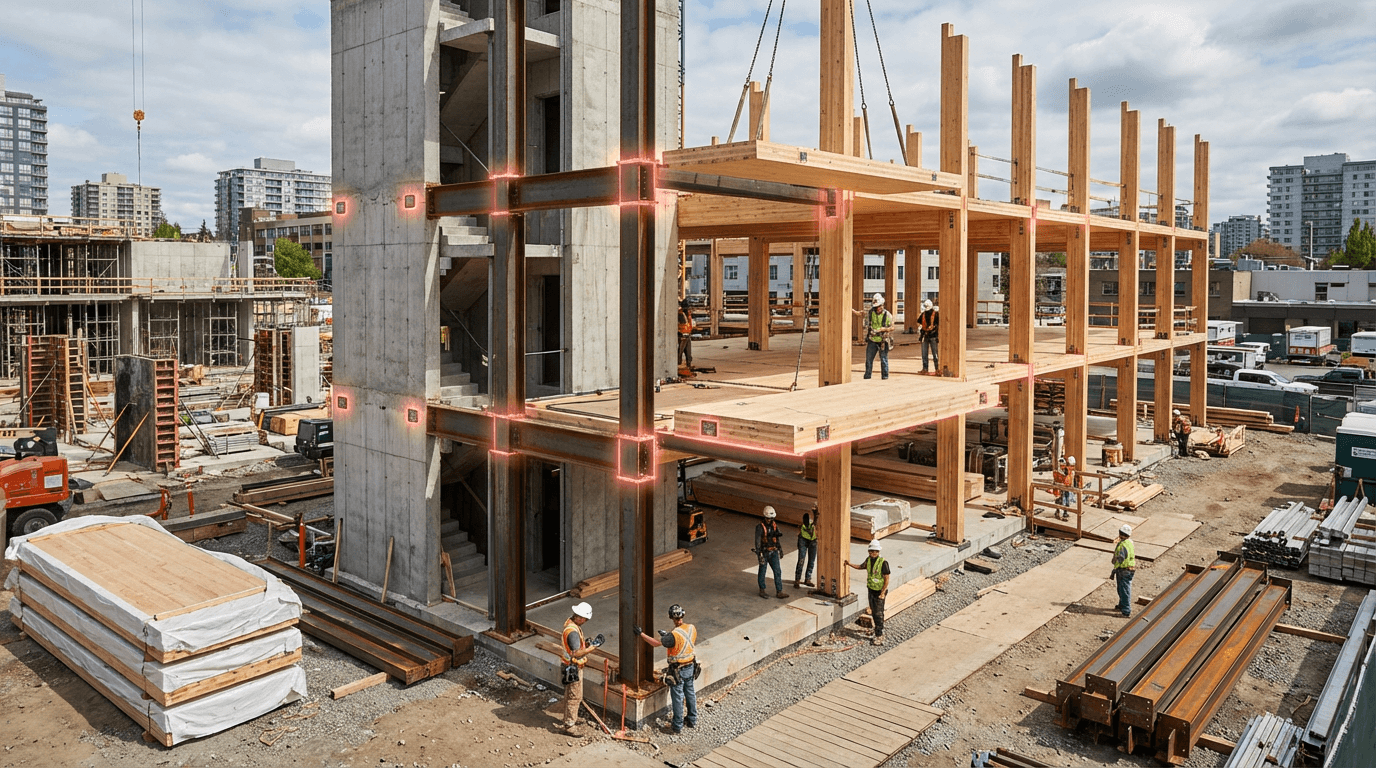
Mass Timber & Hybrid Structural Systems
Mass timber and hybrid structural systems represent a fundamental shift in how buildings are conceived and constructed, moving away from carbon-intensive concrete and steel toward engineered wood products that sequester carbon while offering comparable structural performance. At the heart of this approach are advanced timber technologies such as cross-laminated timber (CLT), glue-laminated timber (glulam), and laminated veneer lumber (LVL). These materials are manufactured by bonding layers of wood under heat and pressure, creating panels and beams that can span significant distances and bear substantial loads. CLT panels, for instance, consist of multiple layers of lumber boards stacked crosswise and glued together, resulting in large-format structural elements that can be prefabricated with precision in controlled factory environments. When combined with steel or concrete cores—typically used for elevator shafts, stairwells, and lateral stability—these hybrid systems leverage the strengths of each material: timber provides rapid assembly and reduced weight, while the core elements offer proven fire resistance and structural rigidity. The integration requires careful detailing at connection points, where metal fasteners, brackets, and adhesives must accommodate the different thermal expansion rates and load-transfer characteristics of wood and inorganic materials.
The construction industry faces mounting pressure to reduce its carbon footprint, which currently accounts for a significant portion of global greenhouse gas emissions, with concrete and steel production being particularly energy-intensive. Mass timber addresses this challenge directly by substituting materials that emit carbon during manufacture with wood that stores atmospheric carbon absorbed during tree growth. Beyond carbon benefits, these systems solve practical construction challenges that have long plagued urban development. The lighter weight of timber structures reduces foundation requirements, which can be especially advantageous on challenging sites or in seismic zones where reduced building mass translates to lower lateral forces. Prefabrication of timber components in factory settings enables tighter quality control, minimizes weather-related delays, and dramatically accelerates on-site assembly—some projects report construction timelines shortened by months compared to conventional methods. This speed advantage carries economic implications, reducing financing costs and allowing buildings to generate revenue sooner. Hybrid configurations also address fire safety concerns that have historically limited timber's use in taller structures; by encapsulating timber elements in gypsum board or incorporating concrete cores and floors, designers can achieve fire ratings that meet stringent building codes while maintaining the material efficiency and aesthetic appeal of exposed wood.
Early adopters in Europe and North America have demonstrated the viability of mass timber in buildings ranging from mid-rise residential towers to institutional and commercial structures, with some projects reaching heights previously unthinkable for wood construction. These pioneering buildings serve as proof-of-concept for broader industry transformation, though widespread adoption faces several hurdles. Building codes in many jurisdictions are evolving to accommodate taller timber structures, but regulatory frameworks often lag behind technological capabilities, requiring project-specific approvals that add time and uncertainty. The supply chain for mass timber remains concentrated in certain regions, and scaling production capacity requires substantial investment in specialized manufacturing facilities equipped with computer-controlled cutting and assembly equipment. Moisture management throughout the supply chain—from forest to fabrication to construction site—demands rigorous protocols to prevent dimensional changes, mold growth, and structural degradation. Acoustic performance, particularly in residential applications, requires careful attention to floor and wall assemblies, as timber's lighter mass can transmit sound more readily than concrete. Despite these challenges, the trajectory is clear: as climate imperatives intensify and the construction industry seeks alternatives to conventional materials, mass timber and hybrid systems are positioned to become mainstream solutions. The technology aligns with broader trends toward modular construction, digital fabrication, and circular economy principles, where buildings can be disassembled and materials reclaimed at end-of-life. As forestry practices evolve to ensure sustainable sourcing and manufacturing processes become more efficient, mass timber offers a pathway toward a built environment that works with natural carbon cycles rather than against them.
Related Organizations

A leading European manufacturer of solid wood products and building solutions, including CLT and glulam.

Stora Enso
Finland · Company
One of the largest global providers of renewable solutions in packaging, biomaterials, and wooden construction (CLT/LVL).
A subsidiary of Mercer International, manufacturing CLT and providing mass timber integration services.

A technology platform for hybrid timber construction, licensing their building system to partners worldwide.
Pioneers in the production of large-format cross-laminated timber elements.
An international property and infrastructure group that has pioneered the construction of commercial timber office buildings.

Holistic mass timber provider offering engineering, fabrication, and installation services.

An architecture firm internationally recognized for advocating and designing tall wood buildings.

A Japanese forestry and construction company planning the W350 Project, a 350-meter tall wooden skyscraper in Tokyo.

An architecture practice dedicated to sustainable construction, known for designing the world's first tall CLT residential building.

Engineering company developing modular wind turbine towers made from laminated wood.
Multinational developer of high-tech solutions for timber building safety and fixing systems.
Supporting Evidence
Research this in Signals
Signals turns a topic into a sourced research record you can inspect and rerun. Your first scan is free, and this one starts with Mass Timber & Hybrid Structural Systems already loaded, so edit it or scan as is.