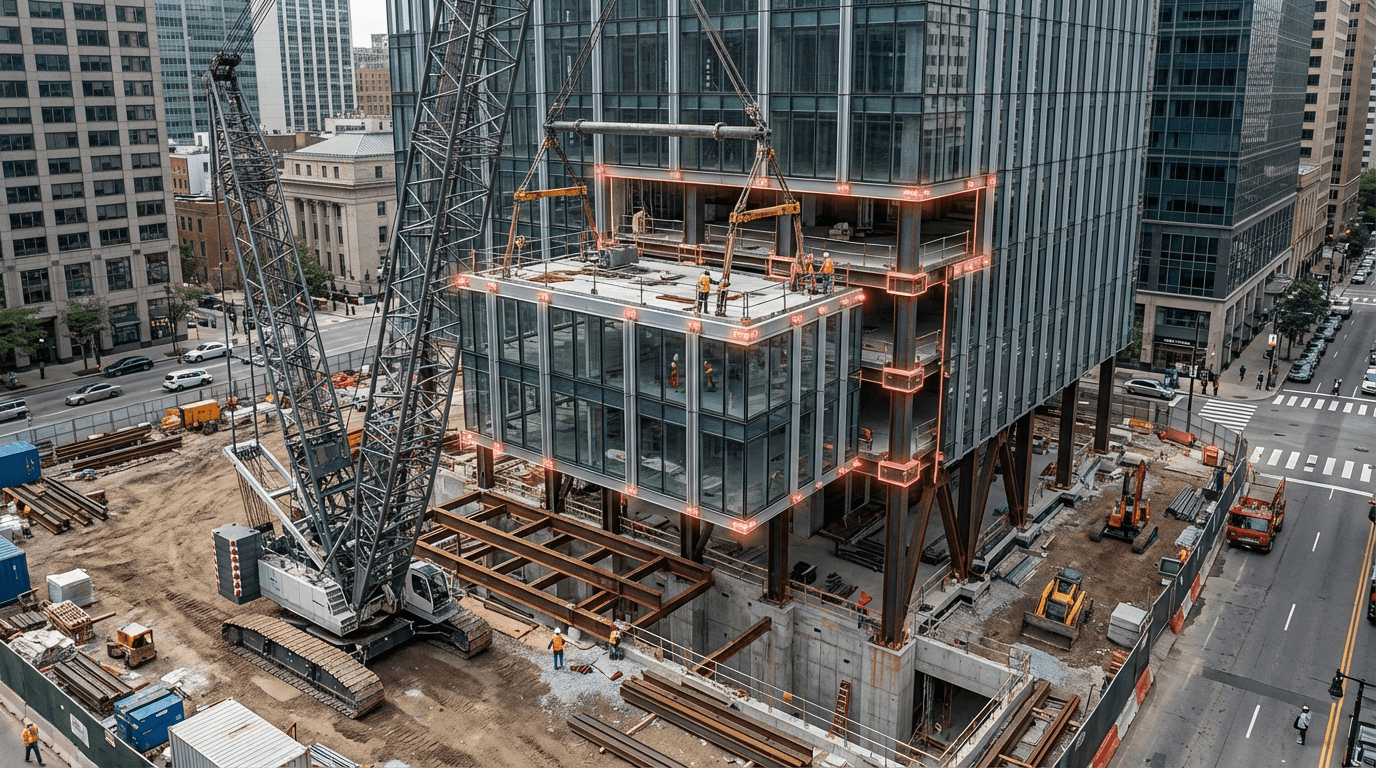
Modular High-Rise Assembly
Modular high-rise assembly represents a fundamental shift in how tall buildings are constructed, moving much of the fabrication process from chaotic construction sites into controlled factory environments. Unlike traditional construction where buildings rise floor by floor with materials assembled in place, this approach involves manufacturing complete three-dimensional units—often entire rooms or apartments—in off-site facilities. These modules arrive at the construction site with finishes, fixtures, plumbing, and electrical systems already installed, ready to be stacked and connected like sophisticated building blocks. The modules are typically constructed using steel or timber frames, with walls, floors, and ceilings built to precise specifications using automated manufacturing processes. Quality control occurs throughout factory production rather than relying solely on on-site inspections, and the controlled environment eliminates weather-related delays that plague conventional construction. Once transported to the site, modules are lifted into place by cranes and secured to a pre-built structural core or frame, with connections made between units to create continuous building systems.
The construction industry faces mounting pressure to deliver projects faster, more affordably, and with greater predictability, challenges that modular high-rise assembly directly addresses. Traditional high-rise construction is notoriously slow, expensive, and prone to cost overruns, with projects often taking years to complete and generating significant disruption to surrounding neighborhoods through noise, dust, and traffic. By shifting 60-80% of construction work to factories, this method can reduce overall project timelines by 30-50%, as site preparation and module fabrication occur simultaneously rather than sequentially. The factory setting enables better working conditions for construction workers, reducing safety risks associated with working at height and in variable weather conditions. Labor shortages, a persistent challenge in many developed markets, are partially mitigated as factory work attracts a broader workforce and allows for more efficient use of skilled trades. Additionally, the precision of factory manufacturing significantly reduces material waste—research suggests reductions of 50% or more compared to conventional methods—while the controlled environment enables tighter building envelopes that improve energy efficiency.
Several high-profile projects have demonstrated the viability of modular high-rise construction in recent years, with buildings ranging from student housing to hotels and residential towers completed in major cities worldwide. Early adopters have reported construction speeds that seem almost implausible by traditional standards, with some projects adding multiple floors per day once module installation begins. The approach has gained particular traction in markets with high labor costs, strict noise regulations, or urgent housing needs, where the benefits of speed and reduced site disruption justify the upfront investment in factory infrastructure and logistics. However, the technology faces challenges including transportation constraints—modules must travel on public roads—and the need for highly coordinated design and manufacturing processes. As the construction industry grapples with housing affordability crises, climate commitments requiring dramatic reductions in embodied carbon, and persistent productivity challenges, modular high-rise assembly represents a pathway toward industrializing building production. The trajectory points toward increasingly sophisticated factories employing automation and digital fabrication techniques, tighter integration with building information modeling systems, and standardization that could transform tall building construction from a craft-based process into a manufacturing discipline.
Related Organizations

A developer and contractor responsible for some of the world's tallest modular towers, including 101 George Street in Croydon.

Manufacturer of volumetric 3D structural modules used in high-rise developments across the UK.

Chinese manufacturer known for its 'Living Building' stainless steel modular system that allows for extremely rapid high-rise assembly.

CIMC Modular Building Systems
China · Company
A global leader in modular building systems, supplying modules for hotels, student accommodation, and residential projects worldwide.

Brooklyn-based company specializing in the design, manufacture, and assembly of mid-to-high-rise modular buildings.

A vertically integrated volumetric modular construction company operating in the US and Europe.

General contractor and modular specialist responsible for the AC Marriott NoMad in NYC, the world's tallest modular hotel.

A modular construction company using a proprietary steel vectorbloc system for off-site construction.

International engineering and construction enterprise, a leader in Design for Manufacture and Assembly (DfMA).

One of the world's largest homebuilders, pioneering factory-built, precision-engineered housing.
Supporting Evidence
Research this in Signals
Signals turns a topic into a sourced research record you can inspect and rerun. Your first scan is free, and this one starts with Modular High-Rise Assembly already loaded, so edit it or scan as is.