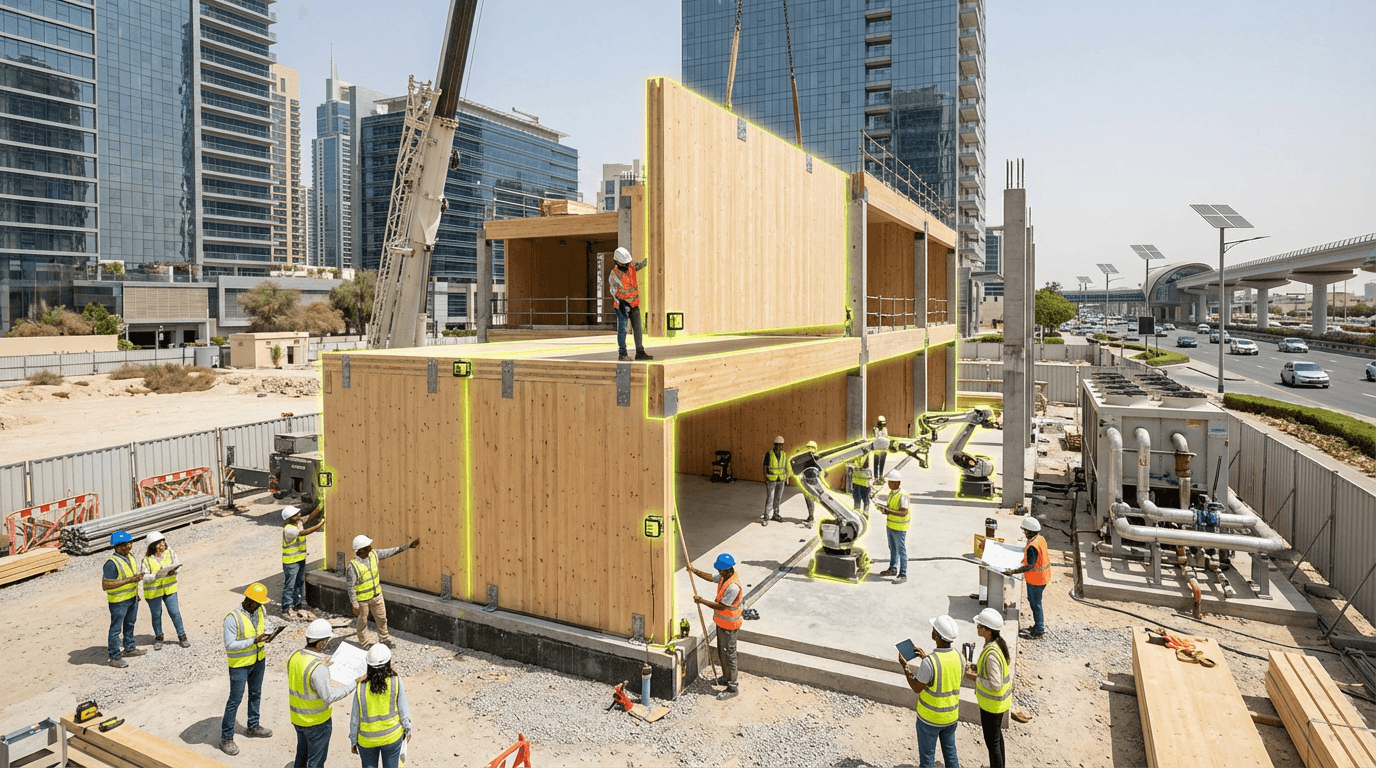
Mass Timber & Cross-Laminated Timber (CLT)
Mass timber and Cross-Laminated Timber (CLT) represent a fundamental shift in how large-scale buildings can be constructed, moving away from the carbon-intensive concrete and steel that have dominated urban development for over a century. These engineered wood products—created by bonding layers of lumber at perpendicular angles under high pressure—achieve structural performance comparable to traditional materials while sequestering carbon rather than emitting it during production. The core challenge they address is the construction sector's massive carbon footprint, which accounts for nearly 40 percent of global emissions. In regions like the Gulf, where concrete production is particularly energy-intensive due to extreme heat requirements for curing and cooling, mass timber offers a pathway to reduce embodied carbon in buildings while meeting ambitious net-zero commitments. Beyond environmental performance, these materials provide aesthetic differentiation through exposed wood interiors that align with biophilic design principles, creating spaces that feel warmer and more human-scaled than conventional concrete structures.
Early adoption in GCC markets is concentrated in hospitality, tourism, and premium residential developments where sustainability credentials and design innovation carry commercial value. Projects like NEOM and the Red Sea Development have explored mass timber for eco-resort structures, leveraging the material's rapid assembly timelines and lower construction weight to minimize site disturbance in sensitive coastal and desert environments. Dubai's boutique hospitality sector has incorporated CLT panels for mid-rise buildings, attracted by construction speeds that rival modular systems and the marketing appeal of visible timber elements. Industry observers note that mass timber's technical viability in Gulf climates depends heavily on moisture management strategies, including protective cladding systems and controlled interior environments, as well as adaptation of fire codes originally written for concrete-dominant construction. Supply chains remain nascent, with most timber imported from European or North American manufacturers, though regional processing facilities are under discussion as demand signals strengthen. The technology's appeal extends beyond carbon accounting to include seismic resilience, acoustic performance, and the ability to prefabricate complex components off-site for precision assembly.
The implications for Gulf construction extend beyond individual projects to broader questions about material diversification and supply chain resilience. As carbon pricing mechanisms and green building certifications gain traction across GCC markets, mass timber could transition from niche differentiation to mainstream consideration for certain building typologies, particularly those under ten stories where structural efficiency is strongest. Key monitoring points include the development of regional timber processing capacity, evolution of fire and moisture protection standards specific to Gulf conditions, and the emergence of local engineering expertise in timber design. The technology's trajectory will likely depend on whether early adopters can demonstrate long-term performance in extreme heat and humidity, and whether cost premiums narrow as supply chains mature. For developers and policymakers, mass timber represents a test case for how quickly construction practices can shift when sustainability storytelling aligns with technical feasibility and regulatory adaptation.
Related Organizations

A leading European manufacturer of solid wood products and building solutions, including CLT and glulam.
Pioneers in the production of large-format cross-laminated timber elements.
An architecture practice dedicated to sustainable construction, known for designing the world's first tall CLT residential building.

Producer of Kerto LVL (Laminated Veneer Lumber) and other engineered wood products.
Arup
United Kingdom · Company
A multinational professional services firm dedicated to sustainable development, known for pioneering the use of BIM in complex engineering projects.
The world's leading resource for professionals focused on the inception, design, construction, and operation of tall buildings.
An architecture firm internationally recognized for advocating and designing tall wood buildings.
Multinational developer of high-tech solutions for timber building safety and fixing systems.
Red Sea Global
Saudi Arabia · Company
Developer of The Red Sea and Amaala projects, implementing high-standard modular housing for construction staff.