Industrial Brain-Computer Interfaces
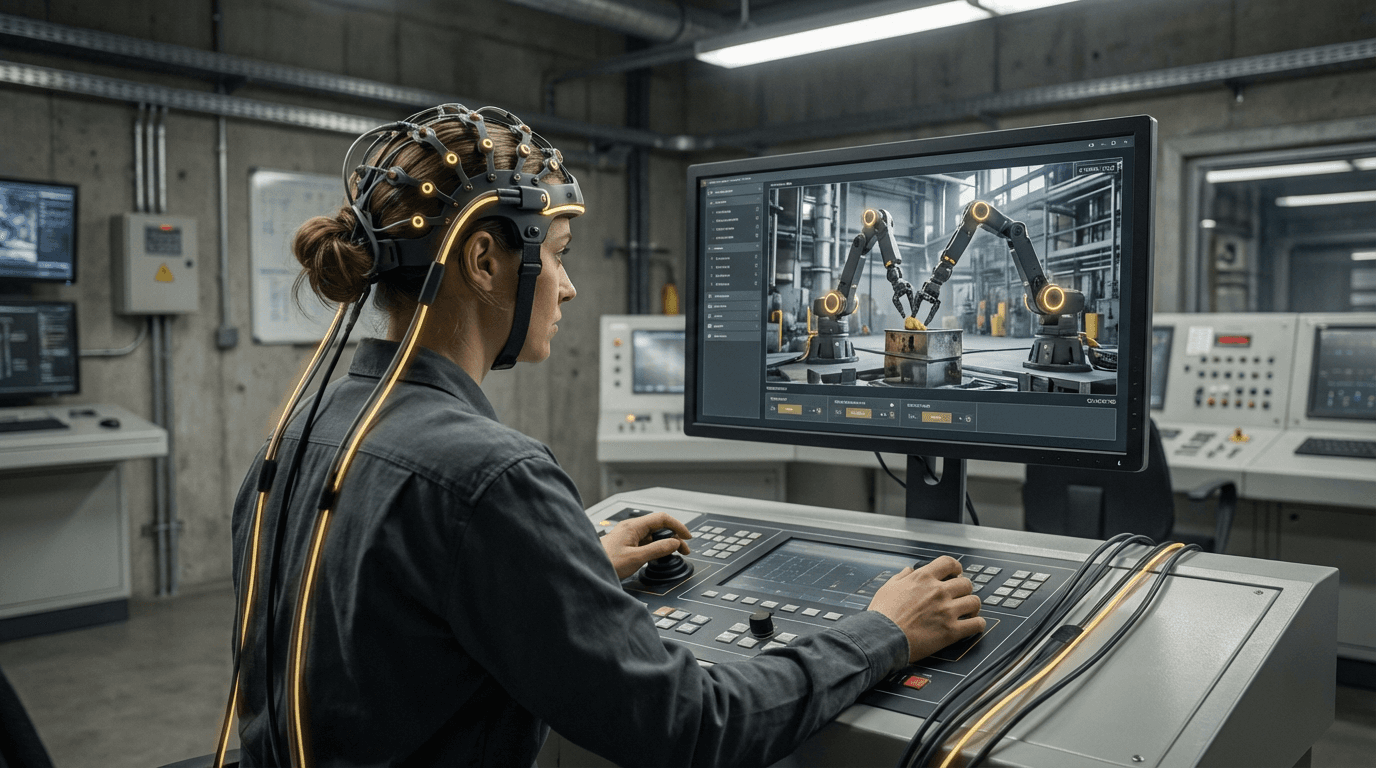
Industrial Brain-Computer Interfaces represent a significant advancement in human-machine interaction, enabling operators to control complex machinery and robotic systems through direct neural signals rather than traditional physical controls. These systems typically employ non-invasive electroencephalography (EEG) to detect electrical brain activity and electromyography (EMG) to capture muscle activation patterns, translating these biological signals into machine commands in real-time. Unlike consumer-grade BCIs designed for simple binary choices, industrial variants must achieve high signal fidelity and low latency to support the precise, multi-dimensional control required in manufacturing, remote operations, and hazardous material handling. The technology relies on sophisticated signal processing algorithms that filter out neural noise and decode operator intent from complex brainwave patterns, while machine learning systems adapt to individual neural signatures over time to improve accuracy and responsiveness.
The industrial sector faces persistent challenges in environments where traditional control interfaces prove inadequate or dangerous—situations involving extreme temperatures, radiation exposure, confined spaces, or operations requiring simultaneous manipulation of multiple systems. Industrial BCIs address these limitations by enabling hands-free operation, allowing workers to maintain visual focus on critical tasks while controlling auxiliary equipment through thought alone. This capability proves particularly valuable in teleoperation scenarios where human expertise must be projected into remote or hazardous locations through robotic avatars. Early deployments in nuclear decommissioning and deep-sea operations suggest that neural interfaces can reduce cognitive load by making machine control more intuitive, as operators think about desired outcomes rather than translating intentions into sequences of button presses or joystick movements. The technology also opens possibilities for enhanced safety protocols, as neural monitoring can detect operator fatigue or stress levels in real-time, triggering automated safeguards before human error occurs.
Research institutions and industrial technology developers are currently exploring pilot implementations in sectors ranging from aerospace manufacturing to mining operations, though widespread commercial adoption remains limited by the need for operator training and system calibration. The technology shows particular promise in augmenting human capabilities rather than replacing them—enabling a single skilled operator to coordinate multiple robotic systems simultaneously or allowing workers with physical disabilities to perform tasks previously inaccessible to them. As sensor technology improves and signal processing becomes more sophisticated, industrial BCIs are expected to transition from specialized applications to broader deployment across manufacturing environments. This evolution aligns with the Fourth Industrial Revolution's emphasis on human-machine collaboration, where cyber-physical systems amplify rather than supplant human expertise. The trajectory suggests a future where neural interfaces become standard components of industrial control systems, fundamentally reshaping how humans interact with increasingly autonomous machinery while maintaining the irreplaceable elements of human judgment and adaptability in complex operational contexts.
Related Organizations

Produces EEG headsets and the BCI-OS platform, allowing developers to build applications that respond to cognitive stress and facial expressions.

Institute for Production Systems and Design Technology.

Develops high-performance BCI hardware, including the 'Unicorn' hybrid black interface for developers.

Develops semi-dry and dry EEG wearable devices for human behavior research and neurotechnology applications.

Builds AI-powered BCI headsets with AR displays for accessibility and communication.

Produces dry electrode EEG systems based on technology licensed from Quantum Applied Science and Research (QUASAR).

Develops BMI technology including the FocusCalm headband and prosthetic hands.

Developed a visual cortex BCI for controlling digital interfaces (acquired by Snap Inc.).
Creates open-source brain-computer interface tools and the Galea headset (integrating with VR) for researching physiological responses.

Develops open-source compatible EEG and EMG devices for HCI applications.
Supporting Evidence
Research this in Signals
Signals turns a topic into a sourced research record you can inspect and rerun. Your first scan is free, and this one starts with Industrial Brain-Computer Interfaces already loaded, so edit it or scan as is.