Industrial Brain-Computer Interfaces (BCI)
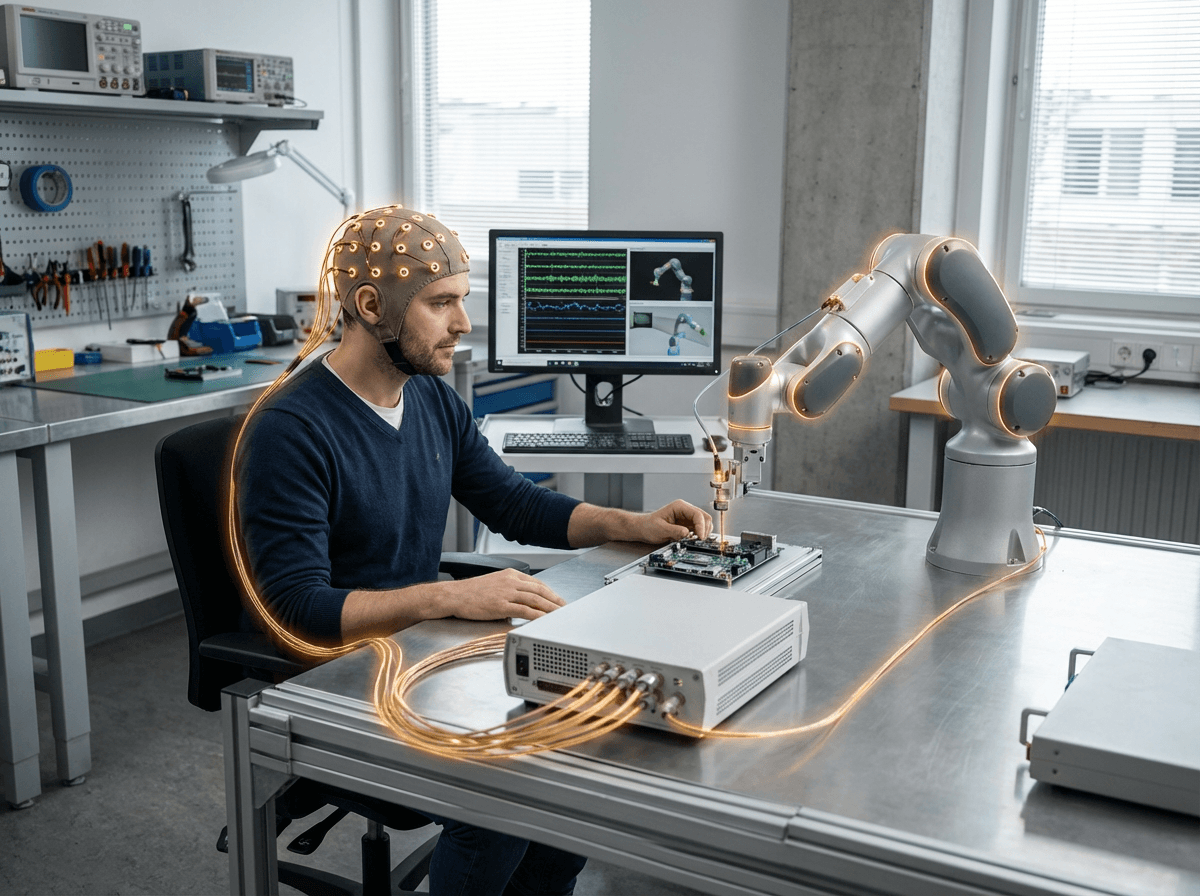
Industrial Brain-Computer Interfaces represent a fundamental shift in human-machine interaction within manufacturing and industrial environments, moving beyond traditional physical controls to direct neural communication. These systems capture electrical signals generated by brain activity—primarily through non-invasive electroencephalography (EEG) sensors embedded in caps, headbands, or helmet-integrated arrays—and translate them into machine commands. The technology works by detecting specific patterns of neural activity associated with particular thoughts, intentions, or mental states. Signal processing algorithms filter out noise and identify relevant brainwave patterns, which are then mapped to predefined control functions. Unlike invasive BCIs that require surgical implantation, industrial variants prioritize practicality and safety, using external sensors that can be donned like standard safety equipment. The systems typically combine EEG data with other biometric inputs such as eye tracking or muscle tension monitoring to improve accuracy and reduce false positives in noisy industrial settings.
The manufacturing sector faces persistent challenges in optimizing human-machine collaboration, particularly in scenarios where workers' hands are occupied, environments are hazardous, or operators have physical limitations. Industrial BCIs address these constraints by enabling workers to control machinery, robotic arms, or material handling systems through thought alone, freeing their hands for other tasks or eliminating the need for physical manipulation entirely. This capability proves especially valuable in assembly operations requiring simultaneous manual dexterity and equipment control, or in environments where traditional interfaces are impractical due to protective gear or contamination concerns. Beyond direct control, these systems offer a novel approach to workplace safety by continuously monitoring cognitive states such as attention levels, mental fatigue, or stress. When the system detects dangerous lapses in concentration or elevated stress that might compromise judgment, it can trigger automatic safety protocols, pause operations, or alert supervisors. For workers with mobility impairments or disabilities affecting manual dexterity, BCIs provide an inclusive pathway to operate complex machinery that would otherwise be inaccessible, expanding the available workforce and promoting workplace diversity.
Early industrial deployments have focused on controlled environments such as warehouse logistics, where operators use neural signals to direct autonomous mobile robots or overhead crane systems, and in quality inspection stations where thought-based commands trigger camera systems or reject mechanisms. Research initiatives in automotive and aerospace manufacturing are exploring BCI integration with collaborative robots, allowing assembly workers to summon robotic assistance or adjust robot behavior without interrupting their workflow. The technology remains in relatively early stages of commercial adoption, with most implementations occurring in pilot programs or specialized applications rather than widespread factory deployment. Current limitations include the need for individual calibration, sensitivity to electromagnetic interference common in industrial settings, and the cognitive load required to maintain consistent control. However, as machine learning algorithms improve pattern recognition and hardware becomes more robust and affordable, industrial BCIs are positioned to become increasingly practical. This trajectory aligns with broader industry movements toward adaptive automation and human-centric manufacturing, where technology augments rather than replaces human capabilities. The long-term vision extends beyond simple control to bidirectional communication, where machines could provide sensory feedback directly to operators' nervous systems, creating truly integrated human-machine work cells that leverage the complementary strengths of biological and artificial intelligence.
Related Organizations


Produces EEG headsets and the BCI-OS platform, allowing developers to build applications that respond to cognitive stress and facial expressions.


Develops high-performance BCI hardware, including the 'Unicorn' hybrid black interface for developers.

Develops BCI-enabled headphones that detect focus and intent to control digital experiences.

Develops semi-dry and dry EEG wearable devices for human behavior research and neurotechnology applications.

Develops BMI technology including the FocusCalm headband and prosthetic hands.

Builds AI-powered BCI headsets with AR displays for accessibility and communication.
Creates open-source brain-computer interface tools and the Galea headset (integrating with VR) for researching physiological responses.

Produces dry electrode EEG systems based on technology licensed from Quantum Applied Science and Research (QUASAR).

Manufacturer of the Utah Array, the gold-standard electrode system used in the majority of human BCI research.
Supporting Evidence
Research this in Signals
Signals turns a topic into a sourced research record you can inspect and rerun. Your first scan is free, and this one starts with Industrial Brain-Computer Interfaces (BCI) already loaded, so edit it or scan as is.