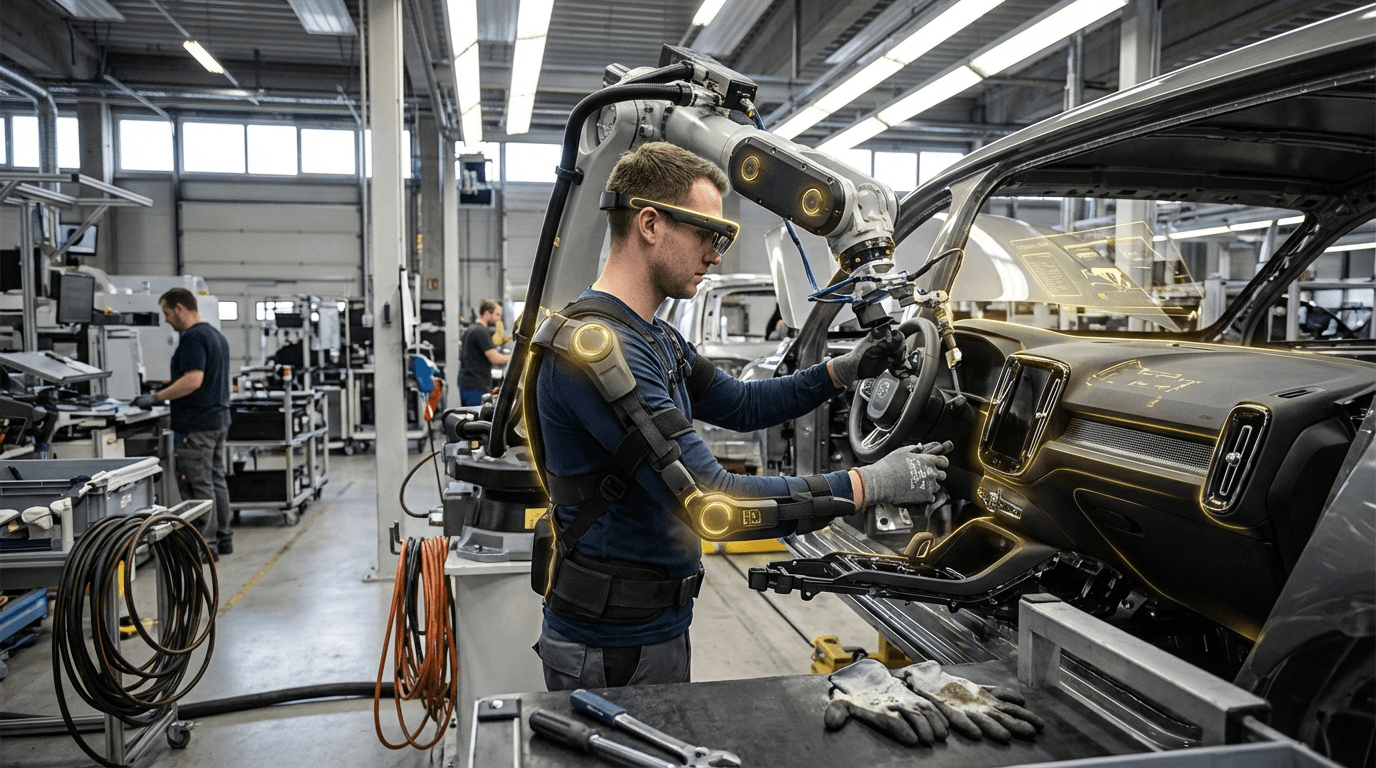
Human-Augmented Workcells
Human-augmented workcells represent an integrated approach to industrial workstations that combine collaborative robots, augmented reality interfaces, and wearable assistive devices to enhance worker capabilities while reducing physical strain. These systems merge digital overlays with physical tasks, allowing operators to receive real-time visual instructions, quality checks, and process guidance directly in their field of view through AR headsets or smart glasses. Simultaneously, powered exoskeletons provide mechanical support for repetitive motions or heavy lifting, redistributing load across the body's skeletal structure to minimize fatigue and injury risk. The collaborative robots, or cobots, work alongside human operators rather than replacing them, handling precision tasks or heavy components while the human worker manages complex decision-making and fine motor skills. Sensor arrays embedded throughout the workcell capture motion data, task completion metrics, and environmental conditions, creating a continuous feedback loop that optimizes both human and machine performance.
The manufacturing sector faces persistent challenges around workforce aging, knowledge transfer, and rising injury rates from repetitive strain. Traditional assembly lines often force workers into awkward postures or require them to memorize complex procedures, leading to quality inconsistencies and high training costs. Human-augmented workcells address these issues by offloading physical burden to mechanical systems while preserving human judgment and adaptability. The AR component proves particularly valuable for onboarding new workers, reducing training time by providing step-by-step visual guidance that adapts to individual pace and skill level. This technology also captures the tacit knowledge of experienced workers—the subtle techniques and problem-solving approaches that typically disappear when veteran employees retire—by recording successful task sequences and decision patterns. For manufacturers dealing with high-mix, low-volume production, these workcells enable rapid reconfiguration without extensive retraining, as workers receive updated instructions for new product variants through their AR displays.
Early deployments in automotive assembly, aerospace manufacturing, and logistics operations indicate significant reductions in musculoskeletal injuries and improvements in first-time quality rates. Companies implementing these systems report that workers can maintain productivity for longer periods without fatigue-related performance degradation, while the captured data enables continuous process improvement. The technology aligns with broader industry movements toward mass customization and flexible manufacturing, where production lines must accommodate frequent changeovers and smaller batch sizes. As the global workforce ages and younger workers seek less physically demanding roles, human-augmented workcells offer a pathway to retain institutional knowledge while making industrial work more sustainable and appealing. The integration of these technologies represents a shift from viewing automation as worker replacement to recognizing it as worker enhancement, creating hybrid human-machine systems that leverage the strengths of both.
Related Organizations

Produces the Cray X, a connected power suit that supports lifting movements and provides data analytics.

The pioneer of collaborative robots (cobots), featuring the PolyScope interface which popularized low-code/no-code programming for arms.

Develops ruggedized head-mounted tablet devices for industrial frontline workers to access data hands-free.


Develops flexible manufacturing systems and open automation solutions for the automotive and battery industries.

Offers 'TeamViewer Frontline', an enterprise AR productivity platform (acquired from Ubimax) for logistics and manufacturing.

A pioneer in the field of robotic exoskeletons for medical and industrial use.

Develops wearable barcode scanners integrated into gloves, allowing workers to scan hands-free while handling parts.

Develops highly mobile, dexterous industrial robots and exoskeletons like the Guardian XO.
Supporting Evidence
Research this in Signals
Signals turns a topic into a sourced research record you can inspect and rerun. Your first scan is free, and this one starts with Human-Augmented Workcells already loaded, so edit it or scan as is.