Organoid Intelligence (Biocomputing)
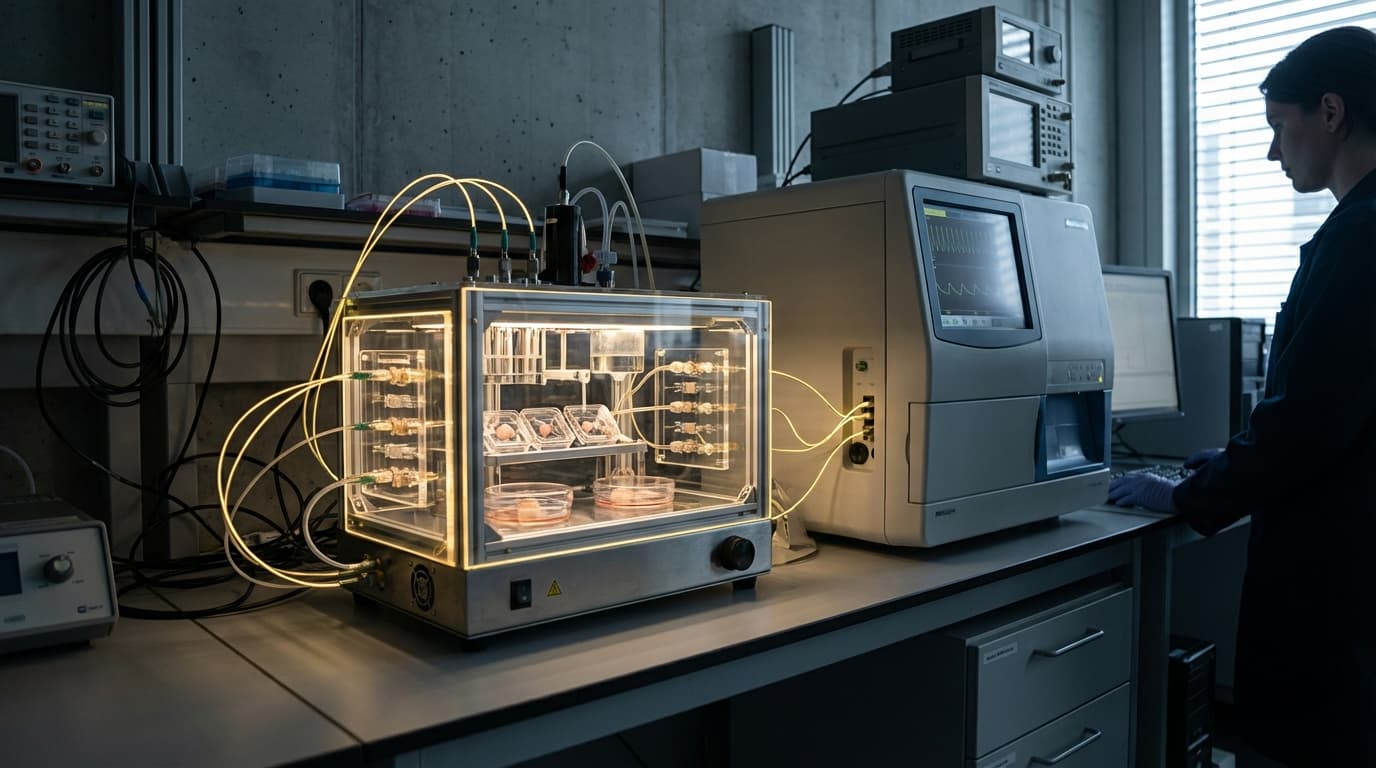
Organoid Intelligence represents a paradigm shift in computing architecture, leveraging three-dimensional cultures of living neural tissue—known as brain organoids—to perform computational tasks. These miniaturised brain-like structures are grown from human stem cells in laboratory conditions, developing networks of neurons that can form synaptic connections and exhibit electrical activity similar to biological brains. Unlike traditional silicon-based processors that rely on binary logic gates, organoid-based biocomputers harness the inherent properties of living neural networks, including their ability to process information through complex electrochemical signaling, adapt their connectivity patterns through synaptic plasticity, and operate with remarkable energy efficiency. The organoids are typically interfaced with electronic systems through microelectrode arrays that can both stimulate the neural tissue and record its responses, creating a hybrid biological-digital computing platform.
The industrial motivation for organoid intelligence stems from fundamental limitations in conventional computing architectures, particularly concerning energy consumption and certain types of cognitive processing. Modern artificial intelligence systems, while powerful, require enormous amounts of electrical power and generate significant heat, creating sustainability challenges as computational demands continue to escalate. Research suggests that biological neural networks can perform certain pattern recognition and associative learning tasks using orders of magnitude less energy than their silicon counterparts, potentially offering a pathway to more sustainable computing infrastructure. Furthermore, organoid systems may excel at tasks that remain challenging for traditional AI, such as processing sensory information in noisy environments, learning from limited examples, and adapting to novel situations—capabilities that could prove valuable in robotics, autonomous systems, and advanced sensor networks. This technology also addresses the growing need for edge computing solutions that can perform sophisticated processing locally without constant connectivity to energy-intensive data centers.
Early research initiatives have demonstrated proof-of-concept systems where brain organoids successfully learned to perform simple tasks, such as controlling basic game environments and responding to specific input patterns. These experimental platforms typically involve organoids containing hundreds of thousands to millions of neurons, interfaced with computer systems that translate digital inputs into electrical or chemical stimuli the biological tissue can process. While commercial deployment remains years away, pilot programs are exploring applications in biosensing, where organoid systems might detect chemical signatures or patterns that conventional sensors miss, and in pharmaceutical testing, where their biological nature could provide more accurate models of drug effects on neural tissue. The field faces significant technical challenges, including maintaining organoid viability over extended periods, scaling up the complexity and size of neural cultures, and developing standardised interfaces between biological and electronic components. Nevertheless, organoid intelligence represents a convergence of neuroscience, bioengineering, and computer science that could fundamentally reshape how we approach computation in an era demanding both greater processing capabilities and environmental sustainability.
Related Organizations

Creators of 'DishBrain', a system that integrates living brain cells with silicon chips to play video games like Pong.

Offers the first online platform providing access to biological neural networks (organoids) for biocomputing research.

Develops high-density microelectrode arrays (HD-MEA) with FPGA-based real-time spike sorting capabilities.

Home to the Center for Wearable Sensors (Joseph Wang Lab).

Specializes in CMOS-based high-resolution MEAs with embedded signal processing.

Produces Maestro MEA systems used to measure the electrical activity of neural networks in vitro.

Integrates biological neurons with silicon to create 'smell cyborgs' capable of detecting explosives and diseases.

Conducts research on bio-hybrid systems and neural interfaces.
Supporting Evidence
Research this in Signals
Signals turns a topic into a sourced research record you can inspect and rerun. Your first scan is free, and this one starts with Organoid Intelligence (Biocomputing) already loaded, so edit it or scan as is.