Collaborative Swarm Robotics
Collaborative swarm robotics represents a fundamental shift from traditional centralized automation systems to distributed networks of autonomous agents that coordinate through local interactions and simple rules. Drawing inspiration from biological systems like ant colonies and bee swarms, this technology deploys large numbers of relatively simple, low-cost robots that collectively exhibit sophisticated emergent behaviors without requiring a central controller or hierarchical command structure. Each robot in the swarm operates based on local sensing and communication with nearby units, following basic behavioral algorithms that, when scaled across dozens or hundreds of agents, produce complex coordinated actions. The technical foundation relies on distributed control algorithms, peer-to-peer communication protocols, and sensor fusion techniques that allow individual units to maintain spatial awareness and adapt to changing conditions in real-time. Unlike conventional industrial robots that follow predetermined paths and require extensive programming for new tasks, swarm systems can dynamically reorganize themselves based on environmental feedback and task requirements.
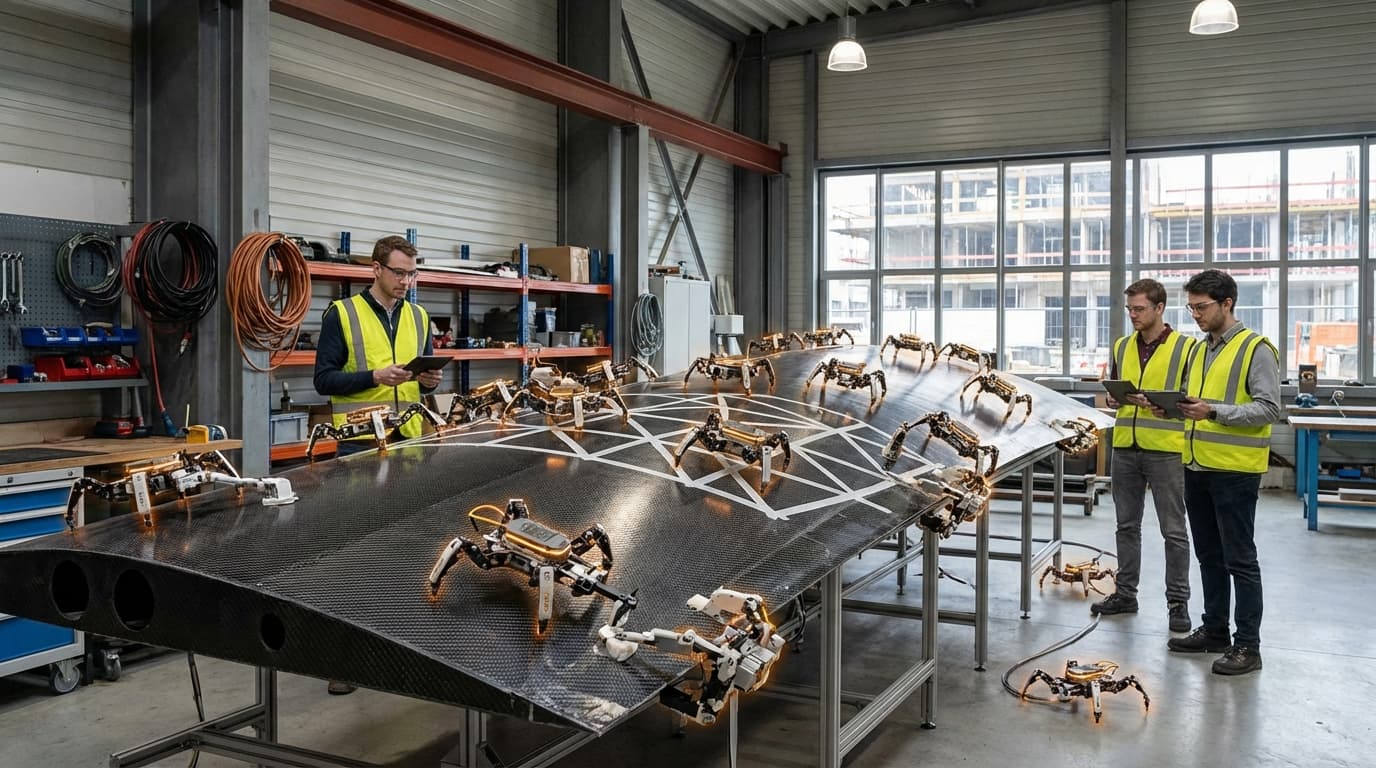
In manufacturing environments, collaborative swarm robotics addresses critical challenges around flexibility, scalability, and resilience that plague traditional fixed automation systems. Factory floors designed around large, expensive robotic cells struggle to adapt when product designs change or production volumes fluctuate, often requiring costly reprogramming and physical reconfiguration. Swarm systems overcome these limitations by enabling rapid task reallocation—the same fleet of robots can transition from transporting materials to performing quality inspection or collaborative assembly simply by updating their behavioral parameters. This adaptability proves particularly valuable in high-mix, low-volume manufacturing scenarios where production requirements shift frequently. The inherent redundancy of swarm systems also provides unprecedented fault tolerance; if individual robots fail or encounter obstacles, the remaining units automatically compensate without disrupting overall operations. Furthermore, swarms can tackle tasks that are impractical for single large robots, such as manipulating oversized components through coordinated lifting or conducting simultaneous multi-point inspections across expansive structures.
Early industrial deployments have demonstrated swarm robotics' potential in warehouse logistics, where mobile robot fleets coordinate to optimize inventory movement and order fulfillment without centralized traffic management. Research facilities and pilot programs are exploring applications in aircraft assembly, where swarms of climbing robots could collaboratively position and fasten large fuselage sections, and in construction, where ground-based swarms might autonomously arrange and connect modular building components. As manufacturing increasingly demands agile production systems capable of handling customization and rapid changeovers, swarm robotics aligns with broader industry movements toward flexible automation and distributed intelligence. The technology's scalability—adding more robots increases capability without exponential complexity growth—positions it as a compelling solution for facilities seeking to balance automation benefits with operational adaptability, potentially reshaping how we conceptualize factory floor organization in the coming decades.
Related Organizations

Developed the SWIFT (Sacrificial Writing into Functional Tissue) method for 3D printing vascular channels in living matrices.

Pioneer of cube storage automation, using a grid of robots on top of stacked bins to dig for and retrieve inventory.

Develops the Ocado Smart Platform, featuring 'The Hive'—a grid where thousands of washing-machine-sized robots swarm to pick groceries.
Develops autonomous agricultural robots that work in swarms to apply crop protection products and manage farmland efficiently.

Creator of the Skypod system, a fleet of autonomous robots that can move in three dimensions (climbing racks) to retrieve bins.

Develops a 3D robotic supply chain system inspired by ant colonies, condensing warehouse aisles into a single vertical storage structure.

Creates autonomous indoor drone swarms for inventory management in warehouses and live entertainment shows.
Supporting Evidence
Research this in Signals
Signals turns a topic into a sourced research record you can inspect and rerun. Your first scan is free, and this one starts with Collaborative Swarm Robotics already loaded, so edit it or scan as is.