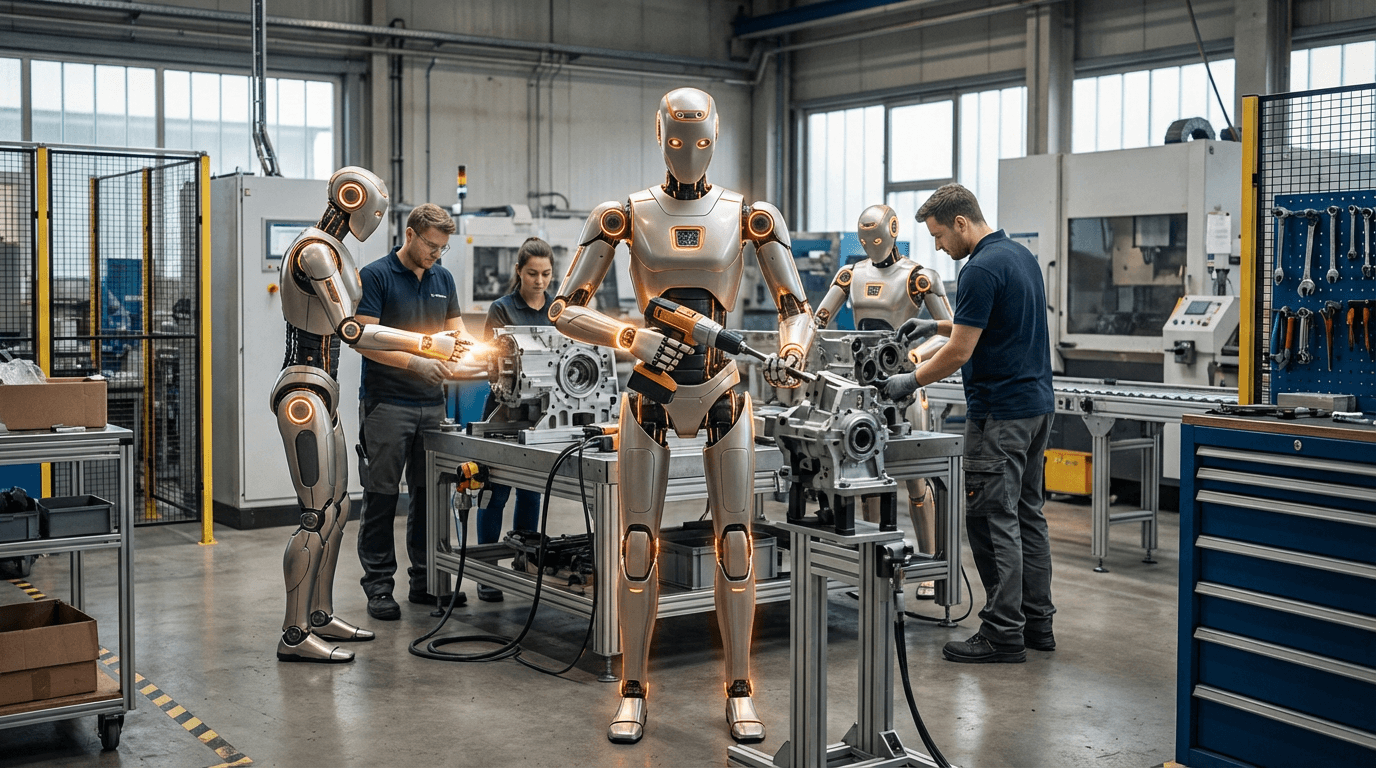
Humanoid Industrial Robots
Humanoid industrial robots represent a fundamental shift in manufacturing automation by adopting human-like bipedal forms and proportions specifically engineered for existing factory environments. Unlike traditional industrial robots that require dedicated workstations, safety cages, and specialized infrastructure, these machines feature articulated torsos, arms, and legs that enable them to navigate standard doorways, climb stairs, and operate equipment designed for human workers. Their anthropomorphic design incorporates advanced sensor arrays—including cameras, LiDAR, and force-torque sensors—that provide spatial awareness and dexterous manipulation capabilities. The underlying control systems combine real-time motion planning algorithms with machine learning models trained on human demonstration data, allowing these robots to adapt their movements to varied tasks and environments. This whole-body coordination enables them to perform complex sequences like picking items from shelves, carrying loads across facilities, and operating machinery with standard human interfaces.
The manufacturing sector faces persistent challenges that humanoid robots are uniquely positioned to address. Legacy factories represent trillions of dollars in infrastructure investments designed around human workers, making wholesale facility redesign economically prohibitive for many manufacturers. Traditional fixed automation solutions require extensive reconfiguration, dedicated floor space, and substantial capital expenditure that smaller manufacturers often cannot justify. Additionally, labor shortages in manufacturing-intensive regions and the need for flexible production lines capable of handling diverse product mixes have created demand for automation solutions that can work alongside humans and adapt to changing requirements. Humanoid robots solve these problems by fitting into existing workflows without facility modification, performing tasks across multiple stations, and potentially working extended shifts to address labor constraints. Their ability to learn new tasks through demonstration and simulation rather than extensive reprogramming reduces deployment time and enables manufacturers to respond more quickly to production changes.
Early commercial deployments are beginning to emerge across automotive, logistics, and general manufacturing sectors, with several companies conducting pilot programs in real production environments. These initial applications focus on repetitive tasks like parts transport, quality inspection, and simple assembly operations where the robots' mobility and dexterity provide clear advantages over conventional automation. Industry analysts note that current systems still face limitations in speed, payload capacity, and task complexity compared to specialized industrial equipment, but rapid advances in AI-driven control systems and battery technology are progressively expanding their capabilities. The technology aligns with broader manufacturing trends toward flexible automation, lights-out production facilities, and human-robot collaboration, suggesting a trajectory where humanoid robots complement rather than completely replace human workers. As production costs decline and reliability improves through field experience, these systems may become viable options for mid-sized manufacturers and industries with high product variability, potentially democratizing access to advanced automation beyond large-scale producers.
Related Organizations

Creators of Digit, a bipedal robot designed for logistics work.

Building autonomous humanoid robots, partnering with OpenAI for the underlying intelligence.

A spin-out from the Human Centered Robotics Lab at UT Austin, developing Apollo, a general-purpose humanoid.

Automotive and energy company developing custom AI silicon for autonomous driving.


Developing general-purpose humanoid robots (Phoenix) powered by Carbon, their AI control system.

A global leader in AI and humanoid robotics, producing the JIMU Robot kits for education.
Backed by OpenAI, developing the 'Eve' (wheeled) and 'Neo' (bipedal) androids for labor markets.

A robotics company known for quadrupeds that recently launched the H1 general-purpose humanoid robot.

Originally a rehab robotics company, now developing the GR-1 general-purpose humanoid robot.
Supporting Evidence
Research this in Signals
Signals turns a topic into a sourced research record you can inspect and rerun. Your first scan is free, and this one starts with Humanoid Industrial Robots already loaded, so edit it or scan as is.