Neuromorphic Control Systems
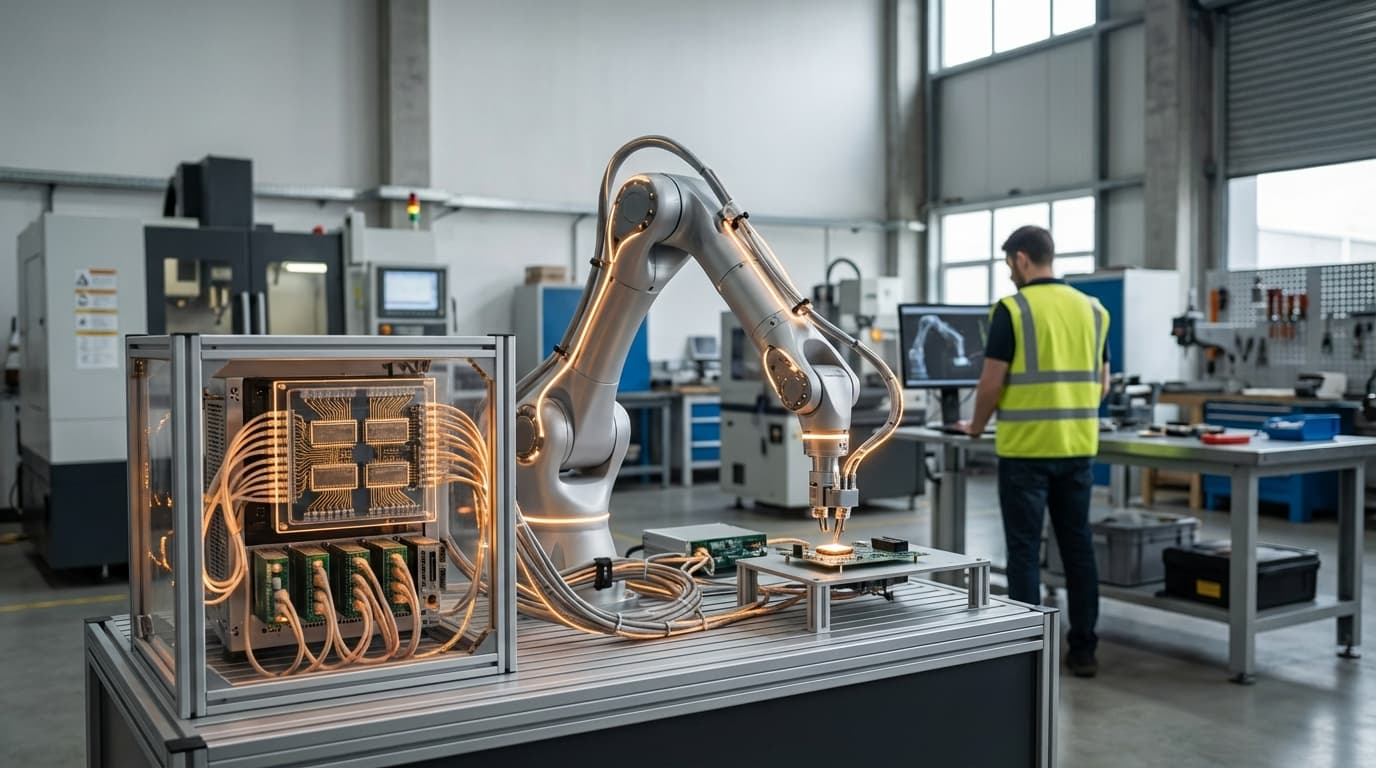
Neuromorphic control systems represent a fundamental shift in industrial automation, moving away from traditional rule-based controllers toward brain-inspired computing architectures that process information in ways analogous to biological neural networks. Unlike conventional digital processors that execute instructions sequentially, neuromorphic chips employ networks of artificial neurons and synapses that operate in parallel, communicating through electrical spikes similar to those found in biological brains. This architecture enables these systems to process vast streams of sensory data simultaneously while consuming orders of magnitude less power than traditional computing approaches. The key technical innovation lies in the integration of memory and processing within the same physical substrate, eliminating the energy-intensive data transfers that plague conventional von Neumann architectures. In industrial settings, these chips can be embedded directly into control systems, robots, and manufacturing equipment, where they continuously learn from sensor inputs and adjust their responses without requiring constant reprogramming or cloud connectivity.
The manufacturing sector faces mounting pressure to create more flexible, adaptive production systems capable of handling diverse product variations, unpredictable supply chain disruptions, and increasingly complex quality requirements. Traditional programmable logic controllers (PLCs) and proportional-integral-derivative (PID) controllers excel in stable, well-defined environments but struggle with non-linear dynamics, multi-variable optimization, and rapid adaptation to changing conditions. Neuromorphic control systems address these limitations by enabling machines to develop intuitive responses to complex patterns in their operational environment. Research suggests these systems can recognize subtle vibrations indicating equipment degradation, adjust robotic movements in response to variations in material properties, and optimize energy consumption across entire production lines without explicit programming for each scenario. This adaptive capability reduces downtime, improves product quality, and allows manufacturers to implement mass customization strategies that would be prohibitively complex with conventional control approaches. Furthermore, the extreme energy efficiency of neuromorphic processors makes them particularly valuable in battery-powered autonomous systems and distributed sensor networks where power constraints limit the deployment of traditional computing solutions.
Early deployments of neuromorphic control systems have emerged in robotics research laboratories and pilot manufacturing facilities, where they demonstrate particular promise in applications requiring real-time sensory-motor coordination. Industrial robots equipped with neuromorphic vision systems can adapt their gripping strategies to handle objects with varying shapes, textures, and fragility levels, learning from experience rather than requiring exhaustive pre-programming. In process control applications, these systems show potential for managing chemical reactors, material mixing operations, and other processes characterized by complex, non-linear dynamics that challenge conventional controllers. The technology aligns with broader industry trends toward edge computing and autonomous systems, as neuromorphic chips can make sophisticated decisions locally without relying on centralized computing infrastructure or cloud connectivity. As semiconductor manufacturers develop more mature neuromorphic chip designs and software frameworks for training these systems become more accessible, adoption is expected to accelerate beyond research environments into mainstream industrial applications. The convergence of neuromorphic computing with other emerging technologies such as advanced sensors, digital twins, and collaborative robotics suggests a future where manufacturing systems possess genuinely adaptive intelligence, capable of learning, optimizing, and evolving their performance over time with minimal human intervention.
Related Organizations

Developer of the Loihi neuromorphic research chip and Foveros 3D packaging technology.
Develops ultra-low-power mixed-signal neuromorphic processors and sensors for edge AI applications.

Develops Nengo, a software suite for building brain-inspired AI applications, and hardware for time-series processing.

Developer of the Akida neuromorphic processor IP and chips.

Creates ultra-low power intelligence for sensors using spiking neural processor architecture.

Pioneer in event-based vision sensors and associated neuromorphic processing algorithms.

Leads the DISCOVERER project focusing on VLEO aerodynamics and materials.

Long-standing leader in neuro-symbolic AI, combining neural networks with logical reasoning for enterprise applications.

Developing 'Natural Intelligence' for machines by reverse-engineering insect brains to create autonomous decision-making software.
Supporting Evidence
Research this in Signals
Signals turns a topic into a sourced research record you can inspect and rerun. Your first scan is free, and this one starts with Neuromorphic Control Systems already loaded, so edit it or scan as is.