Bioelectric Signaling Tools
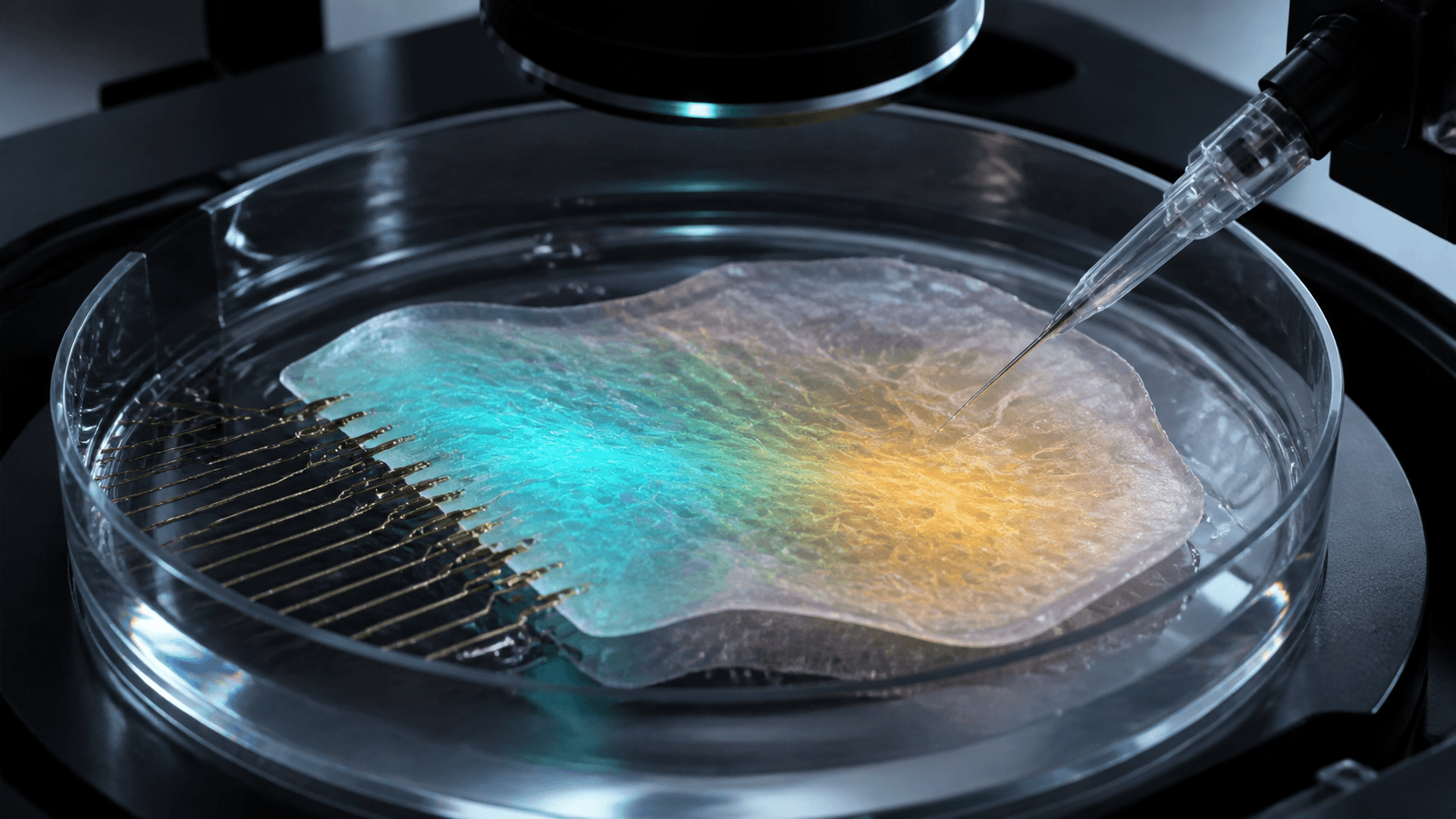
Bioelectric Signaling Tools represent a revolutionary suite of technologies developed by Michael Levin's lab at Tufts University for detecting, monitoring, and manipulating electrical signals in non-neural tissues. These tools enable researchers to 'read' and 'write' bioelectric codes that cells use to communicate, store information, and coordinate growth—revealing a fundamental layer of biological control previously overlooked in favor of genetic and biochemical mechanisms.
Bioelectric Code Discovery
Levin's research demonstrated that all cells, not just neurons, use electrical signals to communicate and coordinate behavior. Key findings include: non-neural cells maintain membrane voltage potentials that encode positional and functional information; voltage gradients across tissues provide instructional cues for morphogenesis and regeneration; bioelectric patterns act as master regulators controlling gene expression downstream; and disruptions in bioelectric patterns precede and predict developmental abnormalities and disease states including cancer. This electrical layer operates as a control system above genetics.
Voltage-Sensing Technologies
To visualize bioelectric patterns in living tissues, Levin's lab developed and adapted voltage-sensitive fluorescent dyes and genetically encoded voltage indicators (GEVIs). These tools enable: real-time visualization of membrane potential across entire tissues and organisms; detection of bioelectric pattern changes during development and regeneration; identification of voltage abnormalities signaling disease states like tumor formation; and time-lapse imaging revealing bioelectric dynamics over developmental timescales. The ability to see voltage patterns revolutionized understanding of morphogenesis.
Ion Channel Manipulation
The 'write' side of bioelectric tools involves targeted manipulation of ion channels and pumps that establish cellular voltage. Key technologies include: optogenetics adapted for non-neural tissues using light-activated ion channels; pharmacological agents targeting specific ion transporters (H⁺/K⁺-ATPase, V-ATPase, sodium channels); genetic modification of ion channel expression in specific cell types; and physical methods including localized pH manipulation and electromagnetic stimulation. These interventions change voltage patterns to reprogram tissue behavior.
Morphogenetic Reprogramming Applications
Using bioelectric tools, Levin's lab achieved remarkable morphological outcomes including
inducing planarian flatworms to regenerate heads with different species-specific anatomical patterns; triggering limb regeneration in normally non-regenerating frog tadpoles; correcting developmental birth defects by normalizing voltage patterns; creating two-headed planarians that stably maintain the altered body plan; and controlling organ size, position, and number through bioelectric cues. These outcomes are achieved without genetic modification—only voltage changes.
Cancer as Bioelectric Disease
A major application involves detecting and preventing cancer through bioelectric signatures. Research demonstrated that: tumor formation is preceded by characteristic voltage depolarization in affected cells; voltage abnormalities can detect pre-cancerous states before genetic or morphological changes; normalizing voltage through ion channel manipulation can prevent tumor formation; and forcing cancer cells back to normal voltage patterns can re-integrate them into healthy tissue without killing them. This offers a non-cytotoxic approach to cancer.
Regeneration Control
Bioelectric tools enable unprecedented control over tissue regeneration including
triggering regeneration of amputated limbs and organs; controlling regeneration outcomes to produce desired anatomical structures; understanding why some species regenerate while others don't (voltage differences); and developing interventions to restore regenerative capacity in mammals. The approach suggests that regenerative limitations are not genetic hard limits but bioelectric programming that can be modified.
Molecular Components
The bioelectric toolkit includes diverse molecular tools
voltage-sensitive dyes (DiBAC, TMRM) reporting membrane potential; genetically encoded voltage indicators for cell-type-specific monitoring; optogenetic actuators (channelrhodopsins, halorhodopsins) for light-controlled voltage manipulation; designer receptors activated by designer drugs (DREADDs) for chemogenetic control; and ion channel blockers and activators for pharmacological intervention. Each tool provides specific capabilities for different applications.
Tissue Memory and Information Storage
Bioelectric research revealed that voltage patterns store information about anatomical goals and tissue identity. Findings include: bioelectric states persist across cell generations providing morphological memory; voltage patterns encode target morphology independent of genetic sequences; cells collectively store and retrieve anatomical information through electrical signaling; and bioelectric memory explains regeneration fidelity and pattern restoration. This suggests tissues have cognitive-like properties processing information to achieve morphological goals.
Integration with Computational Modeling
Bioelectric tools are paired with computational models predicting outcomes from voltage manipulations. The modeling approach includes: simulating bioelectric networks across tissues; predicting morphological outcomes from specific ion channel interventions; optimizing interventions to achieve desired anatomical goals; and understanding emergent behavior from cellular electrical interactions. This enables rational design of bioelectric interventions.
Experimental Validation and Reproducibility
Bioelectric signaling tools represent established, reproducible science with extensive validation
published in peer-reviewed journals (Science, Cell, Development); independently replicated across multiple laboratories; demonstrated across diverse species (planarians, frogs, zebrafish, mammalian cells); and translated toward clinical applications for regeneration and cancer. The field has moved from initial discoveries to systematic manipulation.
Non-Neural Bioelectricity vs. Neuroscience
While neuroscience studies rapid electrical signaling in nervous systems, bioelectric signaling research focuses on slower voltage changes in developmental and regenerative contexts. Key differences include: timescales of hours to days rather than milliseconds; steady-state voltage patterns rather than action potentials; morphogenetic outcomes rather than information processing; and tissue-level coordination rather than circuit computation. Both represent electrical biology but at different scales and purposes.
Translational Applications
The technology suggests numerous medical applications including
limb and organ regeneration for injury and disease; birth defect prevention and correction; cancer detection and prevention through voltage normalization; aging intervention by maintaining youthful bioelectric patterns; and wound healing enhancement through bioelectric stimulation. Several approaches are advancing toward clinical trials.
Ethical and Philosophical Implications
Bioelectric tools raise profound questions
If morphology can be reprogrammed electrically, what defines an organism's 'natural' form? Can body plans be edited as readily as genomes? Do electrical patterns constitute a form of cellular cognition? What are the implications for identity and continuity if anatomy can be radically altered? The work challenges reductionist views of biology as purely genetic.
Future Directions
Current research is expanding bioelectric tools and applications including
higher resolution voltage imaging at subcellular scales; cell-type-specific voltage manipulation in complex tissues; real-time closed-loop control of bioelectric patterns; integration with other signaling modalities (chemical, mechanical); and development of 'anatomical compilers' translating desired morphologies into bioelectric interventions.
Significance
Bioelectric Signaling Tools represent a fundamental advance in biology—revealing an electrical control layer that orchestrates morphogenesis, regeneration, and health. By providing access to voltage patterns that encode anatomical information, these tools enable unprecedented control over biological form and function, offer new approaches to medicine that work with cellular intelligence rather than micromanaging genes, and suggest that life is more plastic and programmable than previously understood. They exemplify the shift from purely genetic views of biology to bioelectric and information-based frameworks.
Research this in Signals
Signals turns a topic into a sourced research record you can inspect and rerun. Your first scan is free, and this one starts with Bioelectric Signaling Tools already loaded, so edit it or scan as is.