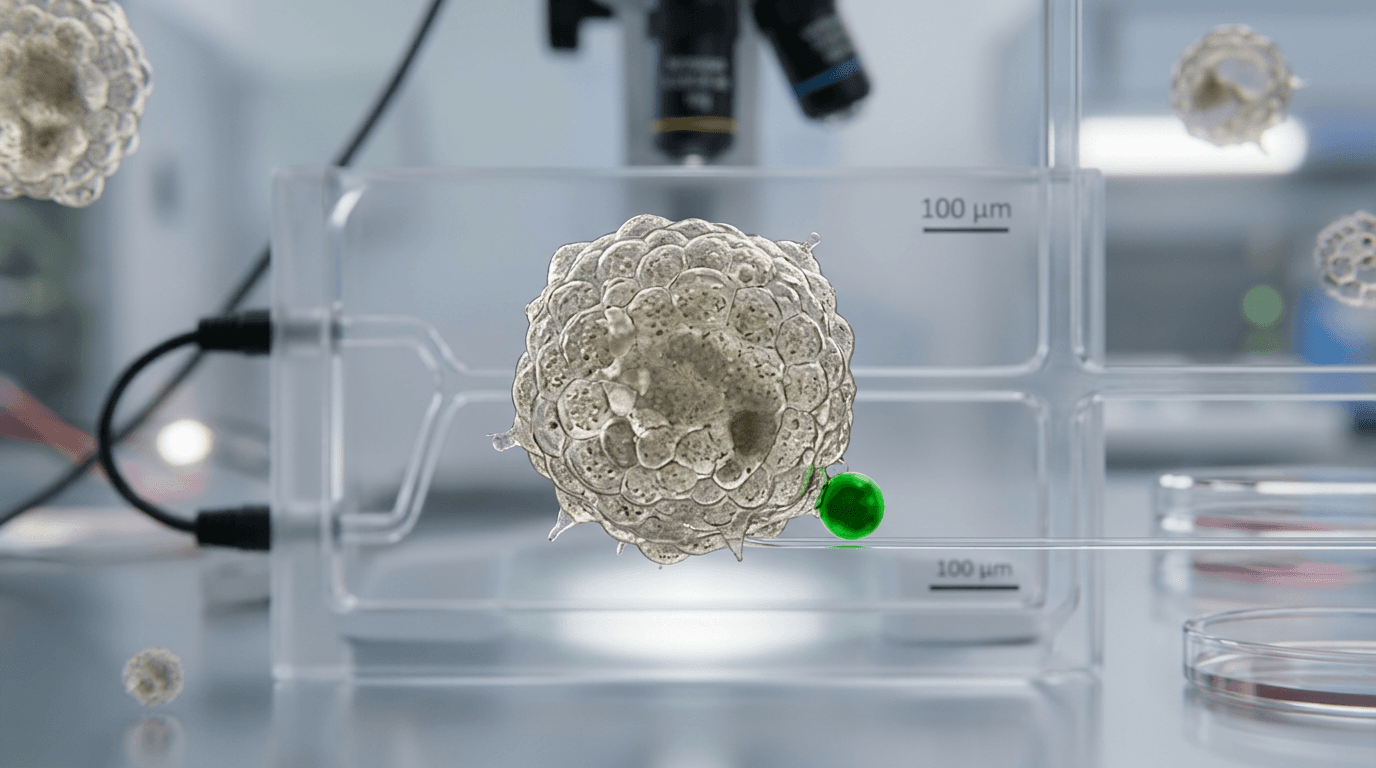
Xenobots
Xenobots represent a revolutionary class of synthetic living constructs—multicellular organisms engineered from animal cells to perform programmed tasks. Created by Michael Levin's lab at Tufts University in collaboration with computer scientists at the University of Vermont, xenobots are built from frog (Xenopus laevis) skin and heart muscle cells, computationally designed to exhibit specific behaviors, and represent the first example of living, programmable organisms created entirely from biological components.
Design and Construction Process
Xenobots are created through a unique computational-biological pipeline combining evolutionary algorithms with biological implementation. The process involves: (1) computational modeling using evolutionary algorithms to design optimal cell configurations for desired behaviors; (2) in silico testing and refinement through thousands of virtual iterations; (3) biological implementation by manually arranging living frog cells according to computational designs; and (4) emergent behavior verification as the living construct self-organizes and performs designed tasks. This represents the first practical application of computational design to living organism construction.
Biological Architecture
Unlike traditional robots made from metal and plastic, xenobots are constructed entirely from living biological components. The architecture typically combines: frog skin cells (epithelial cells) providing structural integrity and cohesion; cardiac muscle cells (cardiomyocytes) providing motile force through rhythmic contractions; emergent collective behavior arising from cellular self-organization; and adaptive responses to environmental conditions through cellular sensing. The organisms are typically 0.5-1mm in size and survive for days to weeks depending on configuration.
Programmable Behaviors
Xenobots have been designed and demonstrated to perform various complex tasks including: locomotion through aqueous environments using coordinated muscle contractions; cargo transport by capturing and moving microscopic particles; collective behavior and swarm coordination among multiple xenobots; environmental remediation by collecting microplastics or other particles; wound healing and self-repair through cellular reorganization; and kinematic self-replication by gathering loose cells into functional offspring configurations. Each behavior is achieved through specific cellular arrangements rather than genetic modification.
Kinematic Self-Replication
In 2021, Levin's team demonstrated that xenobots can engage in a form of self-replication never before observed in organisms. Through a process called 'kinematic self-replication,' parent xenobots move through their environment gathering loose frog cells into piles that spontaneously develop into functional offspring xenobots. This replication method requires no genetic changes and differs fundamentally from sexual or asexual reproduction—it represents an entirely novel biological phenomenon made possible by cellular reorganization according to physical rules rather than genetic programming.
Living vs. Robotic Systems
Xenobots challenge traditional boundaries between living organisms and engineered systems. They exhibit characteristics of both: fully biodegradable composition eliminating environmental persistence concerns; energy autonomy drawing from cellular energy stores without external power; adaptive behavior and self-repair impossible in conventional robots; limited lifespan providing inherent safety mechanism; and emergent intelligence from cellular cooperation rather than central control. This hybrid nature opens new possibilities for biocompatible, biodegradable micro-machines.
Computational Morphogenesis
The xenobot design process pioneered computational morphogenesis—using algorithms to design living forms. The approach involves: defining desired behaviors and performance metrics; running evolutionary algorithms to optimize cell configurations; simulating emergent behaviors from cellular interactions; and translating successful virtual designs into biological implementations. This represents a fundamental shift from traditional genetic engineering to morphological engineering.
Applications and Potential
Xenobots suggest numerous practical applications including: targeted drug delivery navigating through human tissues; microsurgery performing precise interventions in hard-to-reach areas; environmental remediation collecting microplastics or toxins from waterways; tissue engineering and regenerative medicine applications; biosensing and diagnostic tools responsive to specific conditions; and fundamental research into collective cellular behavior and morphogenesis. The biodegradable nature makes them attractive for applications where environmental persistence is undesirable.
Theoretical Implications
Beyond practical applications, xenobots raise profound questions about the nature of life, intelligence, and design: What constitutes an organism versus a machine? Can intelligence and goal-directed behavior emerge from cellular cooperation without neural tissue? How do collections of cells make collective decisions about form and function? Can morphology be engineered as directly as genomes? The work suggests that cellular collectives possess computational and decision-making capabilities previously unrecognized.
Scientific Foundation and Validation
Xenobots represent peer-reviewed, experimentally validated science published in leading journals (PNAS, Science Robotics). The research has been independently replicated and extended, distinguishing it from speculative xenotechnology. Key validations include: demonstrated locomotion and task performance matching computational predictions; observed self-replication through kinematic mechanisms; confirmed biodegradability and environmental safety; and reproducible construction protocols enabling further research.
Relationship to Bioelectricity Research
Xenobots emerged from Levin's broader research program on bioelectric signaling and morphogenetic fields. The work demonstrates that: cellular collectives can be reprogrammed through physical arrangement rather than genetic modification; emergent behaviors arise from electrical and mechanical cellular interactions; morphological outcomes can be predicted and designed computationally; and living systems exhibit radical plasticity in form and function beyond genetic constraints.
Ethical and Safety Considerations
The creation of novel living organisms raises important questions addressed by the research team: xenobots cannot survive outside laboratory conditions and have limited lifespans; they pose no ecological risk due to inability to reproduce conventionally or persist in natural environments; the research follows established bioethics protocols and regulatory frameworks; potential dual-use concerns are mitigated by limited capabilities and biodegradability; and the work emphasizes beneficial applications and responsible development.
Future Directions
Current research is expanding xenobot capabilities including: longer lifespans through optimized cellular configurations; enhanced sensing and responsiveness to environmental signals; more complex behaviors through sophisticated designs; integration with synthetic biology and genetic circuits; and scaling from individual constructs to coordinated swarms. The field is evolving toward 'living machines' that combine biological and engineered properties.
Significance
Xenobots represent a paradigm shift in biotechnology—from genetic engineering to morphological engineering, from designing genomes to designing forms. They demonstrate that life is more plastic and programmable than previously understood, that intelligence emerges from cellular cooperation, and that living machines can be computationally designed and biologically constructed. As the first synthetic organisms created through computational design, xenobots establish a new frontier bridging computer science, developmental biology, and robotics.
Research this in Signals
Signals turns a topic into a sourced research record you can inspect and rerun. Your first scan is free, and this one starts with Xenobots already loaded, so edit it or scan as is.