Energy Community Models
Energy community models represent a strategic convergence of housing development and renewable energy infrastructure, structured around principles of local ownership and shared economic benefit. Unlike conventional approaches where housing and energy systems operate as separate domains with distinct stakeholders, these models integrate renewable generation—solar arrays, district heating networks, geothermal systems—directly into residential developments with governance structures that allow residents or local entities to own, operate, or financially benefit from the energy infrastructure. This integration addresses a fundamental challenge in both sectors: the persistent gap between sustainability ambitions and community acceptance. Housing developments frequently encounter resistance over density and local impact, while renewable energy projects face opposition over visual intrusion and perceived external benefit capture. By coupling these functions and embedding ownership locally, energy community models create alignment between sustainability objectives and tangible household-level advantages, potentially transforming resistance into engagement.
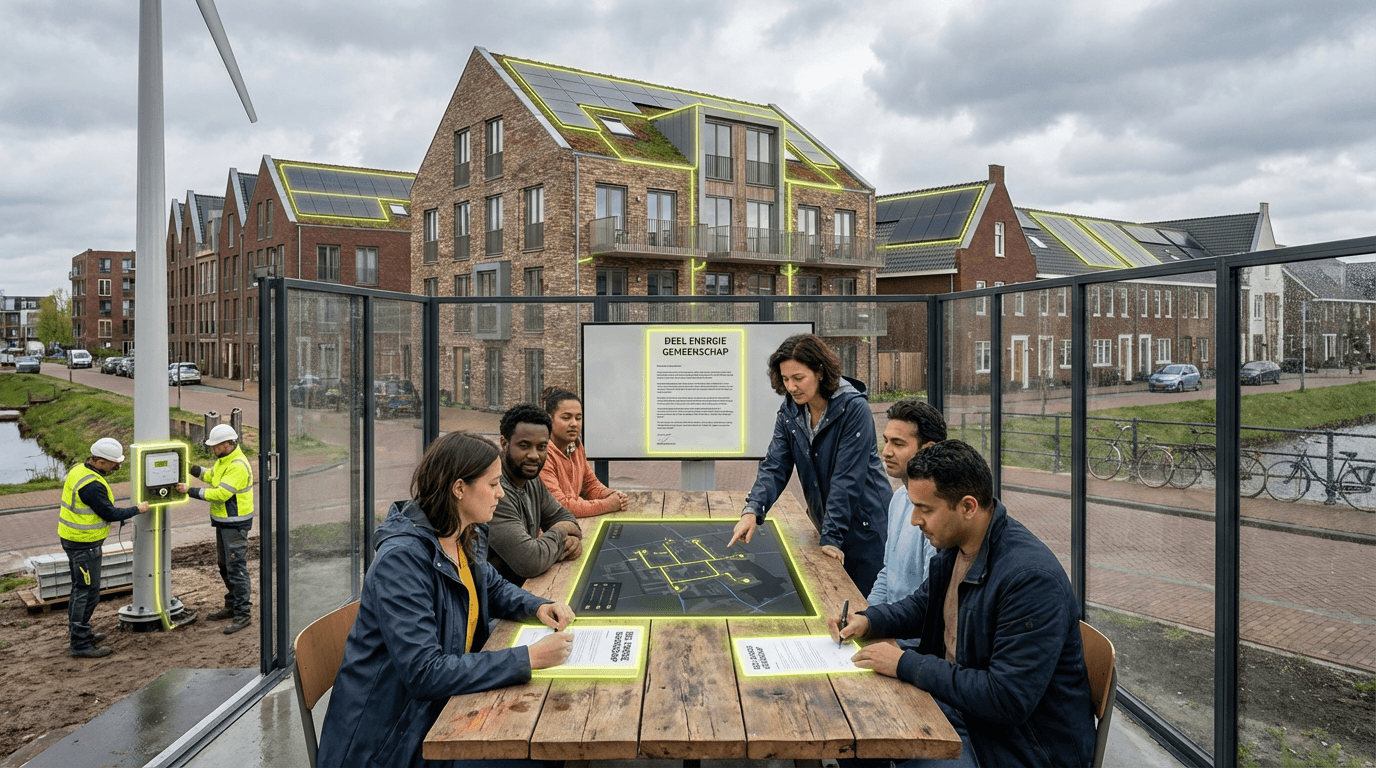
Early implementations across the Benelux region demonstrate varied structural approaches and emerging patterns. Dutch energy cooperatives have pioneered models where housing associations or resident groups collectively own solar installations or participate in wind energy revenues, with some developments designed from inception to integrate generation capacity and distribute returns through reduced energy costs or direct payments. Belgian experiments with district heating networks increasingly incorporate resident ownership stakes or cooperative governance, particularly in urban renewal projects where thermal infrastructure serves multiple buildings. Luxembourg has seen community solar arrangements layered onto social housing developments, where panel installations on rooftops generate income streams that offset rents or fund building improvements. These examples remain relatively small-scale, often supported by specific subsidy frameworks or municipal partnerships, and face ongoing challenges around regulatory clarity for energy communities, complexity in financing structures that blend housing and energy investment, and technical integration requirements that demand coordination across traditionally separate professional domains.
The implications extend beyond individual projects to broader questions of how housing and energy transitions might be governed and financed. If energy community models prove viable at scale, they could reshape expectations around housing development, making energy self-sufficiency and revenue generation standard features rather than exceptional add-ons. This could influence land-use planning, building codes, and social housing finance, particularly if demonstrated returns attract institutional investors seeking combined housing-energy portfolios. For policymakers, the signal suggests monitoring adoption rates beyond pilot phases, regulatory barriers that prevent scaling, and whether community ownership structures genuinely distribute benefits or concentrate them among already-advantaged groups. Critical thresholds include whether energy communities can operate without sustained subsidy support, how grid integration evolves as distributed generation increases, and whether governance models maintain genuine community participation as projects mature. The trajectory remains uncertain, dependent on energy price dynamics, regulatory evolution, and whether the administrative complexity proves manageable for community-based organizations.