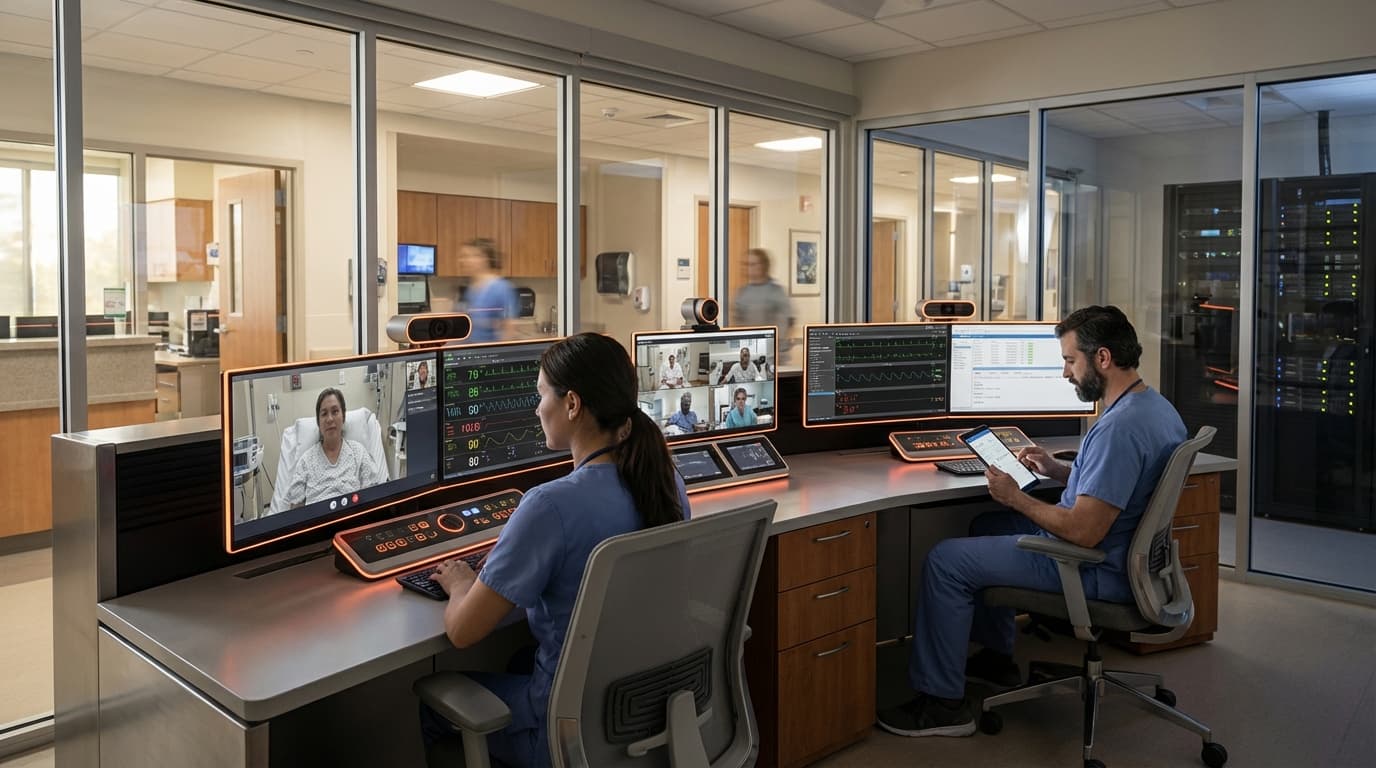
Tele-ICU & Virtual Specialist Networks
Tele-ICU and virtual specialist networks represent a fundamental shift in how critical care expertise is distributed across healthcare systems. These platforms employ high-bandwidth audio-visual communication infrastructure combined with integrated electronic health record systems and real-time patient monitoring dashboards to connect community hospitals with centralized teams of intensivists and medical specialists. The technical architecture typically includes bedside cameras with pan-tilt-zoom capabilities, two-way audio systems, and streaming vital sign data from ICU monitoring equipment directly to remote command centers. Advanced implementations incorporate artificial intelligence algorithms that flag concerning trends in patient data, alerting remote specialists to potential deterioration before it becomes clinically obvious. This hub-and-spoke model allows a single intensivist or specialist to oversee multiple ICU beds across several facilities simultaneously, providing continuous expert oversight that would be economically unfeasible for smaller hospitals to maintain on-site.
The healthcare delivery challenge these networks address is stark: the geographic mismatch between where critical care expertise exists and where patients need it. Rural and community hospitals frequently lack 24/7 intensivist coverage, forcing them to transfer critically ill patients to distant tertiary centers even when local facilities have adequate physical infrastructure. These transfers are costly, disruptive to families, and carry inherent medical risks. Tele-ICU systems enable local hospitals to retain and manage complex cases they would otherwise transfer, improving patient outcomes by reducing transport-related complications while simultaneously decreasing the burden on overcrowded urban medical centers. The model also addresses workforce shortages in specialized fields, allowing scarce expertise to be leveraged more efficiently across wider geographic areas. For procedures requiring specialist guidance—such as complex ventilator management or emergency neurosurgical consultations—remote experts can provide real-time coaching to on-site teams, effectively extending their capabilities without requiring physical presence.
Early adopters of tele-ICU networks have demonstrated measurable improvements in patient outcomes, including reduced mortality rates and shorter ICU lengths of stay in participating community hospitals. Major health systems have established regional networks where a central monitoring hub supports dozens of outlying facilities, creating economies of scale that make the technology financially viable. The COVID-19 pandemic accelerated adoption significantly, as hospitals faced unprecedented surges in critically ill patients and needed mechanisms to share expertise rapidly across facilities. Beyond intensive care, the virtual specialist network model is expanding into other domains including tele-stroke programs, tele-psychiatry, and remote neonatal intensive care. As healthcare systems continue to consolidate while simultaneously seeking to maintain community access points, these technologies represent a crucial bridge—enabling the clinical integration and quality standardization of large health networks while preserving the geographic accessibility that community hospitals provide. The trajectory points toward increasingly sophisticated remote monitoring capabilities and broader specialist coverage, fundamentally reshaping the traditional assumption that expertise must be physically co-located with patients.
Related Organizations

Provides acute telemedicine services including TeleNeurology, TelePsychiatry, and TeleICU (formerly SOC Telemed).

The largest independent telemedicine provider in the US, formerly known as Advanced ICU Care.

Mercy Virtual
United States · Nonprofit
The world's first facility dedicated entirely to virtual care, operating a massive Tele-ICU command center.

Global electronics giant producing the Lumea series, one of the most widely sold at-home IPL devices.

Virtual hospital system delivering telemedicine services to rural and frontier communities.

Large health system that operates 'Connect Care Pro,' a major internal Tele-ICU and infectious disease support network.

A multinational telemedicine and virtual healthcare company.

Provider of telemedicine programs for acute care hospitals, including Tele-ICU and Tele-Hospitalist.

Physician practice group that offers tele-hospitalist and tele-critical care services.
Supporting Evidence
Research this in Signals
Signals turns a topic into a sourced research record you can inspect and rerun. Your first scan is free, and this one starts with Tele-ICU & Virtual Specialist Networks already loaded, so edit it or scan as is.