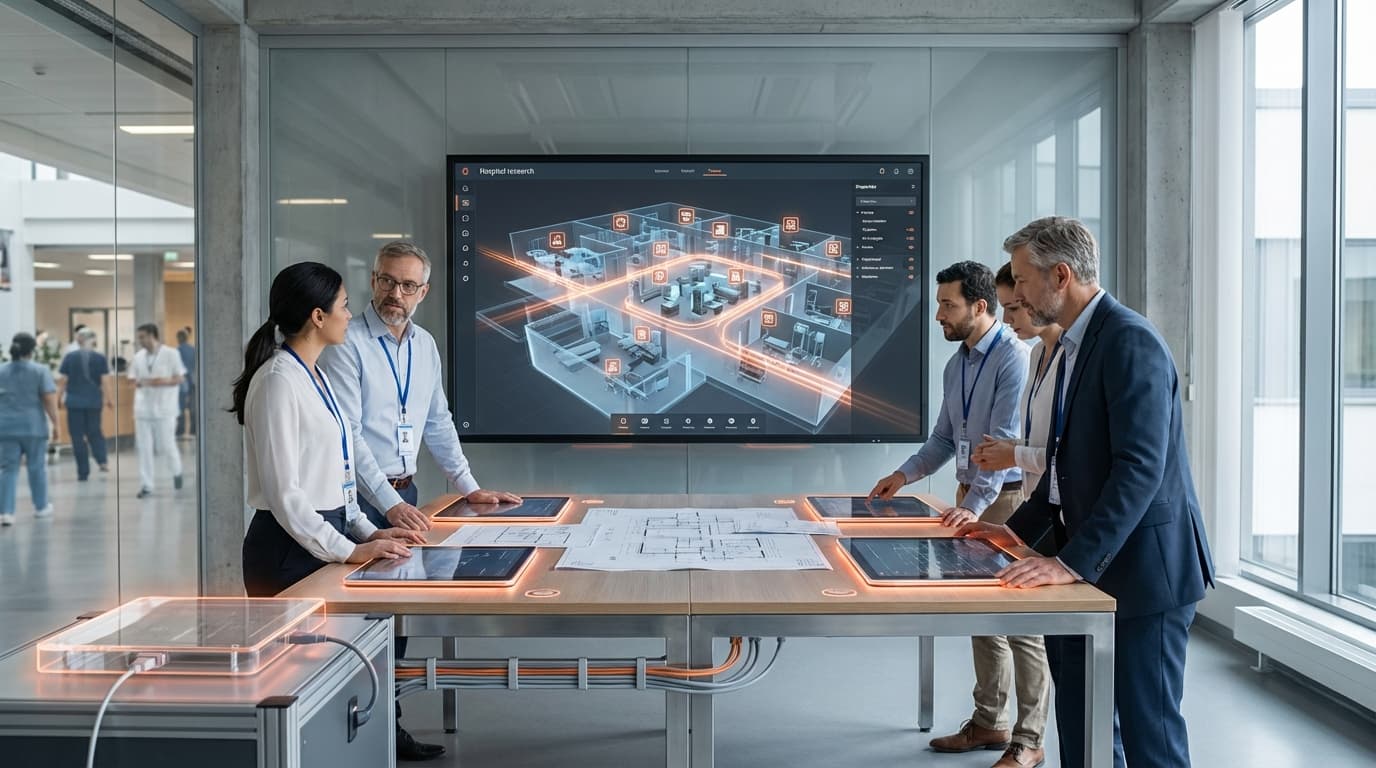
Digital Twin Hospitals
Digital twin hospitals represent a sophisticated convergence of building information modeling, Internet of Things sensors, and advanced simulation software to create living virtual replicas of healthcare facilities. These systems continuously ingest real-time data from physical hospital infrastructure—including patient admission rates, equipment utilization, staff movements, environmental conditions, and resource consumption—to maintain an up-to-date digital mirror of operations. The underlying architecture typically combines 3D spatial models with discrete event simulation engines and machine learning algorithms that can predict bottlenecks, identify inefficiencies, and model the cascading effects of operational changes. Unlike static architectural blueprints or isolated data dashboards, digital twins integrate multiple data streams into a unified, interactive environment where administrators can visualize how modifications to one system ripple through the entire facility ecosystem.
Healthcare delivery faces mounting pressure from aging populations, staff shortages, and the need to maintain operational resilience during public health emergencies. Traditional approaches to hospital optimization often rely on retrospective analysis or costly pilot programs that disrupt patient care. Digital twin technology addresses these challenges by enabling evidence-based decision-making without the risks associated with real-world experimentation. Hospital administrators can test scenarios ranging from emergency department reconfigurations to evaluate patient throughput, to modeling the impact of adding specialized treatment units, to simulating evacuation procedures during natural disasters. This capability proved particularly valuable during recent pandemic responses, where facilities used digital twins to rapidly prototype isolation ward layouts, predict ventilator demand, and optimize staff deployment patterns. The technology also supports long-term strategic planning, allowing healthcare systems to evaluate the return on investment for major capital projects or assess how demographic shifts might affect service demand years in advance.
Early adopters in healthcare systems across North America, Europe, and Asia have begun deploying digital twin platforms for specific use cases, with implementations ranging from single-department models to comprehensive whole-hospital systems. Research hospitals and large academic medical centers have led initial adoption, using these tools to optimize surgical suite scheduling, reduce patient wait times in imaging departments, and improve energy efficiency in aging facilities. The technology aligns with broader healthcare trends toward value-based care and operational excellence, where marginal improvements in efficiency can translate to significant cost savings and better patient outcomes. As sensor networks become more ubiquitous in healthcare facilities and interoperability standards mature, digital twin hospitals are expected to evolve from planning tools into continuous operational support systems that provide real-time recommendations and automated adjustments. This progression positions digital twins as foundational infrastructure for the next generation of smart hospitals, where physical and digital systems work in concert to deliver more responsive, efficient, and patient-centered care.
Related Organizations

A major medical technology company offering 'AI-Rad Companion', a family of AI-powered, cloud-based augmented workflow solutions.

Software corporation specializing in 3D design and digital mock-ups.

Develops ultrasound systems (Voluson) with AI features that assist in assessing fetal development and cervical length, key indicators for preterm risk.

Partnered with Siemens Healthineers to create a digital twin of their radiology department to optimize patient flow and reduce wait times.

Developing foundation models for robotics (Project GR00T) and vision-language models like VILA.

Provides simulation and scheduling software used to create digital twins of hospital emergency departments and surgical suites.


City of Hope
United States · Nonprofit
Utilizes digital twin simulations to model patient scheduling and infusion center operations to improve efficiency for cancer treatment.

Spatial data company that integrated mobile LiDAR support into their capture app, democratizing real estate digital twins.
Supporting Evidence
Research this in Signals
Signals turns a topic into a sourced research record you can inspect and rerun. Your first scan is free, and this one starts with Digital Twin Hospitals already loaded, so edit it or scan as is.