Telepresence Robotic Colleagues
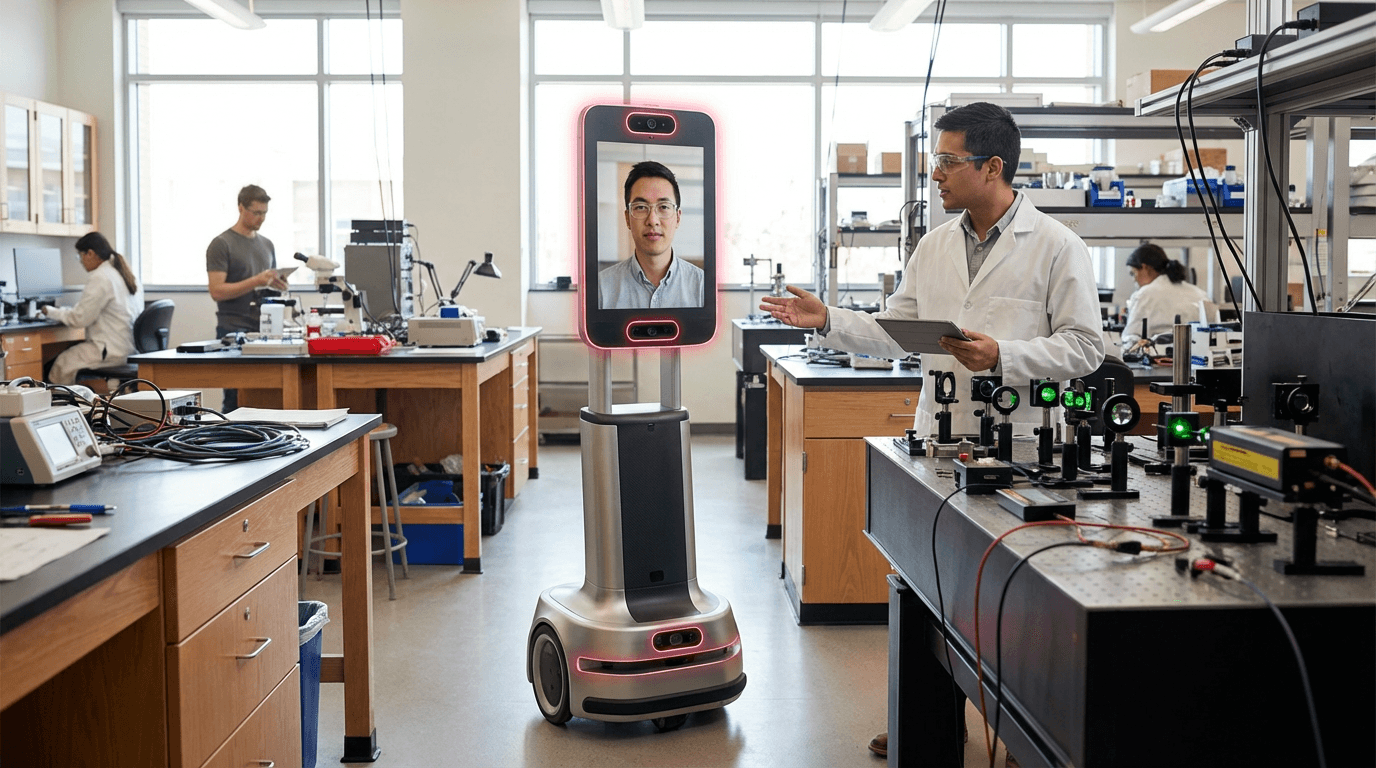
Telepresence robotic colleagues represent a convergence of mobile robotics, video conferencing technology, and workplace automation designed to address the persistent challenges of hybrid work environments. These systems typically consist of wheeled platforms equipped with high-definition cameras, directional microphones, speakers, and vertical displays that show the remote worker's face in real-time. The robots are controlled remotely through intuitive interfaces that allow distant employees to navigate office spaces, adjust their viewing height, and move between rooms or floors. Advanced models incorporate obstacle detection sensors, automatic docking stations for recharging, and spatial mapping capabilities that enable smooth navigation through crowded corridors and doorways. Unlike static video conferencing setups, these mobile platforms provide remote workers with agency over their physical presence, allowing them to position themselves optimally during meetings, approach whiteboards to examine diagrams, or join spontaneous hallway conversations that would otherwise exclude distributed team members.
The fundamental problem these systems address is the asymmetry of participation and social capital that emerges in hybrid organizations. Research suggests that remote workers often experience diminished influence in decision-making processes, reduced access to informal knowledge sharing, and fewer opportunities for relationship building compared to their office-based counterparts. Traditional video conferencing solutions, while enabling communication, cannot replicate the spontaneity of physical presence or the ability to engage with three-dimensional objects and spatial arrangements. Telepresence robots help bridge this gap by restoring elements of embodied presence that are critical for collaboration in fields requiring physical prototyping, spatial design review, or hands-on problem-solving. Organizations deploying these systems report improvements in remote worker engagement during brainstorming sessions, more equitable participation in meetings, and better integration of distributed team members into workplace culture. The technology also addresses practical challenges in industries where physical presence has traditionally been considered essential, enabling companies to access broader talent pools without sacrificing the benefits of in-person collaboration.
Early adopters of telepresence robotic colleagues include technology companies, research institutions, and organizations with geographically distributed teams working on hardware development or spatial design projects. Deployment scenarios range from manufacturing facilities where remote engineers need to inspect production lines, to architectural firms where distant designers participate in physical model reviews, to healthcare settings where specialist consultants provide guidance during procedures. The technology aligns with broader trends toward workplace flexibility and the recognition that hybrid work models require more sophisticated tools than simple video calls. As organizations continue to navigate the complexities of distributed work arrangements, telepresence robots represent an evolving category of workplace technology that attempts to preserve the advantages of physical co-location while accommodating the realities of remote work. Future developments in this space may incorporate artificial intelligence for autonomous navigation, haptic feedback systems for physical interaction, and integration with building management systems to create seamless transitions between digital and physical workplace experiences.
Related Organizations
A spinoff from iRobot that develops intelligent, autonomous telepresence robots for corporate offices and industrial facilities.

Parent company of GoBe Robots, which produces mobile telepresence solutions for professional communication.


Amy Robotics
China · Company
A service robot company manufacturing telepresence and reception robots for commercial environments.
Revolve Robotics
United States · Company
Developers of Kubi, a robotic tablet stand that allows remote users to look around a room during video calls.

A Canadian startup developing telepresence solutions tailored for healthcare and senior care, adaptable to office use.

A technology company that acquired the Kubi telepresence assets to continue development and sales.

Creators of the Meeting Owl, a 360-degree smart video conferencing camera that automatically focuses on the speaker.
Supporting Evidence
Research this in Signals
Signals turns a topic into a sourced research record you can inspect and rerun. Your first scan is free, and this one starts with Telepresence Robotic Colleagues already loaded, so edit it or scan as is.