Collaborative Cognitive Robots (Cobots)
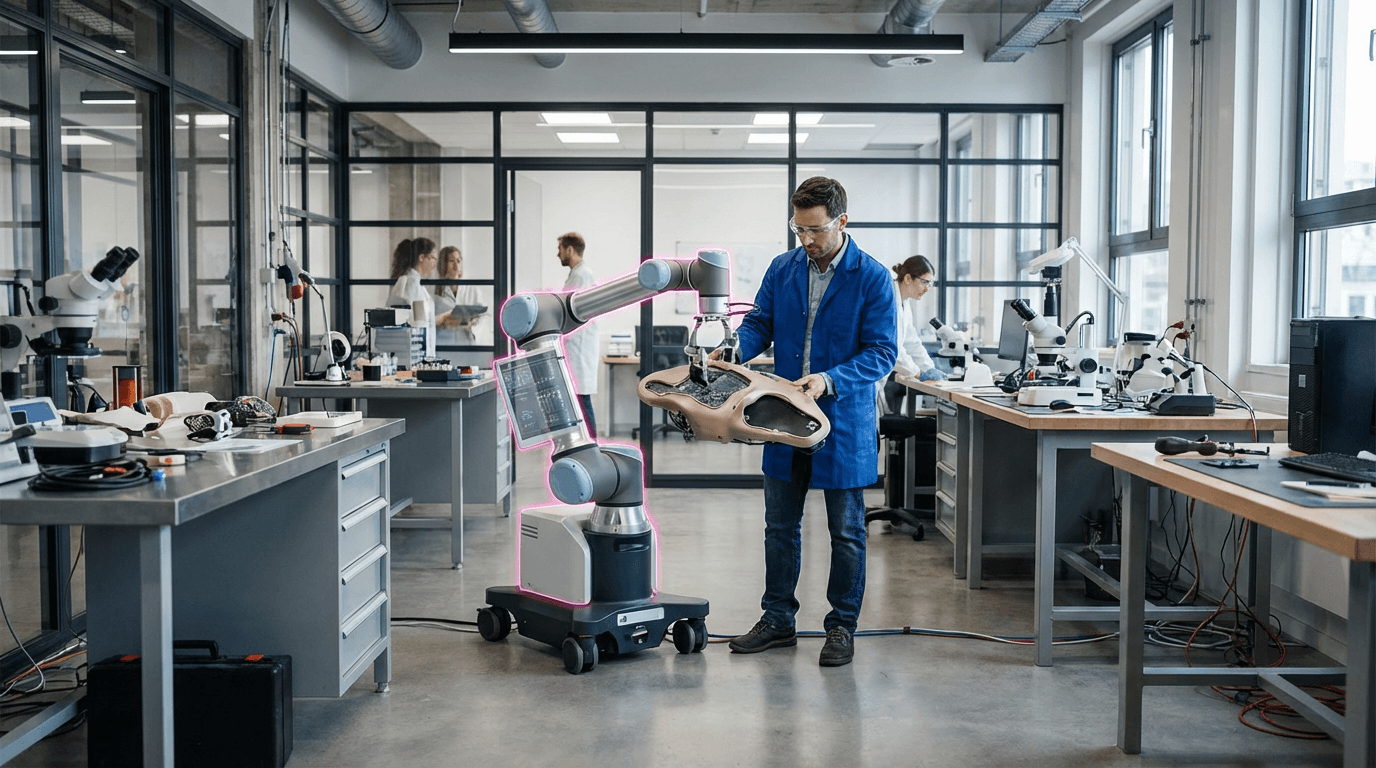
Collaborative cognitive robots, or cobots, represent a significant evolution beyond traditional industrial automation by integrating advanced artificial intelligence capabilities that enable them to work alongside humans in dynamic, knowledge-intensive environments. These systems combine natural language processing, computer vision, and sophisticated manipulation capabilities with machine learning algorithms that allow them to understand context, interpret human intentions, and adapt their behavior in real-time. Unlike their industrial predecessors, which operate in highly structured environments performing repetitive tasks, cognitive cobots are designed to function in unstructured settings where variability and uncertainty are the norm. They achieve this through sensor fusion technologies that create detailed environmental models, enabling them to navigate complex workspaces, recognize objects and materials, and respond to verbal instructions or gestural cues from human collaborators.
The emergence of cognitive cobots addresses a fundamental challenge in modern knowledge work: the need for flexible automation that augments rather than replaces human expertise. In research laboratories, these systems can assist scientists by preparing samples, managing equipment, and documenting experimental procedures while learning from observation to anticipate researcher needs. Design studios benefit from cobots that can manipulate physical prototypes, suggest design iterations based on learned patterns, and facilitate rapid testing of concepts. Manufacturing planning environments leverage these robots to bridge the gap between digital design and physical production, allowing planners to collaborate with machines that understand both engineering constraints and creative problem-solving approaches. This capability to engage in what researchers describe as "collaborative cognition" enables organizations to tackle increasingly complex challenges that require both human creativity and machine precision, while also addressing labor shortages in specialized fields where finding skilled workers has become difficult.
Early deployments in academic research facilities and advanced manufacturing settings indicate that cognitive cobots are transitioning from experimental prototypes to practical tools, though widespread adoption remains in nascent stages. Current applications demonstrate particular promise in scenarios requiring repetitive precision combined with adaptive decision-making, such as quality control processes that demand both consistency and contextual judgment. The technology aligns with broader industry trends toward human-machine teaming, where the goal is not full automation but rather the creation of hybrid work systems that leverage complementary strengths. As sensor technologies become more sophisticated and machine learning models improve their ability to generalize from limited examples, cognitive cobots are expected to expand into additional knowledge work domains, potentially transforming how organizations approach tasks that have traditionally required exclusively human intelligence and dexterity.
Related Organizations

Creators of Moxi, a socially intelligent robot assistant designed to help clinical staff with non-patient-facing tasks.

Building autonomous humanoid robots, partnering with OpenAI for the underlying intelligence.

Developing general-purpose humanoid robots (Phoenix) powered by Carbon, their AI control system.
Backed by OpenAI, developing the 'Eve' (wheeled) and 'Neo' (bipedal) androids for labor markets.

Creators of Digit, a bipedal robot designed for logistics work.

A spin-out from the Human Centered Robotics Lab at UT Austin, developing Apollo, a general-purpose humanoid.

AI robotics company building a universal AI brain for robots.

Creates dual-arm mobile robots for facility management, security, and elder care.

Originally a rehab robotics company, now developing the GR-1 general-purpose humanoid robot.

Develops the TIAGo (Take It And Go) mobile manipulator, widely used in research and light industrial applications.
Supporting Evidence
Research this in Signals
Signals turns a topic into a sourced research record you can inspect and rerun. Your first scan is free, and this one starts with Collaborative Cognitive Robots (Cobots) already loaded, so edit it or scan as is.