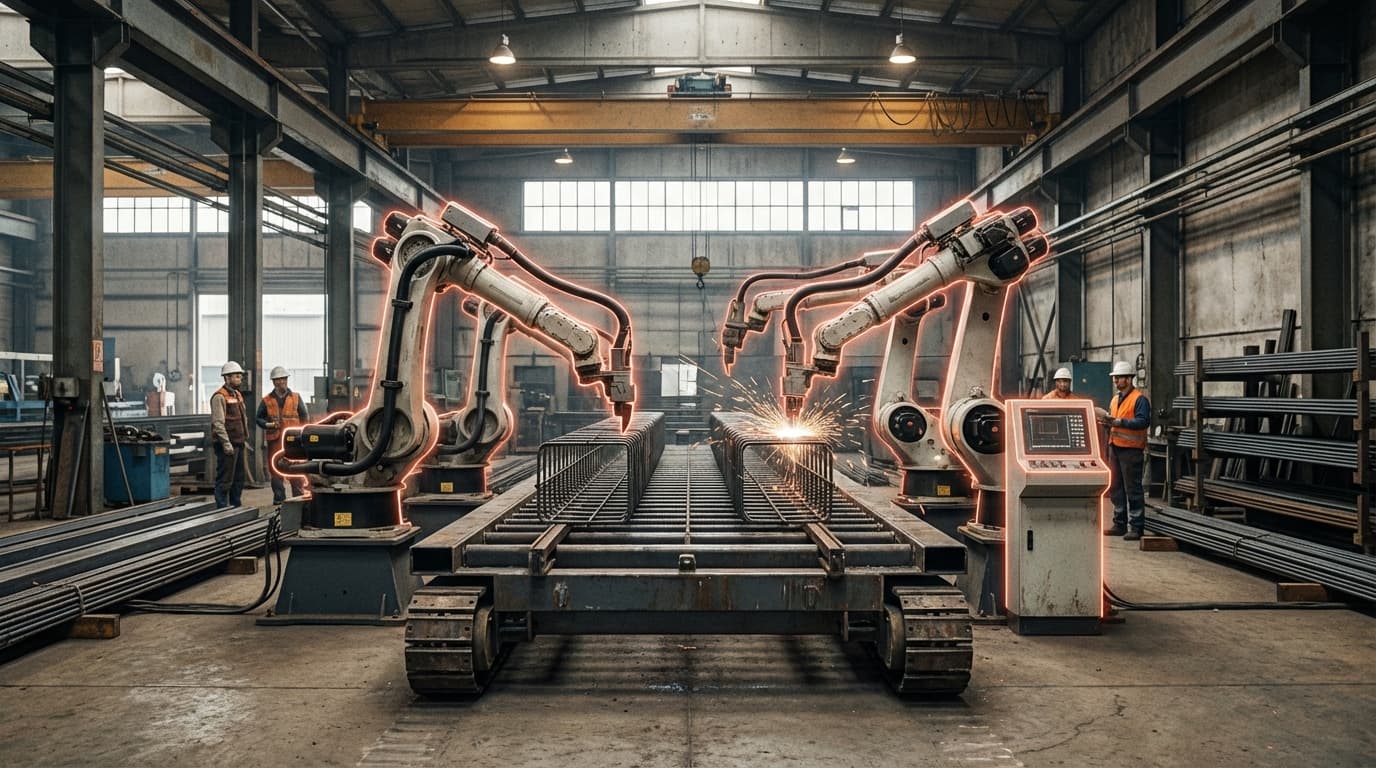
Robotic Rebar & Prefab Fabrication
Robotic rebar and prefabrication systems represent a fundamental shift in how structural components are manufactured for construction projects. These automated cells integrate industrial robotics with specialized tooling to perform tasks traditionally executed by skilled laborers on construction sites—cutting steel reinforcement bars to precise lengths, bending them into complex geometries, tying intersections, and welding assemblies into finished cages or panels. The technology relies on digital fabrication workflows where building information models (BIM) are translated directly into machine instructions, eliminating manual interpretation and the variability that comes with human execution. Sensors and vision systems enable real-time quality control, ensuring that each piece meets dimensional tolerances far tighter than field conditions typically allow. By relocating this work to controlled factory environments, manufacturers can operate multiple shifts, maintain consistent environmental conditions, and achieve throughput rates that would be impossible on congested job sites.
The construction industry has long struggled with labor shortages, schedule unpredictability, and quality inconsistencies stemming from site-based fabrication. Robotic prefabrication addresses these challenges by transforming construction into a manufacturing process. Weather delays, space constraints, and coordination conflicts that plague traditional rebar installation are largely eliminated when components arrive as finished assemblies ready for placement. This approach enables just-in-time delivery strategies that reduce on-site storage requirements and minimize material handling, particularly valuable in dense urban environments where laydown space commands premium costs. The impact extends beyond individual components—when paired with design-for-manufacture and assembly (DfMA) principles, entire building systems can be optimized for automated production. However, realizing these benefits demands significant front-end investment in detailed engineering and coordination. Trades must agree on stable interfaces early in the design process, and procurement teams must commit to fabrication schedules before traditional construction timelines would require such decisions.
Early adopters in markets facing acute labor constraints have demonstrated the viability of robotic prefabrication across residential towers, infrastructure projects, and data centers. Factories equipped with these systems now produce rebar cages for foundation mats, precast wall panels with embedded reinforcement, and modular mechanical-electrical-plumbing racks that arrive on site as plug-and-play assemblies. The technology is particularly well-suited to projects with repetitive elements—parking structures, residential floors, and tunnel segments—where the upfront programming investment can be amortized across many identical units. As the construction sector continues its gradual industrialization, robotic fabrication represents a critical bridge between traditional craft-based methods and fully automated building production. The trajectory points toward increasingly sophisticated systems capable of handling mixed materials, adaptive tooling for custom geometries, and integration with autonomous logistics that could eventually deliver components directly to robotic installation equipment, closing the loop on end-to-end automated construction.
Related Organizations

Norwegian company automating the prefabrication of reinforcement cages using industrial robots.

Robotics and automation for rebar fabrication and assembly in pre-cast environments.

Manufacturer of equipment for the processing of reinforcing steel and resistance welding technology.

Manufacturer of highly automated machinery and software for precast concrete and rebar processing plants.
Schnell Group
Italy · Company
Global leader in the production of automatic machines for reinforcement processing and wire mesh production.

Specializes in the design and manufacturing of automatic machines for steel reinforcement processing.

Manufacturer of rebar fabrication equipment, including automated cutting and bending systems.
Max Bögl
Germany · Company
German construction company with highly automated precast concrete factories utilizing robotic production methods.

A major manufacturer of industrial robots, including the LBR Med, a lightweight robot certified for integration into medical devices.
Supporting Evidence
Research this in Signals
Signals turns a topic into a sourced research record you can inspect and rerun. Your first scan is free, and this one starts with Robotic Rebar & Prefab Fabrication already loaded, so edit it or scan as is.