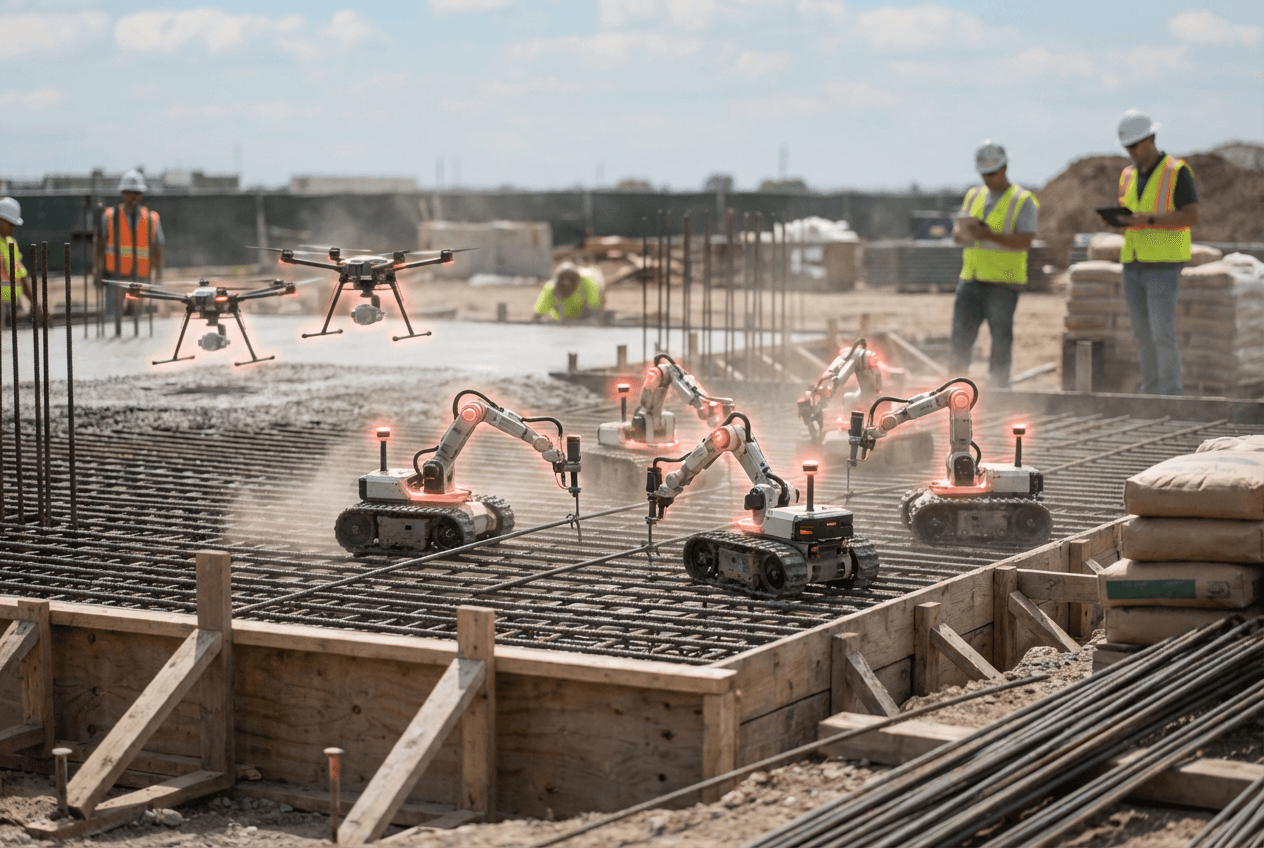
Autonomous Construction Swarms
Autonomous construction swarms represent a paradigm shift in how building projects can be executed, drawing inspiration from the collective behavior observed in nature—such as ant colonies or bee hives—to create coordinated robotic systems capable of performing complex construction tasks. These systems consist of multiple small, specialized robots that operate both on the ground and in the air, communicating with one another through wireless networks to share information about their environment, task progress, and positioning. The fundamental technical principle underlying these swarms is distributed intelligence, where no single robot serves as a central controller. Instead, each unit follows simple rules and responds to local conditions and signals from nearby robots, allowing the collective to exhibit sophisticated emergent behaviors. This decentralized architecture means that the swarm can adapt dynamically to changing site conditions, work around obstacles, and continue functioning even when individual units fail or require maintenance. The robots themselves may be equipped with various tools and sensors depending on their designated tasks—computer vision systems for site surveying and quality control, precision manipulators for bricklaying or material placement, and specialized end effectors for tasks like rebar tying or welding.
The construction industry faces persistent challenges including labor shortages, safety risks associated with dangerous or repetitive tasks, and the need for greater precision and efficiency in building processes. Autonomous construction swarms address these issues by automating labor-intensive activities that are either hazardous for human workers or require tedious repetition with high accuracy. By deploying multiple small robots rather than single large machines, construction sites can benefit from parallel processing of tasks, significantly reducing project timelines. The swarm approach also offers remarkable flexibility—units can be reassigned to different tasks as project phases evolve, and the system scales naturally by adding or removing robots based on workload demands. This modularity overcomes the limitations of traditional construction automation, which often requires substantial capital investment in large, specialized equipment that may sit idle between projects. Furthermore, the resilience inherent in swarm systems means that construction progress continues uninterrupted even when individual robots encounter problems, a critical advantage over conventional automated systems where a single point of failure can halt entire operations.
Early deployments of autonomous construction swarms have focused on specific, well-defined tasks where the technology can demonstrate clear advantages over traditional methods. Research institutions and construction technology companies have conducted pilot programs exploring applications such as automated bricklaying, where small ground-based robots work in coordination to place masonry units with millimeter precision, and aerial drones that perform site surveying by collectively mapping large areas more quickly than conventional methods. Some systems have been tested for infrastructure inspection, with swarms of drones collaborating to examine bridges, towers, and building facades from multiple angles simultaneously. The technology shows particular promise for construction in challenging or hazardous environments—such as disaster response scenarios, remote locations, or extraterrestrial construction applications—where deploying human workers would be impractical or dangerous. As the construction industry increasingly embraces digital technologies like Building Information Modeling and seeks solutions to address skilled labor shortages, autonomous construction swarms represent a natural evolution toward more automated, efficient, and safer building practices. The trajectory suggests that while fully autonomous construction sites remain a future prospect, targeted deployment of swarm robotics for specific high-value tasks will likely expand in the coming years, gradually transforming how we approach the physical act of building.
Related Organizations

A premier bio-inspired engineering lab developing soft robotics and adaptive materials.

Dutch startup developing small, electric, autonomous bricklaying robots that work in swarms.

Conducts advanced research in bioelectronics and the interface between biological systems and electronic circuits.

Research center developing projects like 'Hydroceramic', a passive cooling material that mimics biological transpiration.

The ICD and ITKE institutes conduct advanced research on cyber-physical construction systems, including multi-robot fabrication.

Research institution known for developing stretchable piezoelectric fabrics and energy-harvesting materials.

Home to the Computational Memory Lab led by Michael Kahana.

Printstones
Austria · Startup
Develops 'Baubot', a mobile robotic platform designed to work in groups for tasks like drilling, sanding, and transporting.

Owner of the Arnold renderer, which integrates AI denoising to optimize high-end VFX workflows for film and TV.
Supporting Evidence
Research this in Signals
Signals turns a topic into a sourced research record you can inspect and rerun. Your first scan is free, and this one starts with Autonomous Construction Swarms already loaded, so edit it or scan as is.