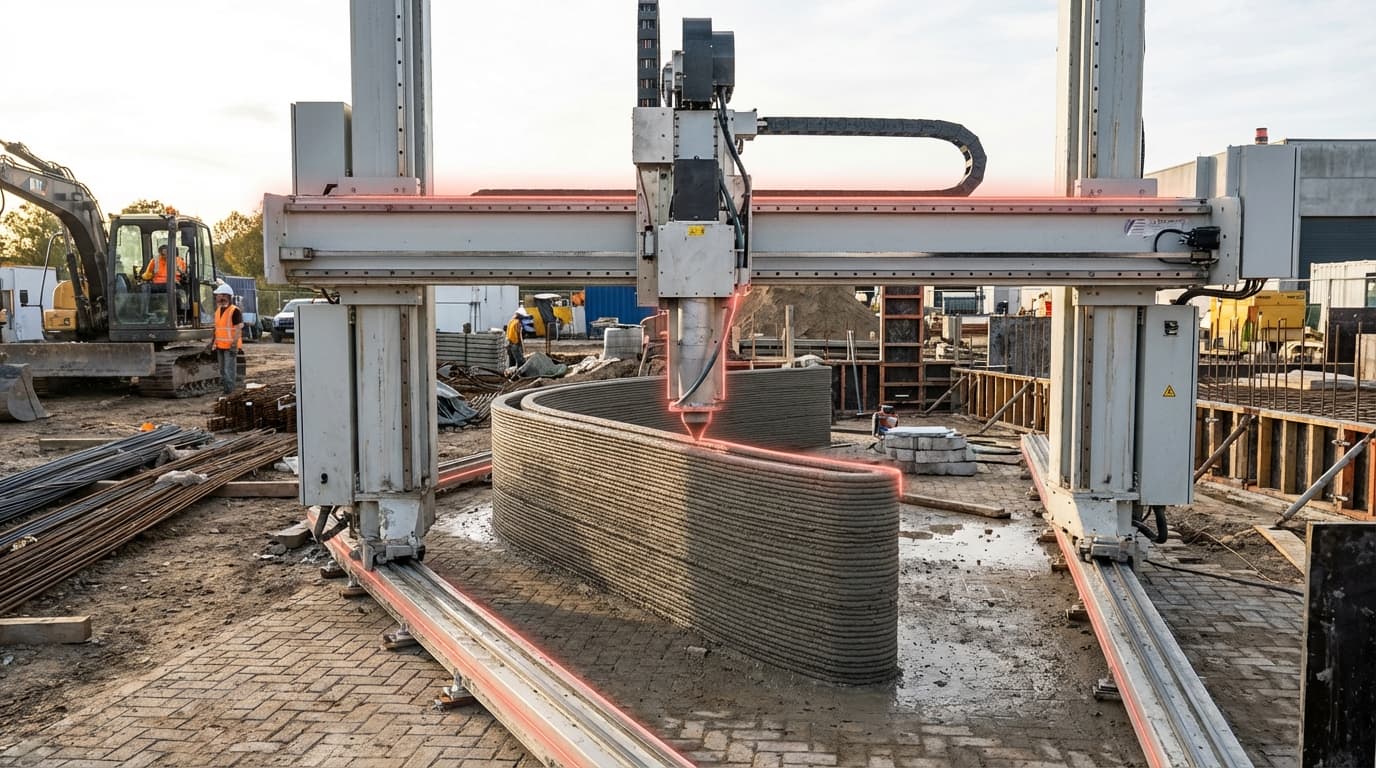
Large-Scale 3D Printing
Large-scale 3D printing, also known as construction-scale additive manufacturing, represents a fundamental shift in how buildings and infrastructure are fabricated. Unlike traditional construction methods that rely on formwork, manual labor, and assembly of prefabricated components, this technology employs robotic systems equipped with large-format extrusion nozzles that deposit construction materials—typically concrete mixtures, but increasingly including earth-based composites, polymers, and fiber-reinforced materials—in precise, computer-controlled layers. The process begins with a digital architectural model that is translated into toolpaths, guiding the printer's movements as it builds structures from the ground up. These systems range from gantry-style printers that move along fixed rails to robotic arms mounted on mobile platforms, each capable of producing components several meters in height and spanning entire building footprints. The materials themselves are specially formulated to maintain structural integrity while remaining workable during extrusion, often incorporating additives that accelerate curing or enhance thermal performance.
The construction industry faces persistent challenges including labor shortages, escalating costs, significant material waste, and lengthy project timelines. Large-scale 3D printing addresses these issues by automating much of the building process, reducing the need for skilled labor in certain tasks while simultaneously cutting construction schedules from months to days or weeks for certain applications. Material waste is dramatically reduced because the technology is purely additive, depositing material only where structurally necessary rather than cutting or forming from larger stock. This precision also enables complex geometries and optimized structural designs that would be prohibitively expensive or impossible with conventional methods, such as walls with integrated insulation channels, organic load-bearing forms, or customized architectural features without additional cost. Furthermore, the technology opens new possibilities for on-site manufacturing in remote or challenging environments, including disaster relief scenarios where rapid shelter deployment is critical, and even extraterrestrial construction where traditional supply chains are nonexistent.
Early deployments indicate growing commercial viability across multiple sectors. Housing projects in several regions have demonstrated the feasibility of printing affordable homes in under 24 hours of print time, while infrastructure applications have included pedestrian bridges and retaining walls. The technology is particularly gaining traction in markets facing acute housing shortages, where speed and cost reduction are paramount. Research institutions and construction firms are actively exploring hybrid approaches that combine 3D-printed structural elements with traditional building systems, allowing for integration of electrical, plumbing, and mechanical systems. As material science advances and regulatory frameworks evolve to accommodate these novel construction methods, large-scale 3D printing is positioned to become a standard tool in the construction industry's arsenal. The technology aligns with broader trends toward automation, sustainability, and mass customization in the built environment, suggesting a future where buildings can be produced with the same efficiency and precision as manufactured goods, fundamentally reshaping the economics and possibilities of construction.
Related Organizations

World leader in 3D construction printing solutions, manufacturing gantry-based printers.

Construction technology company using 3D printing robotics, software, and advanced materials.

Robotics technology company developing specialized equipment for 3D printing concrete buildings.
Mighty Buildings
United States · Startup
Construction technology company using 3D printing and composite materials to prefabricate housing panels.

One of the world's largest manufacturers of formwork and scaffolding.

Uses 'Cellular Fabrication' (C-Fab) to 3D print freeform polymer matrices that are filled with insulation and concrete.

Technology company offering 3D concrete printers, material, and software.

Global leader in innovative and sustainable building solutions.

Italian company designing 3D printers for sustainable construction using natural materials like clay and earth.

Saint-Gobain
France · Company
A multinational corporation producing high-performance materials (glass, insulation) essential for building envelopes in ZEBs.

Supporting Evidence
Research this in Signals
Signals turns a topic into a sourced research record you can inspect and rerun. Your first scan is free, and this one starts with Large-Scale 3D Printing already loaded, so edit it or scan as is.