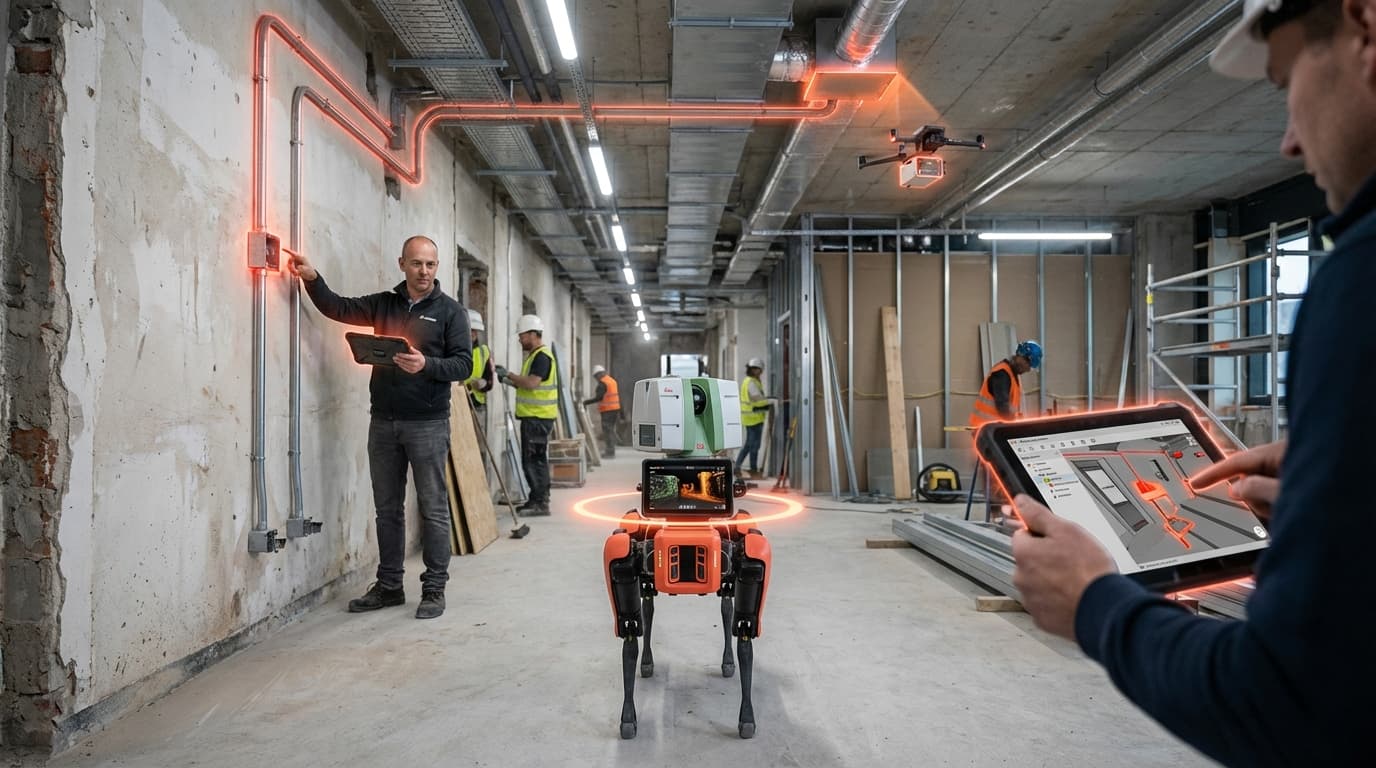
Continuous As-Built Verification (Reality-to-BIM)
Construction projects have long struggled with a fundamental disconnect between what was planned and what actually gets built. Traditional quality control methods rely on manual inspections and periodic checks, often catching errors only after subsequent work has already begun, leading to costly rework, schedule delays, and disputes among contractors. The problem intensifies as projects grow in complexity, with thousands of building components, multiple trades working simultaneously, and tight coordination requirements. Continuous As-Built Verification, often referred to as Reality-to-BIM, addresses this challenge by creating an automated feedback loop between the physical construction site and the digital Building Information Model (BIM). The technology works by capturing frequent reality data—through laser scanning, photogrammetry, or mobile scanning devices—and automatically comparing this data against the design intent encoded in the BIM. Advanced algorithms register point clouds and images to the model geometry, quantify dimensional deviations, identify missing installations, and detect clashes between as-built conditions and planned work. When discrepancies exceed tolerance thresholds, the system flags exceptions and routes them to the appropriate trade or project manager for resolution.
The construction industry faces mounting pressure to improve productivity and reduce the estimated 30% of work that typically requires rework. Continuous verification transforms quality control from a reactive, end-of-phase activity into a proactive, ongoing process integrated throughout construction. By catching deviations early—when a wall is slightly out of plumb or mechanical equipment is installed in the wrong location—teams can correct issues before they cascade into larger problems. This approach significantly reduces punch lists at project completion, as defects are addressed incrementally rather than discovered all at once during final inspections. The technology also creates a valuable audit trail, documenting construction progress and providing evidence of compliance with specifications. For general contractors, this means better coordination among trades and fewer disputes about responsibility for errors. For owners, it offers greater confidence that the finished building matches design specifications and performance requirements.
Early adopters in commercial construction and infrastructure projects report substantial benefits from implementing continuous verification workflows. Some teams conduct weekly or even daily scans of active work areas, creating a rhythm of capture, comparison, and correction that keeps projects on track. The technology proves particularly valuable in complex environments like hospitals, data centers, and industrial facilities, where precise installation of mechanical, electrical, and plumbing systems is critical. As reality capture devices become more affordable and user-friendly—with some systems now mountable on hard hats or integrated into mobile devices—the barrier to adoption continues to fall. The convergence of this technology with other digital construction trends, including digital twins and automated progress tracking, suggests a future where the gap between design and construction narrows significantly, enabling projects to be delivered faster, with higher quality, and with fewer costly surprises.
Related Organizations

Avvir
United States · Company
Reality analysis platform for construction, acquired by Hexagon.

Uses hardhat-mounted cameras and AI to track construction progress against the digital twin.
Platform automating construction quality monitoring using 3D scanning and AI.

AI-powered platform that maps 360° video to floor plans for automated construction documentation.


Visual command center for construction that overlays reality capture on BIM and schedule.

Scaled Robotics
Spain · Startup
Combines mobile robots and software to automate progress monitoring.

Construction progress management platform using 360° photos, acquired by FARO.

Provider of mobile mapping systems and reality capture software for indoor spatial intelligence.

Develops Tekla Structures, a leading BIM software for structural engineering and steel detailing, along with hardware for connecting BIM to the field.
Supporting Evidence
Research this in Signals
Signals turns a topic into a sourced research record you can inspect and rerun. Your first scan is free, and this one starts with Continuous As-Built Verification (Reality-to-BIM) already loaded, so edit it or scan as is.