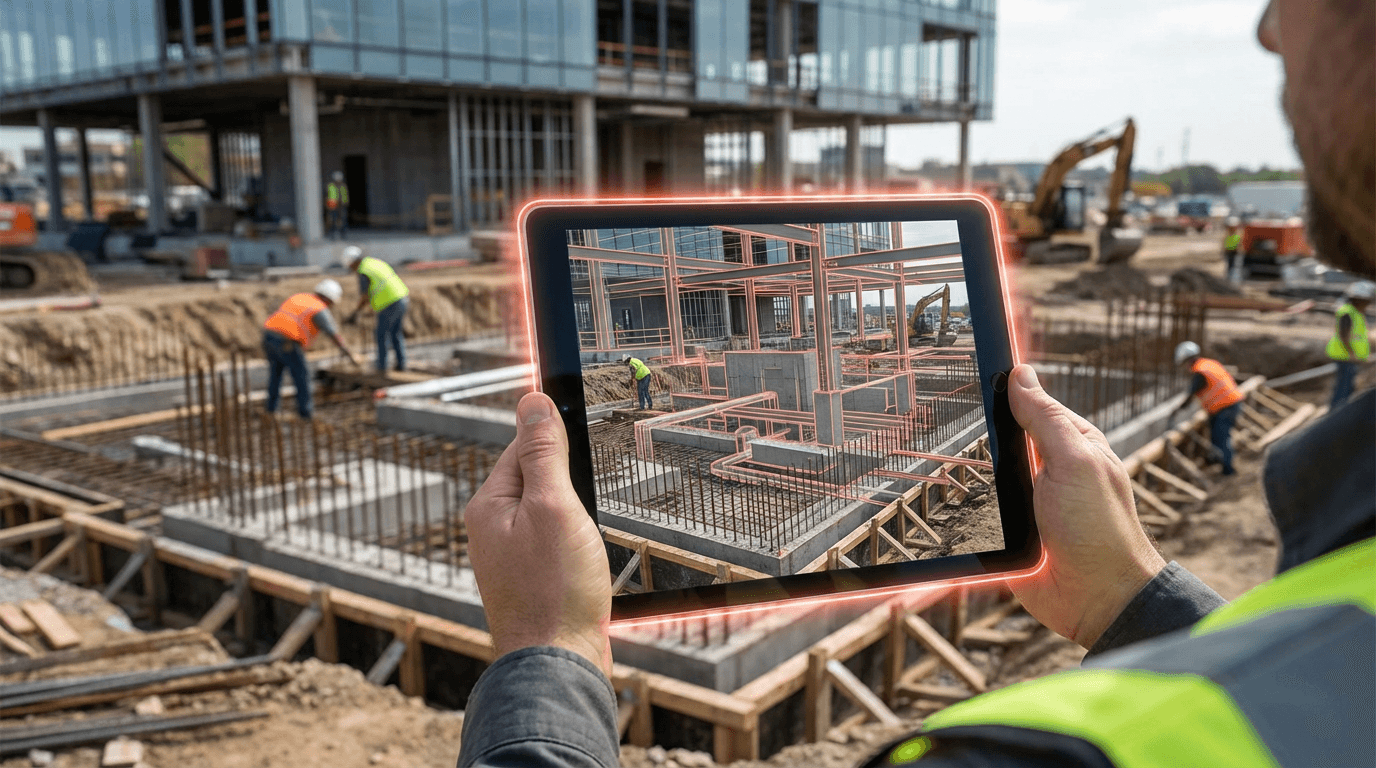
AR Site Visualization
Augmented Reality Site Visualization represents a convergence of Building Information Modeling (BIM) and AR display technology, fundamentally transforming how construction professionals interact with design data in the field. The technology works by precisely aligning three-dimensional digital models—containing detailed information about structural elements, mechanical systems, electrical routing, and plumbing networks—with the physical construction environment through a combination of GPS positioning, visual markers, and spatial mapping sensors. Workers equipped with AR headsets or tablet devices can view these digital overlays in real-time, seeing exactly where components should be installed, how systems interconnect behind walls and floors, and whether the as-built conditions match the original design intent. The system continuously updates its spatial understanding as users move through the site, maintaining accurate registration between the virtual and physical worlds even in dynamic construction environments where conditions change daily.
The construction industry has long struggled with the gap between design documentation and field execution, a disconnect that frequently results in costly rework, schedule delays, and coordination failures among trades. Traditional methods require workers to constantly reference two-dimensional drawings, mentally translating them into three-dimensional reality while accounting for complex spatial relationships and sequencing constraints. AR Site Visualization addresses these challenges by bringing design information directly into the worker's field of view, eliminating the cognitive burden of interpretation and reducing errors caused by misreading plans or misunderstanding spatial relationships. This capability proves particularly valuable when dealing with congested mechanical, electrical, and plumbing systems where coordination between trades is critical, or when working with prefabricated components that must align precisely with existing conditions. The technology also enables earlier detection of design conflicts and constructability issues, allowing teams to resolve problems before materials are purchased or installation begins, thereby reducing waste and preventing expensive remediation work.
Early deployments of AR visualization systems have demonstrated measurable improvements in installation accuracy and productivity across various construction contexts, from commercial building fit-outs to infrastructure projects. General contractors are increasingly incorporating this technology into quality control workflows, using it to verify that installed systems match approved shop drawings and to document as-built conditions for facility management handover. The approach also supports more effective communication between project stakeholders, as architects, engineers, and subcontractors can literally see the same information in the same spatial context, reducing misunderstandings and facilitating collaborative problem-solving on site. As the construction industry continues its digital transformation and as pressure mounts to improve productivity and reduce waste, AR Site Visualization is emerging as a practical bridge between the increasingly sophisticated digital models created during design and the physical reality of construction execution. The technology aligns with broader industry movements toward lean construction practices, integrated project delivery, and data-driven decision-making, positioning it as an essential tool for contractors seeking competitive advantage in an industry where margins are thin and the cost of errors is high.
Related Organizations

Creators of 'The Atom', an engineering-grade AR headset designed specifically for construction accuracy.

Software platform enabling construction teams to visualize BIM models on the job site using augmented reality on mobile devices.

Develops Tekla Structures, a leading BIM software for structural engineering and steel detailing, along with hardware for connecting BIM to the field.

AR software for construction, acquired by Unity, enabling BIM overlay on tablets and HoloLens.
Spectar
United States · Startup
Provides 1:1 scale BIM overlays for the jobsite, specifically targeting specialty contractors like drywall and mechanical.

Software for HoloLens that aligns BIM models to the construction site for QA/QC and installation.


Provides an AR platform that visualizes GIS, BIM, and laser scan data on-site for utilities and municipalities.


AR headset manufacturer utilizing dynamic dimming and eye-tracking for optimized rendering.
Supporting Evidence
Research this in Signals
Signals turns a topic into a sourced research record you can inspect and rerun. Your first scan is free, and this one starts with AR Site Visualization already loaded, so edit it or scan as is.