Computer Vision Progress & Quality Tracking
Construction projects have long struggled with the challenge of accurately tracking progress and maintaining quality standards across vast, dynamic job sites. Traditional methods rely heavily on manual inspections, subjective assessments, and paper-based documentation—processes that are time-consuming, prone to human error, and often lead to disputes over payment and completion milestones. The fundamental problem is one of visibility and verification: contractors need to prove work has been completed to specification, while owners and general contractors require reliable evidence before releasing payments. This information asymmetry, combined with the sheer scale and complexity of modern construction sites, creates friction that delays projects and inflates costs. Computer vision systems designed specifically for construction progress tracking and quality verification address these challenges by transforming ordinary site imagery into quantifiable, objective data about the state of work in place.
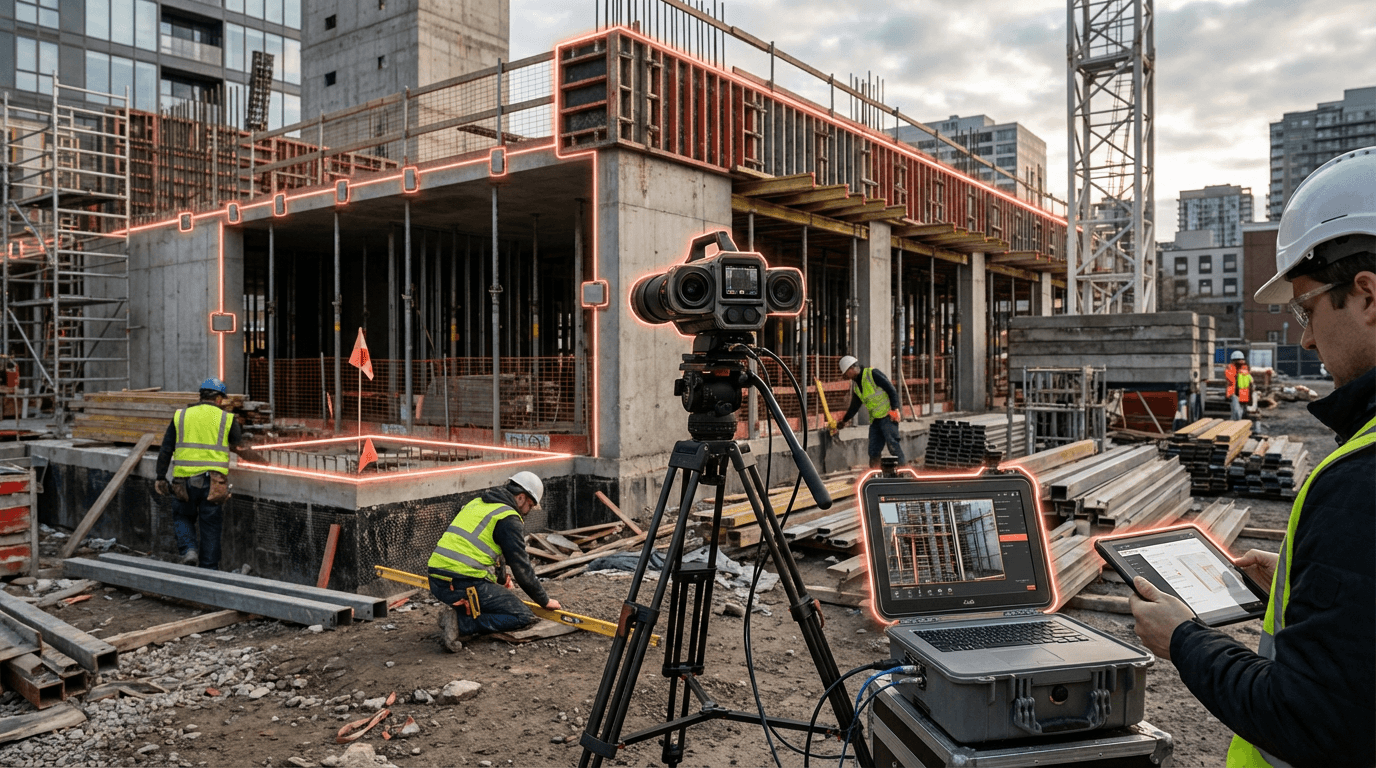
These systems leverage advances in deep learning and image recognition to analyse photographs and video captured from multiple sources—smartphones carried by field personnel, 360-degree cameras mounted at fixed positions, or drones conducting aerial surveys. The underlying computer vision models are trained on vast datasets of construction imagery, learning to recognise specific building components, materials, and installation patterns. When processing new images, these algorithms can automatically identify what work has been completed, calculate the percentage of installation for specific systems like drywall or MEP components, detect deviations from design specifications, and flag potential quality issues such as misaligned fixtures or missing safety equipment. By comparing sequential images over time, the systems generate objective progress curves that show exactly how much work has been accomplished during specific periods. When integrated with project schedules and payment applications, this technology creates an auditable trail of timestamped visual evidence that substantiates contractor claims and reduces the disputes that typically arise during billing cycles.
Early deployments of construction-focused computer vision systems have demonstrated significant value in reducing the administrative burden of progress verification while improving quality outcomes. General contractors on large commercial projects report that automated progress tracking reduces the time spent on manual inspections by substantial margins, allowing project managers to focus on problem-solving rather than documentation. The technology proves particularly valuable for tracking repetitive installations across multiple floors or units, where visual AI can quickly assess completion rates that would take human inspectors hours to verify. Beyond progress quantification, defect detection capabilities help identify issues earlier in the construction process, when remediation is less costly and disruptive. As the construction industry continues its gradual digital transformation, computer vision for progress and quality tracking represents a practical application of artificial intelligence that addresses real pain points—offering a path toward more transparent, efficient, and dispute-free project delivery while building the foundation for increasingly automated construction management systems.
Related Organizations

Uses hardhat-mounted cameras and AI to track construction progress against the digital twin.

AI-powered platform that maps 360° video to floor plans for automated construction documentation.

A construction productivity platform using visual data and AI to track project progress and identify anomalies.


Visual command center for construction that overlays reality capture on BIM and schedule.

Specializes in AI analytics for large-scale infrastructure and civil engineering projects using drone data.

3D AI analytics platform that automates construction progress reporting and defect detection from LiDAR/images.


Cloud software platform for commercial drones, enabling aerial mapping and 3D modeling of construction sites.

Develops photogrammetry software to convert drone images into 3D models and maps.

A construction tech company that turns cranes into smart data collectors.

Provider of construction camera technology and services, increasingly integrating AI analytics.
Supporting Evidence
Research this in Signals
Signals turns a topic into a sourced research record you can inspect and rerun. Your first scan is free, and this one starts with Computer Vision Progress & Quality Tracking already loaded, so edit it or scan as is.