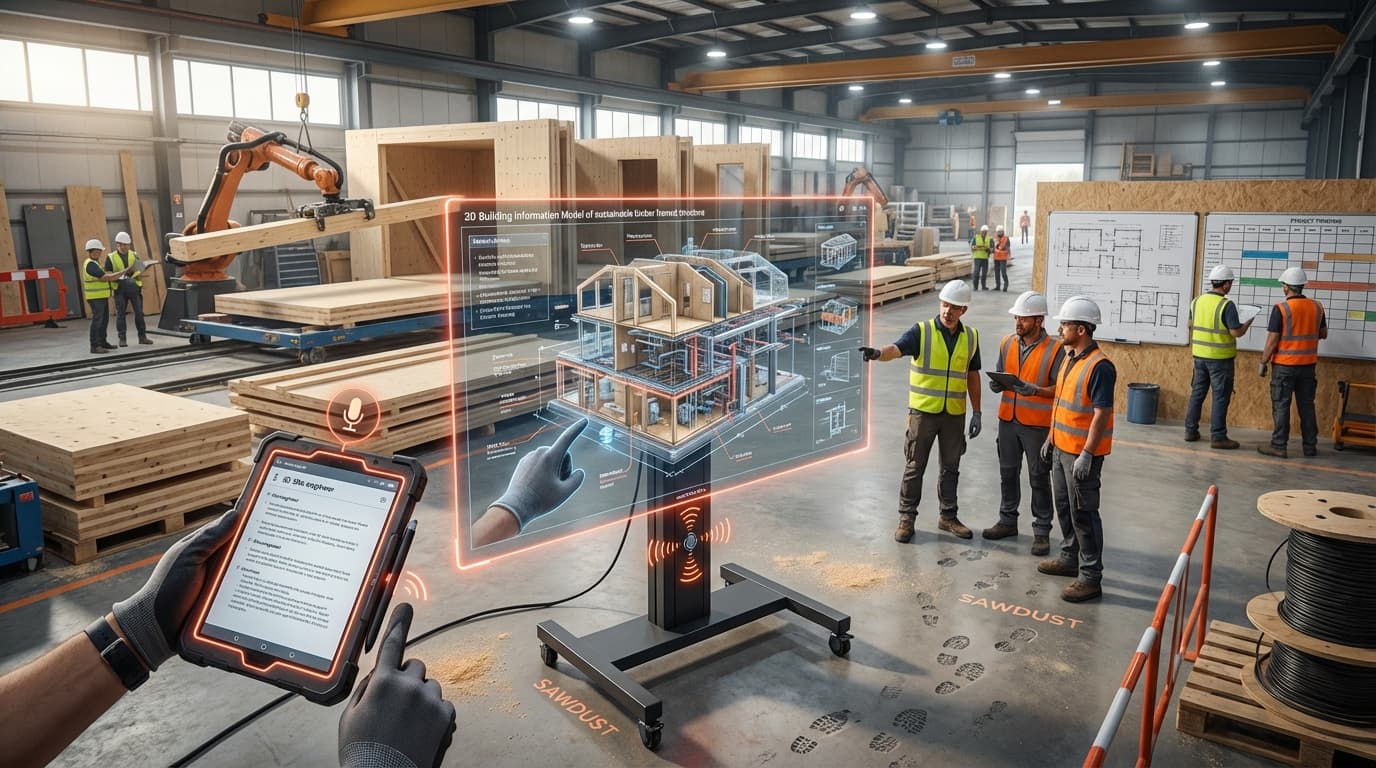
Natural Language to BIM (Multimodal Generative AI)
Natural Language to BIM represents a significant advancement in how building information is created and manipulated, leveraging multimodal generative artificial intelligence to transform conversational inputs and rough sketches into precise three-dimensional building models. At its technical core, this technology combines large language models trained on architectural terminology with computer vision systems capable of interpreting hand-drawn diagrams, photographs, and verbal descriptions. The system processes these diverse inputs—whether typed specifications, voice commands, or sketched floor plans—and translates them into parametric BIM objects complete with geometric properties, material specifications, and relational data. Unlike traditional CAD workflows that require specialized software proficiency and understanding of complex modeling hierarchies, these AI-driven tools can interpret instructions like "create a curtain wall system with horizontal mullions every four feet" or rough napkin sketches of spatial layouts, automatically generating industry-standard BIM families compatible with platforms such as Revit or ArchiCAD. The underlying neural networks have been trained on vast repositories of architectural drawings, building codes, and construction documentation, enabling them to infer design intent from incomplete or ambiguous descriptions.
The construction and architecture industries have long struggled with a fundamental communication gap between those who envision projects and those who model them digitally. Architects spend considerable time translating conceptual ideas into detailed digital representations, while clients and field personnel often lack the technical expertise to directly contribute to BIM models despite possessing valuable spatial insights. This technology addresses these friction points by democratizing access to the modeling process, allowing project stakeholders across skill levels to participate in design development. Early implementations suggest that design teams can explore significantly more conceptual variations in compressed timeframes, as the barrier to testing spatial configurations drops from hours of manual modeling to minutes of conversational iteration. The technology also shows promise in bridging the gap between field conditions and office models, enabling site supervisors to verbally describe as-built conditions or necessary modifications that can be immediately reflected in the central BIM coordination model. However, the outputs still require professional review, as generative systems may produce geometries that violate building codes, structural principles, or constructability constraints that aren't fully encoded in their training data.
Current adoption remains concentrated in the conceptual design phase, where several architecture firms are piloting these tools to accelerate early-stage massing studies and spatial programming exercises. The technology is particularly valuable in client presentations, where stakeholders can request real-time modifications—"make the lobby taller" or "add more natural light to the eastern facade"—and see immediate visual feedback without waiting for a modeler to implement changes manually. Research initiatives are expanding the technology's capabilities to include compliance checking, where the AI cross-references generated geometries against accessibility standards, energy codes, and zoning regulations, flagging potential violations before they propagate through the design process. As the construction industry continues its digital transformation and grapples with persistent labor shortages in technical roles, Natural Language to BIM represents part of a broader trend toward AI-augmented design workflows that preserve human creativity and judgment while automating routine translation tasks. The trajectory suggests these tools will evolve from novelty assistants into standard components of integrated design environments, fundamentally reshaping how building information moves from concept to construction documentation.
Related Organizations

Owner of the Arnold renderer, which integrates AI denoising to optimize high-end VFX workflows for film and TV.

A cloud platform for generating building designs using open standards and community-contributed generative functions.


Generative design platform for architects using AI to generate floor plans from constraints.

A tool that uses algorithms to generate floor plans and optimize building footprints within Revit/Rhino.

Developing foundation models for robotics (Project GR00T) and vision-language models like VILA.

An AI-driven construction planning platform that automates the creation of construction documents.



Provides real-time generative design software for building feasibility, solving site plans for mixed-use, industrial, and residential developments instantly.
Supporting Evidence
Research this in Signals
Signals turns a topic into a sourced research record you can inspect and rerun. Your first scan is free, and this one starts with Natural Language to BIM (Multimodal Generative AI) already loaded, so edit it or scan as is.