Contract/RFI/Submittal Copilots (LLMs)
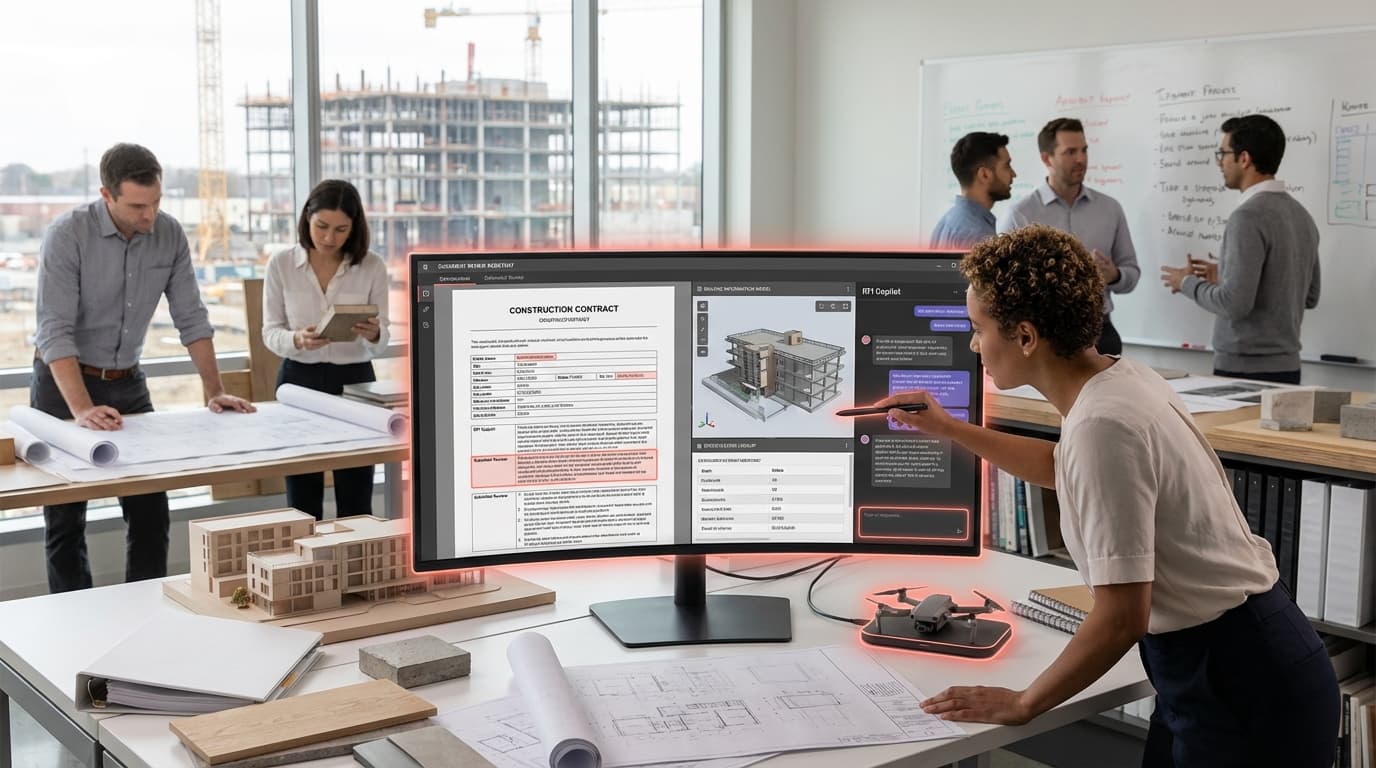
Construction projects generate an overwhelming volume of documentation—contracts, specifications, requests for information (RFIs), submittals, change orders, and meeting minutes—that must be meticulously reviewed, cross-referenced, and responded to within tight deadlines. This document-intensive workflow creates significant administrative burden for project managers, engineers, and contractors, often delaying critical decisions and increasing the risk of costly errors or omissions. Traditional document management relies heavily on manual search through hundreds or thousands of pages to locate relevant clauses, verify compliance with specifications, or draft responses to RFIs. Large language models (LLMs) trained on construction terminology and contract language offer a fundamentally different approach: they can parse natural language queries, retrieve relevant sections from vast document repositories, and generate draft responses or summaries in seconds rather than hours. These copilot systems typically combine retrieval-augmented generation—where the model searches a project-specific knowledge base before formulating answers—with fine-tuning on construction industry documents to improve accuracy and reduce generic or irrelevant outputs.
The core value proposition lies in accelerating routine but time-consuming tasks that currently consume significant portions of a project team's day. When a subcontractor submits an RFI asking whether a particular material substitution is permissible, a copilot can instantly locate the relevant specification sections, cross-reference them with contract clauses governing substitutions, and draft a preliminary response for human review. Similarly, when evaluating a change order request, these systems can pull together scattered references to scope, schedule impacts, and cost provisions, helping teams build more complete and defensible rationales. This capability addresses a persistent pain point in construction: the gap between the speed at which questions arise on-site and the time required to thoroughly research answers using traditional methods. By reducing document review time, LLM copilots enable faster decision-making, fewer delays, and more consistent interpretation of contractual obligations across large project teams.
Early deployments in construction firms indicate promising efficiency gains, though the technology remains in a cautious adoption phase due to the high stakes of contractual interpretation. Industry practitioners emphasize that these tools must be implemented with robust safeguards: comprehensive audit trails that show which source documents informed each response, version control to track how answers evolve, and mandatory human review before any AI-generated content becomes part of the official project record. The risk of hallucination—where the model confidently generates plausible-sounding but factually incorrect information—poses particular concern in construction, where a misinterpreted contract clause or incorrectly cited specification can trigger disputes, delays, or financial liability. As a result, successful implementations treat LLM copilots as assistive tools that augment rather than replace human expertise, combining the speed and pattern-recognition capabilities of AI with the judgment and accountability that experienced construction professionals bring. Looking forward, as these systems mature and firms develop clearer governance frameworks, contract and submittal copilots are likely to become standard components of construction management platforms, fundamentally reshaping how teams interact with project documentation while maintaining the rigorous verification standards the industry demands.
Related Organizations
AI platform specifically for reviewing construction contracts and identifying risks.

AI platform that structures unstructured construction data to automate workflows and answer field questions.

AI platform that connects project data to answer questions and automate workflows.

Owner of the Arnold renderer, which integrates AI denoising to optimize high-end VFX workflows for film and TV.

AI tool for civil engineers to search and extract data from geotechnical reports and construction documents.

A construction management software platform that integrates BIM models for field teams to view and collaborate on mobile devices.
UpCodes
United States · Startup
Provides a platform that helps architects and engineers navigate building codes, using AI to identify compliance errors.

AI platform for architects and designers to automate specification writing and review.

Financial automation platform for construction that uses AI to process invoices and financial documents.

Conversational AI bots for construction field teams to automate attendance, safety, and daily logs.
AI estimation software that automates the takeoff process from plans and documents.
Supporting Evidence
Research this in Signals
Signals turns a topic into a sourced research record you can inspect and rerun. Your first scan is free, and this one starts with Contract/RFI/Submittal Copilots (LLMs) already loaded, so edit it or scan as is.