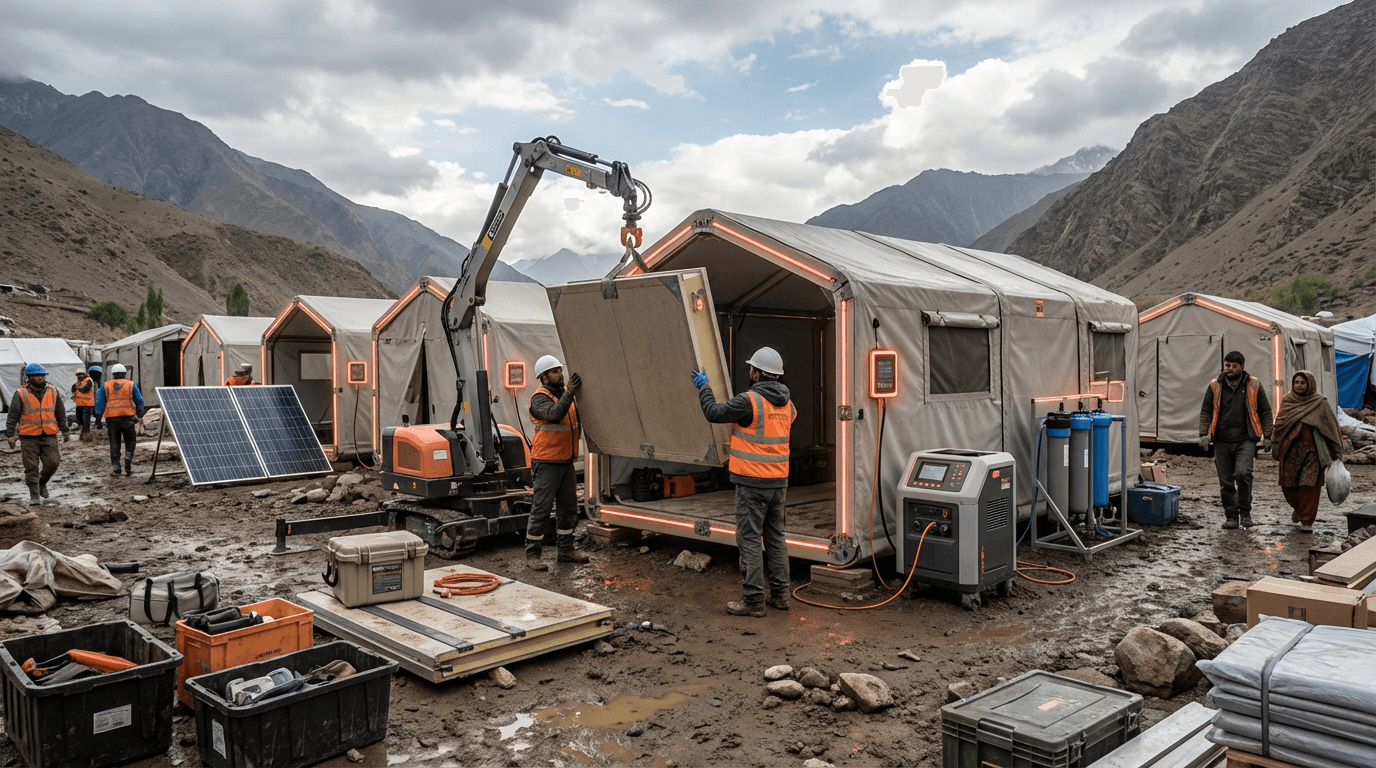
Disaster-Resilient Rapid Deployment Structures
Disaster-resilient rapid deployment structures represent a critical evolution in emergency response infrastructure, combining advances in materials science, modular construction, and logistics to address the urgent need for immediate shelter and essential services following natural disasters, conflicts, or mass displacement events. These systems typically employ lightweight, durable materials such as high-strength polymers, composite panels, and engineered textiles that can withstand extreme weather conditions while remaining portable enough for air transport to remote locations. The fundamental technical principle underlying these structures is modularity—components are designed to be flat-packed for efficient shipping, then assembled on-site with minimal tools and expertise, often by the affected communities themselves. This approach dramatically reduces deployment time from weeks to hours or days, while maintaining structural integrity and basic habitability standards including weather resistance, thermal insulation, and adequate ventilation.
The construction industry has long grappled with the challenge of providing safe, dignified shelter in crisis situations where traditional building methods are impractical or impossible. Conventional emergency responses often rely on tents or improvised shelters that offer inadequate protection and deteriorate rapidly, leaving vulnerable populations exposed for extended periods. Rapid deployment structures address these limitations by providing engineered solutions that bridge the gap between temporary relief and permanent reconstruction. These systems solve critical problems around speed of deployment, durability in harsh conditions, and scalability across diverse geographic and climatic contexts. Beyond immediate humanitarian response, this technology is enabling new approaches to affordable housing in regions facing chronic vulnerability to climate-related disasters, where the ability to quickly rebuild or relocate communities becomes increasingly essential. The modular design principles also support adaptive reuse, allowing structures to be reconfigured for different purposes—from emergency medical facilities to schools or community centers—as recovery progresses.
Current deployments span humanitarian organizations, military operations, and increasingly, municipal disaster preparedness programs in high-risk regions. Field experience has demonstrated that well-designed rapid deployment structures can remain serviceable for several years rather than months, challenging the traditional distinction between temporary and permanent construction. Research in this domain continues to explore integration with renewable energy systems, water purification technologies, and digital connectivity to create more comprehensive emergency infrastructure packages. As climate change intensifies the frequency and severity of displacement events, these systems are evolving from purely reactive tools into proactive elements of urban resilience strategies. Forward-thinking municipalities in flood-prone, earthquake-vulnerable, and coastal regions are incorporating rapid deployment capabilities into their emergency response frameworks, while the construction industry is adapting lessons from these systems—particularly around prefabrication efficiency and material optimization—to inform broader affordable housing initiatives in both developing and developed contexts.
Related Organizations

Develops and deploys flat-pack, modular temporary housing for refugees in partnership with the IKEA Foundation and UNHCR.

International disaster relief charity that provides emergency shelter and other aid items to families around the world.

UNHCR
Switzerland · Government Agency
The UN Refugee Agency, managing international displacement and housing camps globally and in Brazil (Operação Acolhida).

manufactures a flexible, concrete-impregnated fabric that hardens on hydration to form a thin, durable, water-proof and fire-resistant concrete layer.

A social purpose corporation designing rapid-response shelter villages for people displaced by disaster or homelessness.

Developer of flat-packed, modular dwellings that can be assembled without tools.

Construction technology company using 3D printing robotics, software, and advanced materials.

Architectural firm famous for using paper tubes and recycled materials for disaster relief housing.

An architecture and design studio specializing in co-living and modular spaces.

Global leader in innovative and sustainable building solutions.
Supporting Evidence
Research this in Signals
Signals turns a topic into a sourced research record you can inspect and rerun. Your first scan is free, and this one starts with Disaster-Resilient Rapid Deployment Structures already loaded, so edit it or scan as is.