Programmable Matter & 4D Printing
Programmable matter and 4D printing represent an evolution in additive manufacturing where materials are designed to transform their shape, properties, or functionality after fabrication in response to environmental stimuli such as heat, moisture, light, or mechanical stress. Unlike traditional 3D printing, which produces static objects, 4D printing incorporates smart materials—such as shape-memory polymers, hydrogels, or composite materials with embedded actuators—that can undergo predetermined transformations when exposed to specific triggers. The process works by carefully programming the material's internal structure during fabrication, encoding instructions for how different regions should respond to external conditions. This is achieved through precise control of material composition, fiber orientation, and geometric patterning at the microscale, allowing designers to create objects that can fold, expand, contract, or change stiffness without requiring traditional mechanical components or electronic control systems.
In the construction and infrastructure sectors, this technology addresses fundamental challenges related to adaptability, maintenance, and resource efficiency in the built environment. Traditional building systems rely on complex mechanical actuators, motors, and electronic controls to respond to changing conditions, which introduce points of failure, require ongoing maintenance, and consume energy. Programmable matter eliminates much of this complexity by embedding responsive behavior directly into materials themselves. This capability is particularly valuable for infrastructure that must operate in harsh or inaccessible environments where maintenance is difficult or costly. The technology also enables new approaches to construction logistics, as components could be fabricated in compact forms for easier transportation and then self-assemble or expand on-site when exposed to ambient conditions. Industry analysts note that this could significantly reduce construction costs and timelines while enabling structures that continuously optimize their performance in response to environmental conditions.
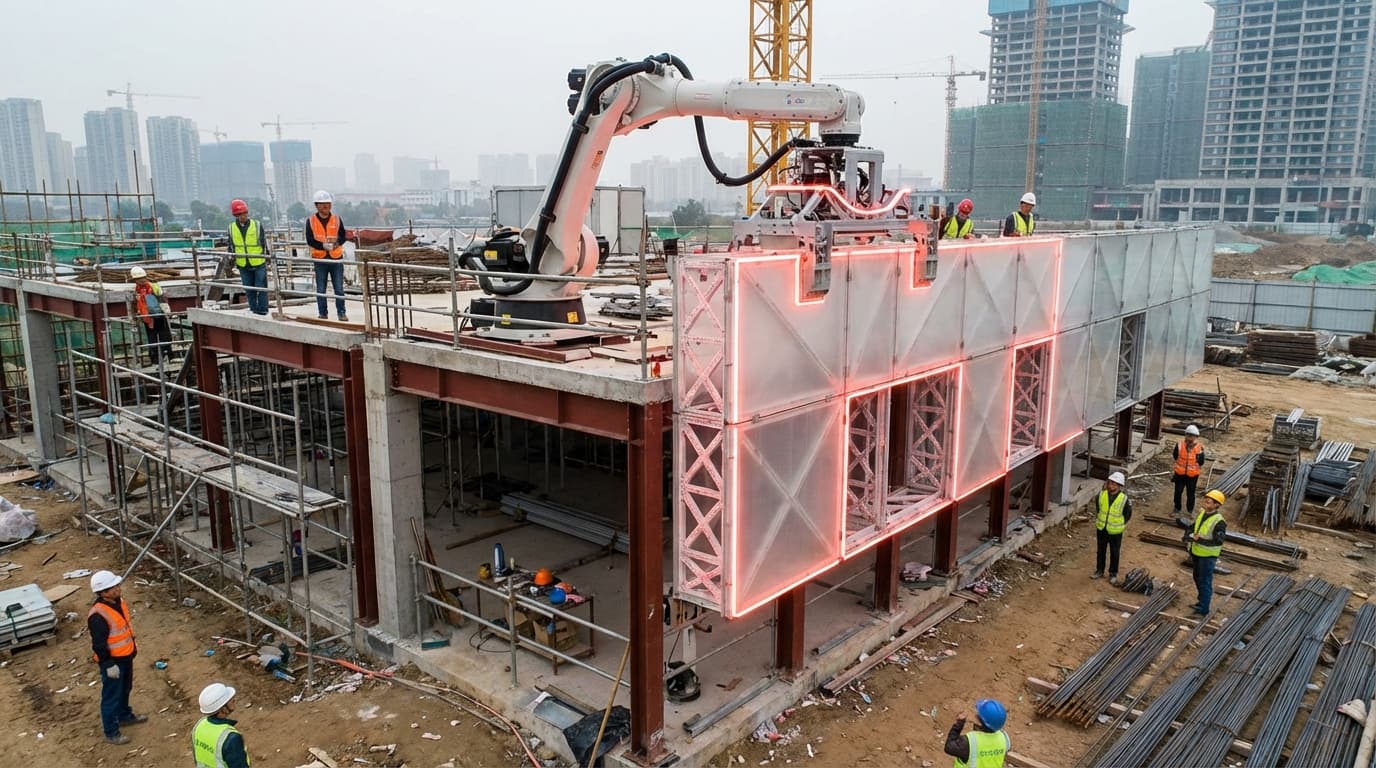
Early deployments indicate promising applications across multiple scales of construction. Research prototypes have demonstrated water pipes that automatically adjust their diameter in response to flow rates, building facades with panels that open or close based on temperature and sunlight exposure, and foundation systems that adapt to soil moisture changes to prevent settling. Some architectural firms are exploring programmable matter for deployable emergency shelters that can be shipped flat and self-assemble when exposed to water or heat. The technology also shows potential for infrastructure in extreme environments, such as structures that could self-repair minor damage or adjust their configuration in response to seismic activity. As climate change increases the frequency of extreme weather events and the need for resilient infrastructure grows, programmable matter offers a pathway toward buildings and systems that can autonomously adapt to changing conditions. The convergence of this technology with advances in material science and computational design suggests a future where the built environment becomes fundamentally more responsive, efficient, and sustainable, moving beyond static structures toward infrastructure that continuously evolves to meet the needs of its users and environment.
Related Organizations

Research lab at MIT developing programmable materials and 4D printing/knitting technologies.

A premier bio-inspired engineering lab developing soft robotics and adaptive materials.

Conducts advanced research in bioelectronics and the interface between biological systems and electronic circuits.


Owner of the Arnold renderer, which integrates AI denoising to optimize high-end VFX workflows for film and TV.

Home to QuTech and the Hanson Lab, which performed the first loophole-free Bell test using NV centers.

Conducts research on reversible logic synthesis and low-power VLSI design.

Generative design studio creating 'Kinematics' 4D printed structures.

Home to the ARC Centre of Excellence for Electromaterials Science (ACES), focusing on 4D printing.

An MIT spinoff developing a printing technology that prints inside a gel suspension, allowing for gravity-defying soft structures.
Supporting Evidence
Research this in Signals
Signals turns a topic into a sourced research record you can inspect and rerun. Your first scan is free, and this one starts with Programmable Matter & 4D Printing already loaded, so edit it or scan as is.