Net-Zero Building Technologies
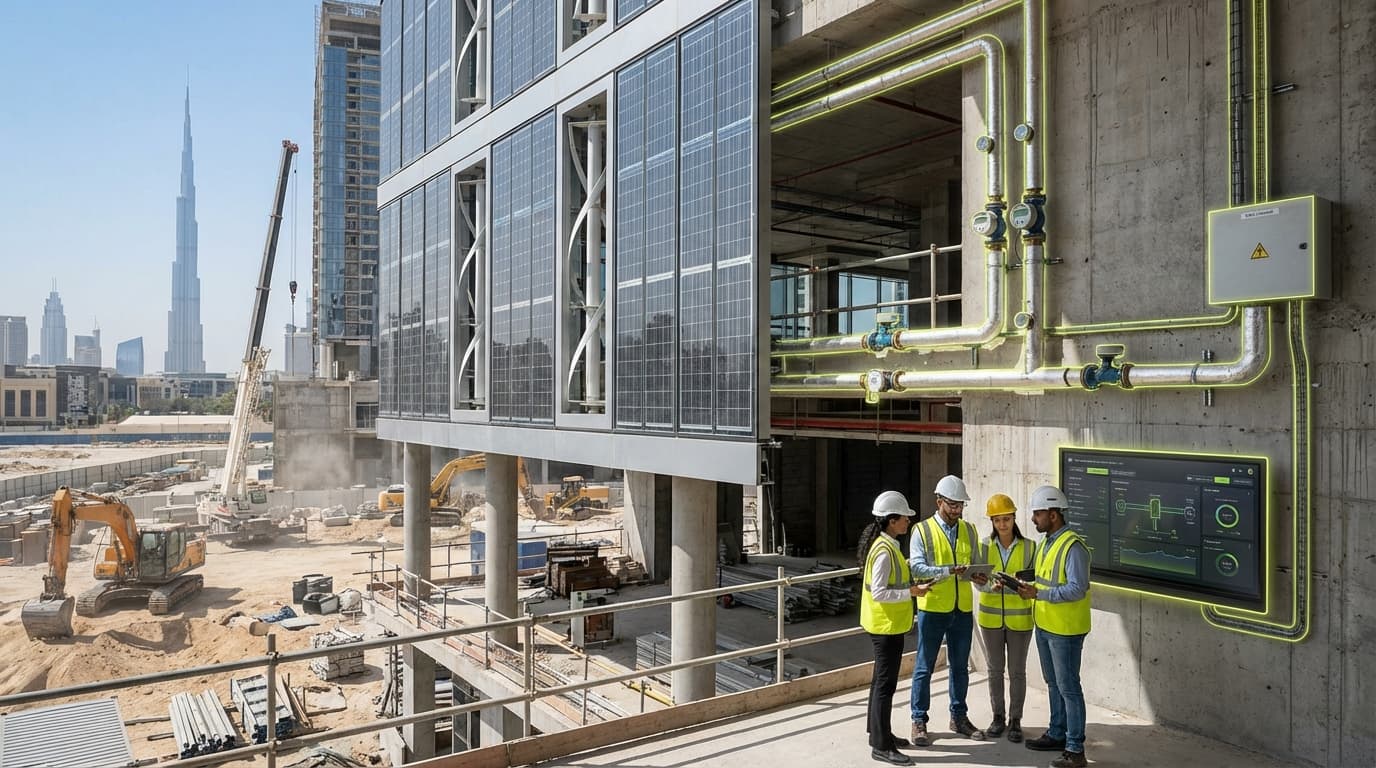
Net-zero building technologies represent a strategic response to one of the Gulf's most pressing urban challenges: reconciling rapid development with climate commitments in a region where cooling demands can account for 60-70% of building energy consumption. The fundamental problem these systems address is the carbon intensity of the built environment in extreme climates, where conventional construction approaches lock in decades of high energy consumption. As GCC nations commit to net-zero targets—UAE by 2050, Saudi Arabia by 2060—the building sector emerges as a critical intervention point. These technologies matter because they demonstrate whether climate-responsive architecture can scale beyond demonstration projects into mainstream development, particularly in contexts where outdoor temperatures regularly exceed 45°C and cooling is not optional but essential to habitability.
The technical approach integrates multiple systems to balance energy demand with on-site generation. Advanced building envelopes employ high-performance insulation, reflective coatings, and dynamic shading to reduce heat gain before it enters conditioned spaces. Solar facades and rooftop photovoltaic arrays generate electricity during peak demand periods, while thermal energy storage systems shift cooling loads to off-peak hours when grid strain is lower. Intelligent building management systems continuously optimise HVAC performance, lighting, and plug loads based on occupancy patterns and weather forecasts. Early regional deployments like Masdar City in Abu Dhabi established proof-of-concept, revealing both technical feasibility and economic constraints. More recent projects such as The Sustainable City in Dubai demonstrate evolution toward market-viable models, incorporating lessons about material selection, maintenance requirements, and user behavior. Policy frameworks now reinforce these technical advances—Saudi Arabia's building code revisions mandate energy performance standards, while UAE utility structures increasingly reward demand flexibility and self-generation.
The implications extend beyond individual buildings to urban energy systems and development economics. Successful net-zero projects establish performance benchmarks that inform building codes, potentially reshaping construction standards across the region. They also test whether distributed generation can reduce peak grid demand, a critical concern as electrification expands. However, significant barriers remain: upfront cost premiums, supply chain constraints for specialized materials, and the need for skilled commissioning and maintenance. Monitoring should focus on post-occupancy performance data, which often reveals gaps between design intent and operational reality, particularly regarding occupant behavior and system degradation in harsh climates. Watch for policy thresholds—mandatory net-zero requirements for new construction, utility rate structures that improve project economics, and whether demonstration successes translate into standardized, cost-competitive building practices. The trajectory of these technologies will indicate whether the Gulf's climate ambitions can align with its development pace.
Related Organizations

A global leader in renewable energy and sustainable urban development (Masdar City).

The National Central Cooling Company, providing district cooling services that drastically reduce energy consumption compared to conventional AC.

Red Sea Global
Saudi Arabia · Company
Developer of The Red Sea and Amaala projects, implementing high-standard modular housing for construction staff.
Emirates Central Cooling Systems Corporation, the world's largest district cooling services provider.
Saint-Gobain
France · Company
A multinational corporation producing high-performance materials (glass, insulation) essential for building envelopes in ZEBs.

A sustainability pioneer in the Middle East, focusing on waste management, recycling, and circular solutions.
Manufacturer of high-performance insulation and building envelope solutions.
Specialist consultancy in sustainability, energy modeling, and façade engineering optimized for the Middle East climate.

Manufactures smart glass that automatically tints to control heat and glare.

Global leader in building-integrated photovoltaic (BIPV) glass, offering transparent and colored photovoltaic glass for facades.