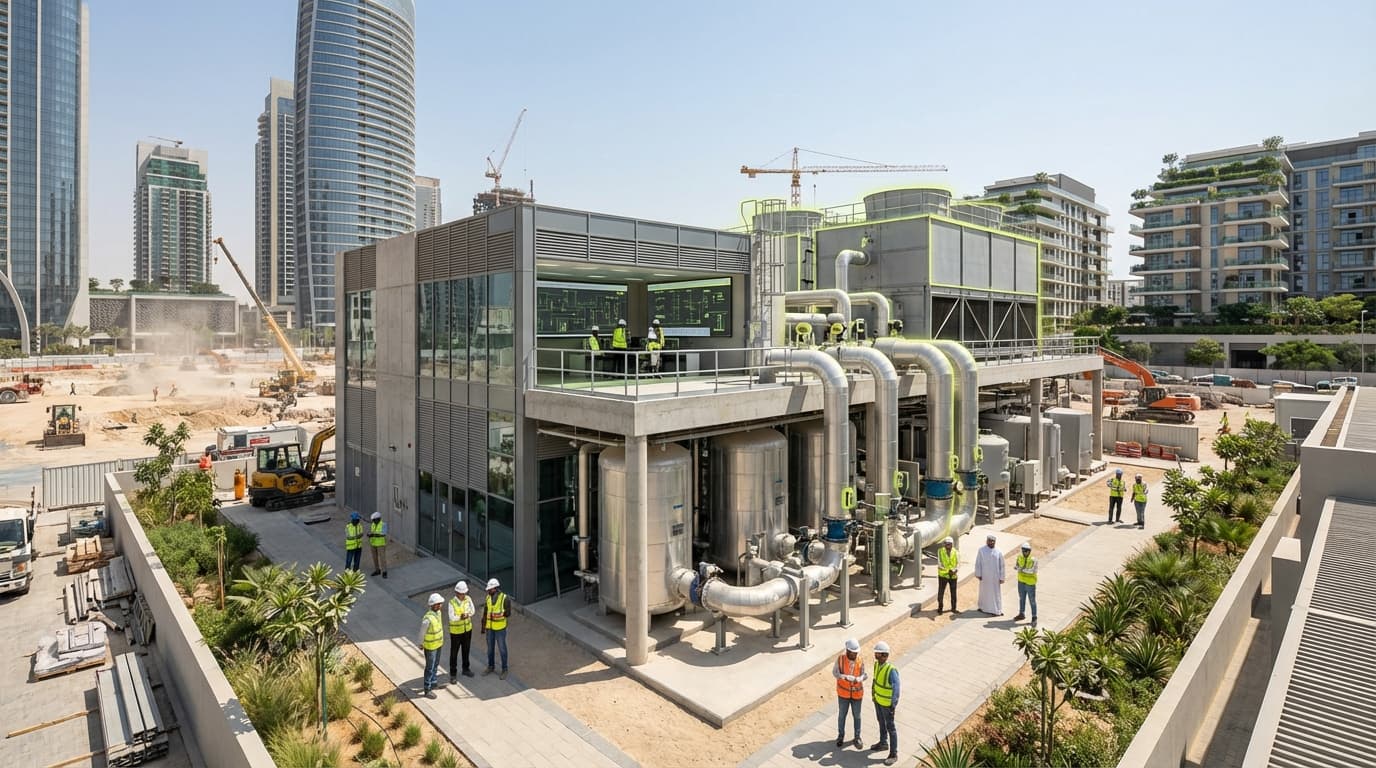
District Cooling Systems
District cooling represents a fundamental infrastructure transition in how cities manage thermal comfort at scale. Rather than equipping each building with its own chillers and cooling towers, this approach establishes centralized plants that generate chilled water and distribute it through underground pipe networks to entire neighborhoods or developments. The signal matters because it addresses a critical vulnerability in Gulf urbanization: the unsustainable energy burden of cooling. In GCC nations, air conditioning can consume 60-70% of peak electricity demand during summer months, straining grids, driving carbon emissions, and creating economic inefficiencies. As the region pursues ambitious net-zero targets while continuing rapid urban expansion, the question is whether cooling infrastructure can shift from fragmented, building-by-building systems to coordinated district-scale networks that fundamentally alter energy economics and spatial planning.
The pattern is already visible across major GCC developments. Dubai's district cooling capacity has grown substantially over the past decade, with operators like Empower and Tabreed serving high-density zones including Business Bay, Dubai Marina, and the Palm Jumeirah. Qatar's Lusail City was designed from inception with district cooling as core infrastructure, serving residential towers, commercial districts, and sports facilities including World Cup stadiums. Saudi Arabia's NEOM and Red Sea projects have embedded district cooling into master plans, treating it as essential as water or power networks. The drivers are both economic and regulatory: developers report 40-50% reductions in operational energy costs, while building codes increasingly favor or mandate district systems for large-scale projects. Early deployments indicate that the technology also enables higher plot ratios by eliminating rooftop mechanical equipment, freeing valuable space in land-constrained developments. However, adoption remains concentrated in greenfield mega-projects rather than retrofitting existing urban fabric, where coordination challenges and capital requirements create barriers.
The implications extend beyond energy savings to reshape urban development models. If district cooling becomes standard infrastructure—comparable to district heating in Nordic cities—it could enable denser, more walkable urban forms by reducing per-building mechanical footprints and noise. It may also shift risk and investment patterns, with infrastructure operators rather than individual building owners managing long-term cooling assets. Key monitoring points include whether smaller-scale developments begin adopting shared cooling systems, whether retrofitting older districts becomes economically viable as energy costs rise, and whether regulatory frameworks evolve to treat cooling as a utility service with mandated connection standards. The technology's trajectory will likely depend on whether GCC governments treat district cooling as optional efficiency measure or essential infrastructure comparable to electricity grids—a distinction that determines both investment flows and urban planning paradigms for the next generation of Gulf cities.
Related Organizations

Emirates Central Cooling Systems Corporation, the world's largest district cooling services provider.

The National Central Cooling Company, providing district cooling services that drastically reduce energy consumption compared to conventional AC.

District cooling service provider wholly owned by Dubai Investments.

Multinational utility company heavily investing in decentralized energy and district cooling/heating networks.

Johnson Controls
United States · Company
Multinational conglomerate producing HVAC and building control systems, notably the OpenBlue digital platform.

Global climate innovator and manufacturer of large-scale chillers.

A global leader in water, waste, and energy management with dedicated facilities for e-waste and battery recycling.

Industry association promoting energy efficiency and district energy technologies.