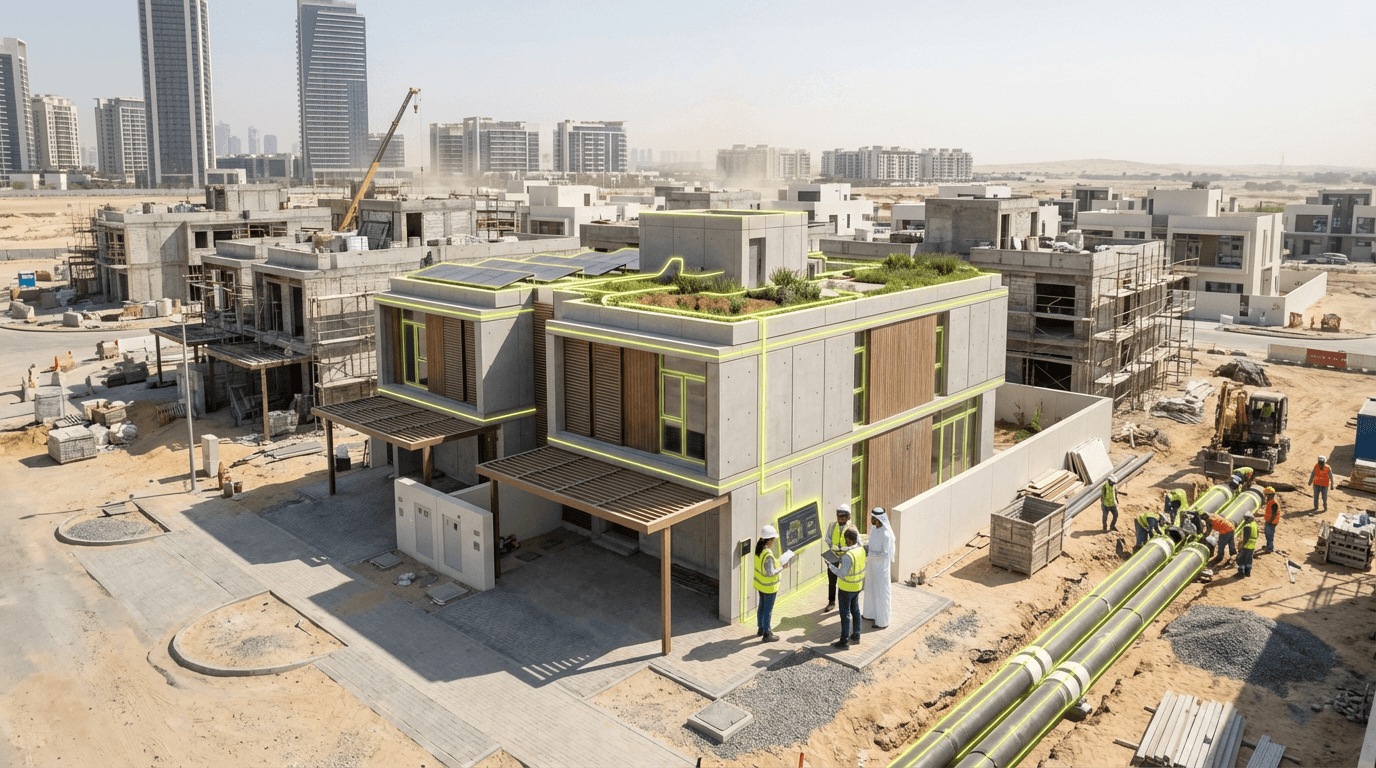
Climate-Resilient Housing Design
Climate-resilient housing design addresses a fundamental challenge facing Gulf nations: how to maintain habitability and comfort in one of the world's harshest climates while reducing dependence on energy-intensive mechanical cooling systems. Traditional Gulf architecture evolved sophisticated passive strategies—wind towers, courtyard layouts, thick walls—that modern construction largely abandoned in favor of sealed, air-conditioned environments. As energy costs rise and climate pressures intensify, this signal reflects a strategic return to climate-responsive principles, now enhanced by contemporary materials science, computational modeling, and building performance analytics. The core problem is not merely technical but systemic: housing stock designed for unlimited cheap energy becomes economically and environmentally unsustainable as temperatures climb and grid demands surge during peak summer months.
The approach integrates multiple interdependent strategies rather than relying on single interventions. Building orientation minimizes direct solar exposure during peak heat hours, while high-performance insulation and reflective roof coatings reduce thermal gain. Natural ventilation systems leverage prevailing winds and thermal buoyancy to move air without mechanical assistance, though effectiveness varies with humidity levels and urban density. Water-efficient fixtures and greywater recycling systems address scarcity constraints, while xeriscaping reduces irrigation demands. Early implementations in projects like Masdar City and The Sustainable City Dubai demonstrate measurable reductions in cooling loads—industry reports suggest 30-40% energy savings compared to conventional designs—though these showcase developments may not fully represent scalability challenges in mass housing. Saudi Arabia's National Housing Company has incorporated climate-responsive guidelines into social housing programs, signaling policy-level recognition. Material innovations include phase-change materials that absorb and release heat, advanced glazing systems, and locally-sourced thermal mass materials adapted to desert conditions.
The implications extend beyond individual building performance to urban-scale energy resilience and housing affordability. Reduced cooling demands lower operating costs for residents and decrease peak electricity loads that strain regional grids. However, monitoring should focus on adoption rates in mid-market and affordable housing segments, where cost pressures often override performance considerations. Cultural acceptance remains variable—some passive strategies conflict with privacy norms or aesthetic preferences shaped by decades of modernist development. The viability threshold depends on whether building codes evolve to mandate climate-responsive features and whether financing mechanisms recognize long-term operational savings. As extreme heat events increase in frequency and duration, the question shifts from whether climate-resilient design is preferable to whether conventional approaches remain viable at all.
Related Organizations

A global leader in renewable energy and sustainable urban development (Masdar City).

Specialist consultancy in sustainability, energy modeling, and façade engineering optimized for the Middle East climate.

Developer of Msheireb Downtown Doha, one of the world's most sustainable and climate-resilient regeneration projects.

United Arab Emirates · Government Agency
Government body managing the 'Estidama' Pearl Rating System, which mandates water and energy efficiency in buildings.

Global architecture firm collaborating with ESA and NASA on lunar habitation concepts involving 3D printing with regolith.

A research university actively developing novel cooling materials, including passive radiative cooling films and energy-efficient building envelopes.

Dubai-based architectural firm known for contextually sensitive designs and adaptive reuse projects.

Architects behind the 'Terra' Sustainability Pavilion, showcasing net-zero water and energy strategies in extreme heat.

Multidisciplinary firm with a strong sustainability division designing resilient infrastructure across the GCC.

Saint-Gobain
France · Company
A multinational corporation producing high-performance materials (glass, insulation) essential for building envelopes in ZEBs.