Heat-Mitigation Building Envelopes (Cool Roofs, Advanced Glazing, PCM)
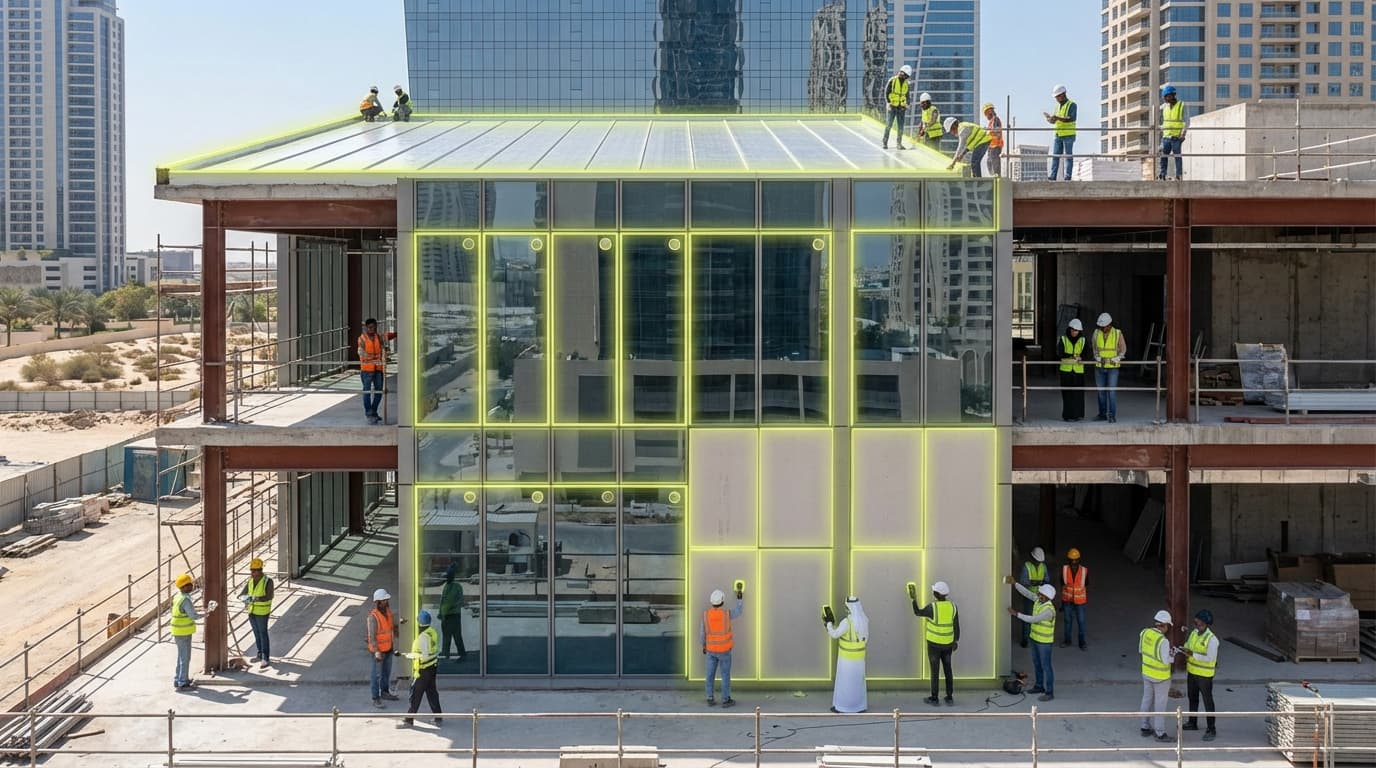
Across the Gulf, cooling accounts for the majority of building energy consumption, often exceeding 60 percent of total demand during peak summer months. Traditional approaches have focused on upgrading mechanical systems, yet the building envelope—the interface between interior and exterior—remains the primary pathway for unwanted heat gain. Heat-mitigation envelope technologies address this challenge by reducing solar absorption and improving thermal resistance through reflective coatings, advanced glazing, external shading, insulated facade assemblies, and phase-change materials that absorb and release thermal energy as they transition between solid and liquid states. This shift from HVAC-centric efficiency to integrated building physics represents a fundamental rethinking of how cities manage thermal loads, particularly in retrofit contexts where replacing entire systems is economically or logistically impractical.
Early adoption patterns suggest that cool roof coatings and spectrally selective glazing are gaining traction in both new construction and retrofit projects, driven by rising electricity costs, stricter energy codes, and growing awareness of embodied carbon. Cool roofs, which use high-albedo materials to reflect solar radiation, can reduce surface temperatures by 20 to 30 degrees Celsius compared to conventional dark surfaces, directly lowering heat transfer into occupied spaces. Advanced glazing systems employ low-emissivity coatings and tinted interlayers to block infrared radiation while maintaining visible light transmission, reducing glare and cooling loads without sacrificing daylighting. Phase-change materials, though still emerging in commercial applications, offer the ability to buffer indoor temperature swings by storing latent heat during the day and releasing it at night, effectively decoupling peak cooling demand from peak solar gain. However, deployment faces practical constraints: retrofit logistics in occupied buildings, facade access challenges in high-rise towers, dust accumulation that degrades reflective performance, and uncertainty around long-term durability under intense UV exposure and high humidity.
The implications extend beyond energy savings to tenant comfort, asset value, and climate resilience. Buildings with effective envelope strategies can maintain habitable conditions longer during power outages, reduce peak demand charges, and lower service fees—critical factors in markets where operating costs influence leasing decisions. For policymakers, envelope performance standards offer a scalable intervention point that complements district cooling networks and renewable energy mandates. Monitoring should focus on adoption rates in existing building stock, performance verification protocols that account for local environmental stressors, and the emergence of integrated retrofit packages that combine envelope upgrades with smart controls and renewable generation. As Gulf cities confront both climate adaptation and decarbonisation goals, the envelope becomes a strategic asset—one that determines whether buildings remain viable or require costly replacement in the decades ahead.
Related Organizations

A research university actively developing novel cooling materials, including passive radiative cooling films and energy-efficient building envelopes.

A global leader in renewable energy and sustainable urban development (Masdar City).

A major manufacturer of high-performance glass with significant operations in Saudi Arabia and UAE, specializing in solar control glazing for hot climates.
A developer of BioPCM (Phase Change Material) mats that can be installed in walls and ceilings to stabilize indoor temperatures and reduce cooling loads.

Develops radiative cooling panels that reject heat into deep space, cooling fluids below ambient temperature without electricity.
Manufacturer of high-performance insulation and building envelope solutions.
Saint-Gobain
France · Company
A multinational corporation producing high-performance materials (glass, insulation) essential for building envelopes in ZEBs.

Manufactures smart glass that automatically tints to control heat and glare.
A leading provider of aluminum building systems (facades, windows) with a strong presence in the Middle East, focusing on thermal break technology.