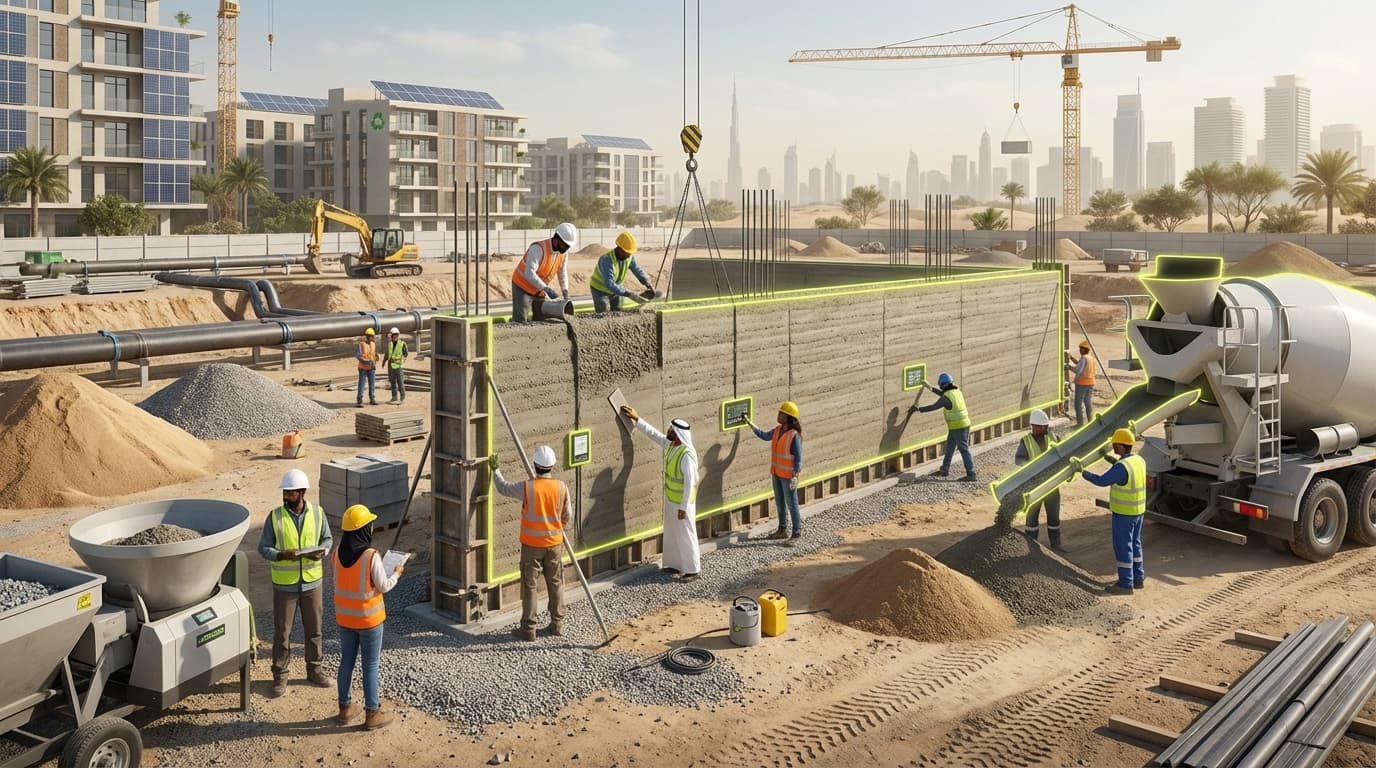
Sustainable Desert Concrete & Local Materials
The Gulf's construction boom confronts a fundamental paradox: surrounded by vast deserts, builders have historically imported sand and aggregates from distant sources because desert sand's spherical grains and fine particle size make it unsuitable for conventional concrete. This reliance on imported materials not only inflates carbon footprints through long-distance shipping but also exposes mega-projects to supply chain disruptions and price volatility. As the region pursues ambitious sustainability commitments alongside unprecedented construction volumes—NEOM alone envisions 380,000 new residents by 2030—this material dependency represents both an environmental liability and a strategic vulnerability. The signal points to an emerging shift in material science that could transform the Gulf's most abundant resources from construction constraints into strategic assets.
Research institutions across UAE and Saudi Arabia are advancing techniques that enable desert sand, recycled construction waste, and desalination brine to function effectively in concrete production. Early approaches include chemical treatments that modify desert sand's surface properties, engineered binders that compensate for particle shape limitations, and hybrid formulations that blend desert sand with recycled aggregates from demolished structures. Pilot projects at facilities linked to major developments suggest these innovations can reduce embodied carbon by 30-40% compared to conventional concrete while maintaining structural performance standards. The integration of desalination brine—previously a disposal challenge—adds another dimension, potentially closing resource loops in water-scarce environments. However, scaling these solutions requires overcoming regulatory inertia, establishing quality assurance protocols for novel material compositions, and building contractor confidence in unfamiliar formulations.
For Gulf nations balancing construction ambitions with decarbonization pledges, this material transition carries significant implications. Successful adoption could fundamentally alter project economics by eliminating aggregate import costs, create new industries around construction waste processing, and position the region as an exporter of desert-adapted building technologies to similar climates globally. The approach also aligns with circular economy frameworks increasingly embedded in national development strategies. Key monitoring points include regulatory approvals for desert-sand concrete in load-bearing applications, procurement requirements in upcoming mega-project phases, and whether material innovations extend beyond concrete to encompass other construction inputs like insulation or cladding. The trajectory suggests a broader pattern: Gulf states leveraging material science to convert environmental constraints into competitive advantages, potentially reshaping construction norms for arid regions worldwide.
Related Organizations

Develops polymer concrete technology that allows the use of inferior local sands (like desert sand) for construction blocks.

A sustainability pioneer in the Middle East, focusing on waste management, recycling, and circular solutions.

Leading UAE research university conducting extensive studies on dune sand concrete and sustainable construction materials.

A research university actively developing novel cooling materials, including passive radiative cooling films and energy-efficient building envelopes.

Major concrete producer in Saudi Arabia developing specialized mixes using local pozzolans and aggregates.


Global leader in innovative and sustainable building solutions.

A specialty chemicals company developing admixtures and systems for self-healing and watertight concrete.

Specializes in additives for construction materials, including solutions for difficult sands and clay-heavy aggregates.