3D Printed Construction
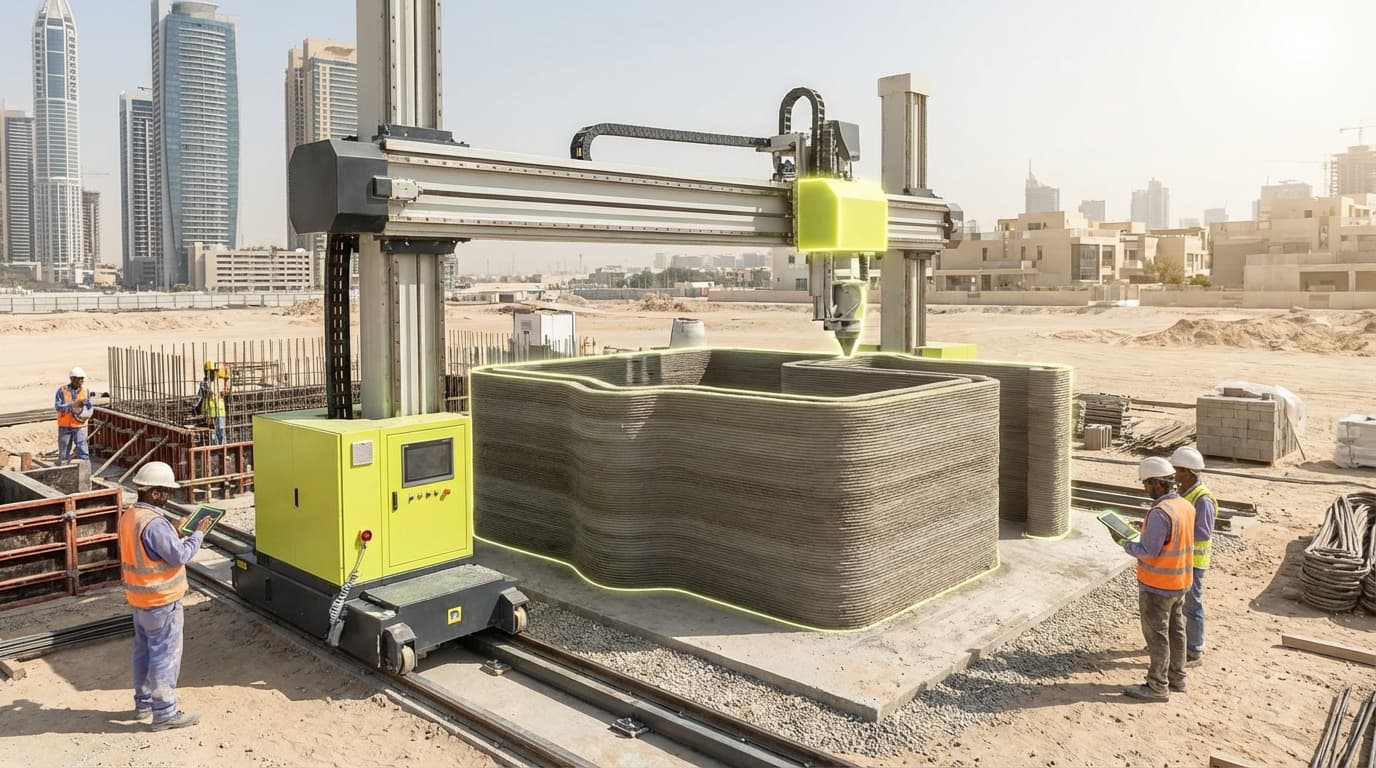
The Gulf's construction sector faces mounting pressures: labor shortages, tight project timelines, extreme climate demands, and ambitious national housing targets. Traditional building methods struggle to deliver the speed, precision, and resource efficiency required by Vision 2030-era development programs. 3D printed construction—additive manufacturing applied at building scale—emerges as a potential response to these constraints. Rather than assembling structures from prefabricated components or pouring concrete into formwork, robotic systems extrude specialized cement mixtures layer by layer, following digital blueprints to create walls, structural elements, or entire building envelopes. The technology promises to reduce material waste by up to 60% compared to conventional methods, compress construction schedules from months to weeks, and minimize reliance on manual labor in conditions where temperatures routinely exceed safe working thresholds. Dubai's 2030 target—that 25% of new buildings incorporate 3D printing—signals institutional commitment beyond pilot projects, positioning the technology as infrastructure for mass delivery rather than architectural novelty.
Early deployments across the region reveal both capabilities and constraints. Dubai's operational 3D printed office building and Saudi Arabia's housing program experiments demonstrate technical feasibility for mid-rise structures and repetitive residential typologies. The technology excels at producing complex geometries that would be prohibitively expensive with traditional formwork, enabling architects to explore organic forms and optimized structural shapes. Emergency shelter applications show promise for rapid deployment scenarios, though questions persist around long-term durability in Gulf climates where thermal cycling, humidity, and sandstorms stress building envelopes. Material science remains a critical frontier: current cement-based mixtures must balance printability, structural performance, and thermal resistance, with limited field data on how these formulations age under sustained heat exposure. Regulatory frameworks lag behind technical development, as building codes written for conventional construction struggle to evaluate layer-bonded structures or certify novel material compositions.
The implications extend beyond construction efficiency to reshape labor markets, supply chains, and urban form itself. If 3D printing scales successfully, it could reduce dependence on migrant construction labor while demanding new technical skills in robotics operation and digital fabrication. Supply chains may consolidate around specialized material suppliers and equipment manufacturers, potentially creating new dependencies even as traditional material flows diminish. For housing ministries pursuing ambitious delivery targets, the technology offers a pathway to accelerate production without proportional increases in workforce or material imports. Key monitoring points include: adoption rates beyond demonstration projects, development of climate-adapted material formulations, evolution of building codes to accommodate printed structures, and whether cost advantages materialize at scale. The transition from controlled pilot environments to routine deployment across diverse building types will reveal whether 3D printing represents incremental improvement or fundamental disruption of Gulf construction practices.
Related Organizations

3DXB Group
United Arab Emirates · Company
A UAE-based company focused on 3D building solutions, recently recognized for printing the world's largest 3D-printed villa in Dubai.

World leader in 3D construction printing solutions, manufacturing gantry-based printers.

Construction technology company using 3D printing robotics, software, and advanced materials.

Technology company offering 3D concrete printers, material, and software.

The government entity responsible for the 'Dubai 3D Printing Strategy', aiming to have 25% of Dubai's buildings 3D printed by 2030.

The region's leading additive manufacturing company, providing 3D printing solutions for construction and energy sectors across UAE and KSA.

Robotics technology company developing specialized equipment for 3D printing concrete buildings.

Global leader in innovative and sustainable building solutions.