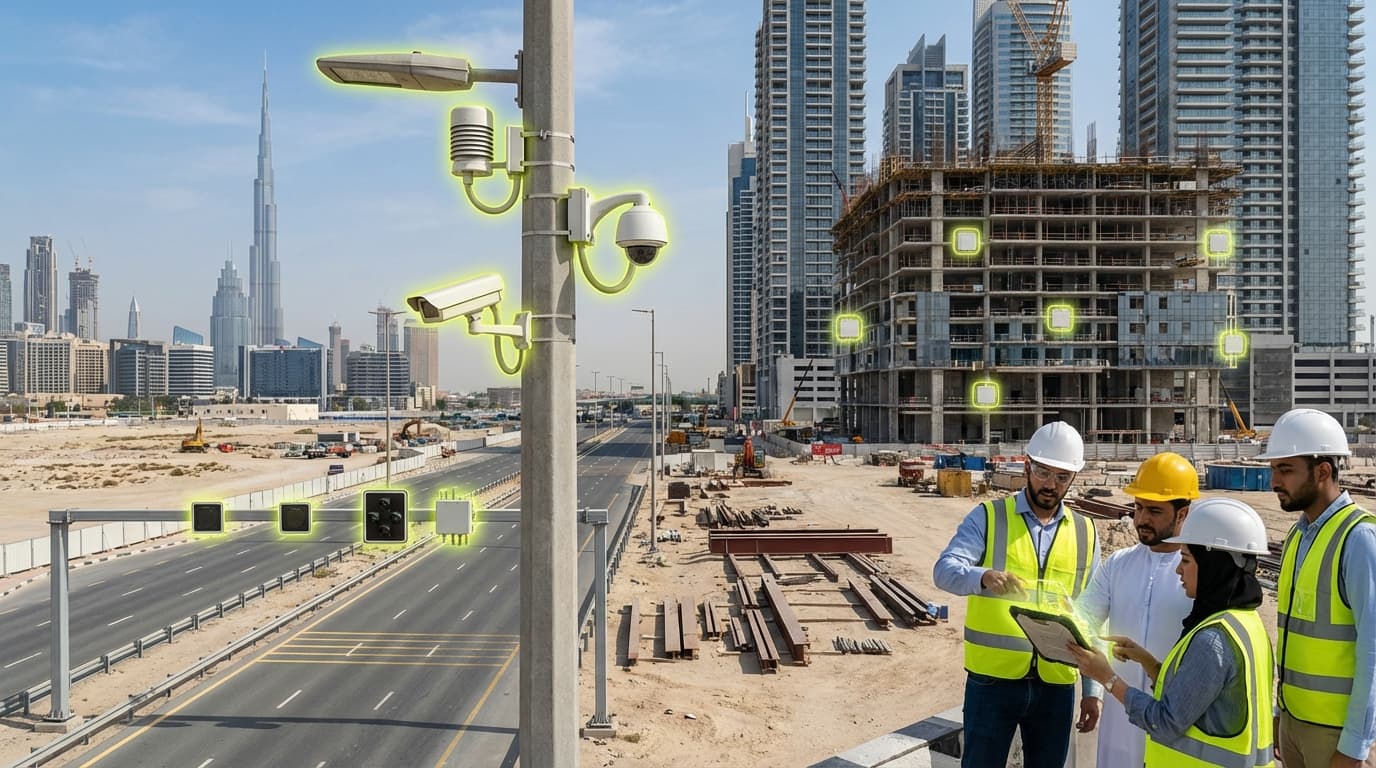
IoT Sensor Networks
IoT sensor networks represent a fundamental infrastructure shift in how cities gather, process, and respond to urban conditions in real time. These distributed systems of connected devices—ranging from air quality monitors and traffic cameras to water flow sensors and structural health monitors—create a continuous data stream that enables cities to move from reactive to predictive management. The core challenge they address is the traditional opacity of urban systems: without granular, real-time data, cities struggle to optimize resource allocation, respond to environmental hazards, or understand how infrastructure performs under stress. In the Gulf context, where extreme temperatures stress electrical grids, water scarcity demands precise consumption tracking, and rapid urban growth outpaces traditional planning cycles, sensor networks offer a pathway toward more responsive and efficient urban operations.
Early deployments across GCC nations demonstrate both the potential and complexity of city-scale sensor infrastructure. Dubai's Smart City initiative has installed thousands of sensors monitoring everything from parking availability to waste bin fill levels, feeding data into centralized platforms that inform municipal decisions. Saudi Arabia's NEOM project envisions sensor density unprecedented in urban environments, with every building, street, and utility monitored continuously. Abu Dhabi's Masdar City serves as a living laboratory for environmental sensors in extreme heat, testing which technologies can withstand sustained temperatures above 45°C while maintaining accuracy. These implementations reveal emerging patterns: successful deployments prioritize interoperability standards from the outset, invest heavily in edge computing to process data locally before transmission, and develop clear governance frameworks for data access and privacy. However, significant challenges persist around sensor maintenance in harsh desert conditions, the integration of legacy infrastructure with new monitoring systems, and the cybersecurity vulnerabilities introduced by thousands of connected endpoints.
The implications extend beyond operational efficiency to reshape urban governance models and citizen expectations. As sensor networks mature, cities gain the capacity for predictive infrastructure maintenance—identifying failing water pipes before they burst or electrical transformers before they fail—potentially reducing service disruptions and extending asset lifespans. During mass events like Hajj or Expo, real-time crowd density data enables dynamic management of pedestrian flows and emergency response positioning. Environmental monitoring becomes granular enough to identify pollution sources at the neighborhood level, supporting targeted interventions. Yet this data abundance raises critical questions about surveillance, algorithmic decision-making in public services, and the digital divide between sensor-rich and sensor-poor neighborhoods. Key indicators to monitor include the emergence of regional interoperability standards, public-private partnerships for sensor deployment and maintenance, regulatory frameworks governing urban data ownership, and evidence of whether predictive insights translate into measurable improvements in service delivery or resource efficiency. The trajectory suggests that sensor networks will become as fundamental to urban infrastructure as water pipes or electrical grids, but their ultimate value depends on governance structures that balance operational benefits with privacy protections and equitable access to the insights they generate.
Related Organizations

The digital transformation arm of Etisalat Group, deploying massive IoT networks across the UAE and region.

A subsidiary of DEWA (Dubai Electricity and Water Authority) providing digital solutions and IoT platforms for Dubai's smart city initiatives.

Leading digital enabler in KSA, deploying IoT infrastructure for smart cities like Riyadh and NEOM.

du (EITC)
United Arab Emirates · Company
UAE telecommunications provider offering the 'Dubai Pulse' platform and IoT connectivity.

Ooredoo
Qatar · Company
Qatari telecommunications provider leading the TASMU Smart Qatar initiative.

Saudi Technology and Security Comprehensive Control Company, managing traffic and public safety sensors.

Offers Webex Hologram, an augmented reality meeting solution that projects photorealistic 3D holograms of participants into the room.

Designs and manufactures wireless sensor network hardware for IoT applications.

Regional telecom operator with a dedicated 'ZainTech' division for digital and IoT services.

Provides the ThingPark platform for LPWAN IoT connectivity management.