Community Governance Super-Apps
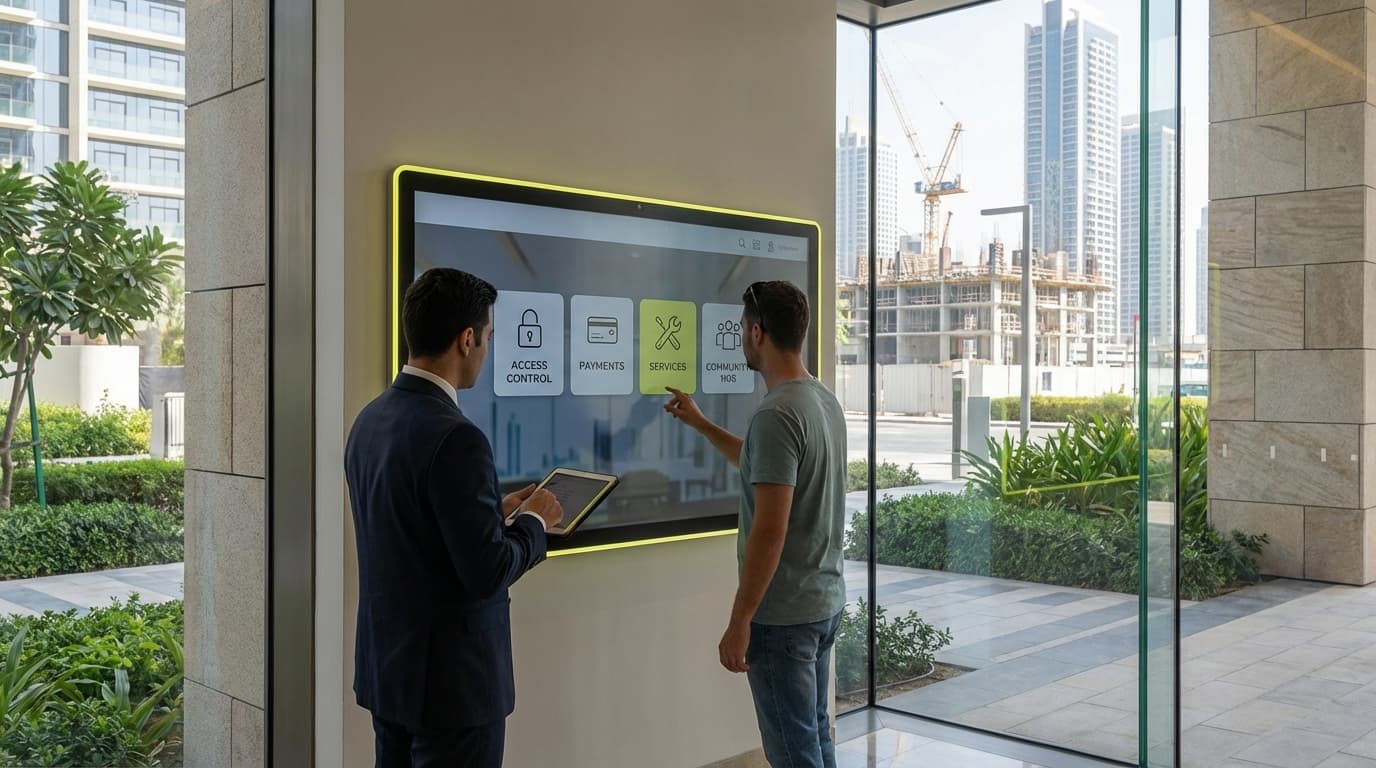
Community governance super-apps represent a fundamental shift in how residential districts are administered and experienced, addressing the challenge of coordinating complex service ecosystems across large-scale developments. In master-planned communities spanning thousands of units—common across the Gulf's urban expansion—traditional property management struggles with fragmentation: separate systems for security, payments, amenity booking, maintenance ticketing, and government liaison create friction for residents and operational inefficiency for managers. These integrated platforms consolidate what were previously disparate touchpoints into a single digital interface, transforming the relationship between inhabitants and their built environment. The signal matters because it points toward a future where urban living increasingly resembles platform-mediated services, raising questions about data governance, digital inclusion, and the privatization of civic functions within walled communities.
Early deployments across GCC master developments demonstrate the pattern's directional momentum. Major developers have rolled out proprietary apps that handle everything from gate access via QR codes to service charge payments, visitor pre-registration, facility reservations, and direct channels to municipal utilities. Some platforms now integrate e-government portals, allowing residents to renew visas or access health records without leaving the app ecosystem. Industry observers note that facility managers report measurable efficiency gains through digitized maintenance workflows and automated billing, while resident adoption rates in newer communities approach near-universal usage for core functions like access control. The technology stack typically combines IoT integration for physical systems, cloud-based databases for resident information, and payment gateways compliant with regional financial regulations. However, uncertainty remains around interoperability—residents moving between developments face learning curves with incompatible systems—and around what happens when platform providers change or discontinue services.
The implications extend beyond operational convenience to questions of urban citizenship and data sovereignty. As these apps become the mandatory interface for community participation, they create detailed behavioral profiles of residents' movements, service usage, and social patterns. Monitoring should focus on regulatory frameworks emerging around data ownership and portability, particularly whether residents can export their information or whether it remains proprietary to developers. Watch for tensions between the efficiency gains of centralized platforms and demands for open standards that prevent vendor lock-in. The model's expansion into mixed-use districts and even public housing projects will test whether platform-based governance can scale beyond affluent gated communities without exacerbating digital divides or creating two-tier access to urban services.
Related Organizations
One of the world's most valuable real estate development companies, developer of the 'Emaar One' app.
DAMAC Properties
United Arab Emirates · Company
A major luxury real estate developer in the Middle East that utilizes the 'DAMAC Living' app for community management.

The regulatory arm (RERA) operates the 'Mollak' system, a mandatory digital platform for payment of service charges and management of Owners Associations.

A security and community management app that dominates the Indian market and has expanded models relevant to high-density gated communities.

Investment and property management software for all types of real estate.

AI-driven property operations platform that unifies building data to optimize performance and sustainability.

A UAE-based proptech offering a property management platform and a 'Rent Now, Pay Later' solution for tenants.

Cloud-based property management software that includes community association management features and mobile portals for residents.

A platform for documentation and communication in construction and real estate projects, facilitating defect management and compliance reporting.