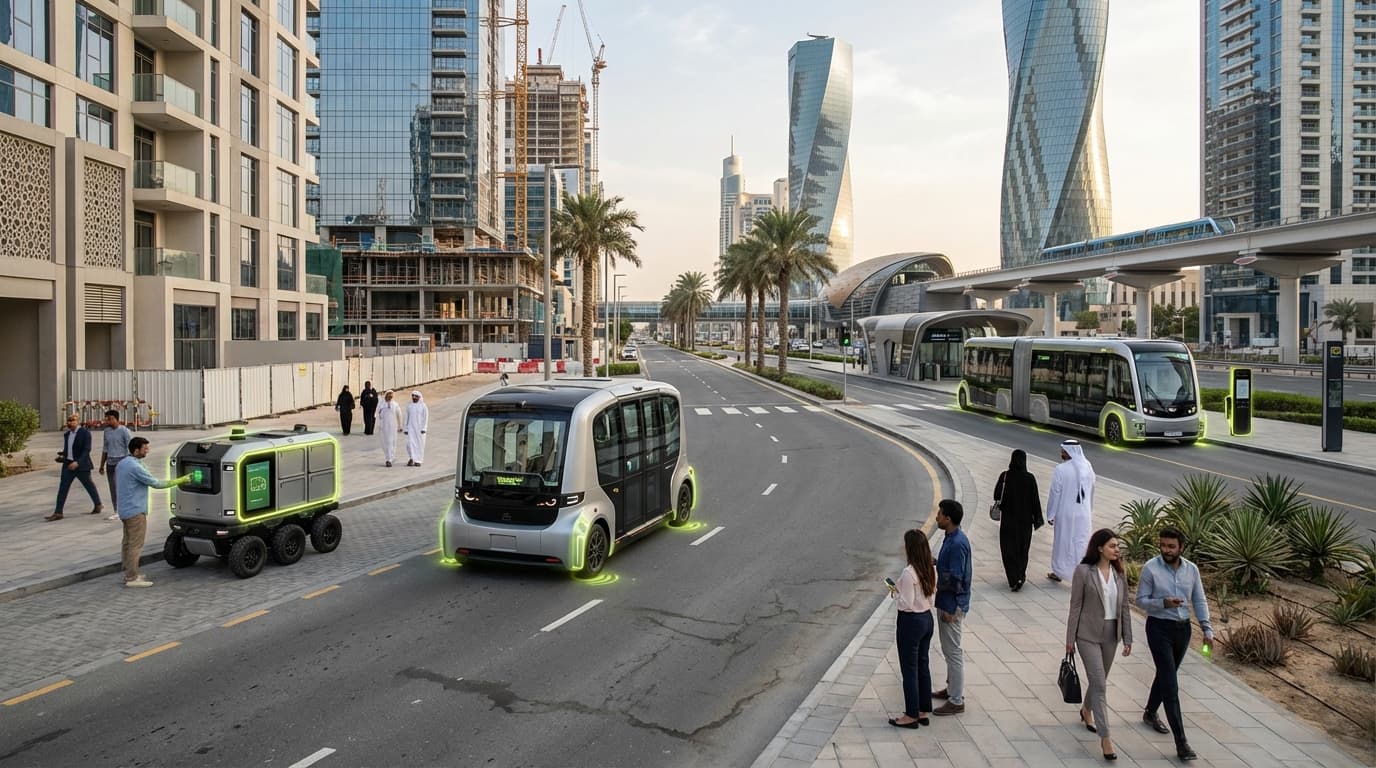
Autonomous Mobility Systems
Autonomous mobility systems represent a fundamental shift in how cities approach transportation infrastructure, moving from human-operated vehicles toward self-navigating platforms that promise to reshape urban form, reduce congestion, and alter land use patterns. The core challenge these systems address is the inefficiency of traditional transport networks—where private car ownership consumes vast amounts of urban space for parking, traffic congestion wastes productive hours, and last-mile connectivity remains a persistent gap in public transit systems. In the Gulf context, where rapid urbanization and ambitious master-planned developments create unique opportunities, autonomous mobility is not merely an incremental improvement but a foundational assumption in next-generation city design. The signal matters because it points toward a potential decoupling of urban density from transport infrastructure constraints, enabling new spatial configurations and development models that would be impractical with conventional transit systems.
Early evidence of this transition is visible across multiple deployment contexts in the region. Dubai's stated target of 25% autonomous trips by 2030 reflects policy-level commitment, while operational pilots—including autonomous pods at Masdar City and robotaxi testing programs—provide real-world performance data under Gulf climate and regulatory conditions. NEOM's The Line concept explicitly designs urban form around the assumption of autonomous mobility, eliminating traditional street networks in favor of underground autonomous transit layers. Air taxi development through partnerships with eVTOL manufacturers like Joby and Lilium suggests parallel investment in vertical mobility infrastructure. These initiatives remain largely experimental, with deployment concentrated in controlled environments—new developments, dedicated zones, or limited service areas—rather than full-scale urban integration. The pattern direction indicates growing confidence in technical feasibility but persistent uncertainty around regulatory frameworks, public acceptance thresholds, and economic viability at scale.
The implications extend beyond transport efficiency to fundamental questions of urban design, real estate economics, and social equity. If autonomous systems achieve widespread adoption, cities could reclaim parking infrastructure for other uses, redesign street networks around pedestrian priority, and enable lower-density development patterns without sacrificing accessibility. However, monitoring should focus on regulatory harmonization across GCC jurisdictions, insurance and liability frameworks for autonomous operations, and evidence of sustained public usage beyond initial novelty periods. Critical thresholds include transition from geofenced pilots to open-road deployment, demonstration of cost-competitiveness with conventional transit, and integration with existing transport networks rather than parallel systems. The risk remains that autonomous mobility becomes a premium service layer rather than a democratizing force, reinforcing rather than reducing urban inequalities.
Related Organizations

Government authority spearheading the Dubai Autonomous Transportation Strategy to make 25% of transport autonomous by 2030.

A G42 company leading the TXAI initiative, the first fleet of autonomous taxis deployed in Abu Dhabi.

Autonomous vehicle company backed by GM, holding an exclusive agreement with Dubai RTA to operate robotaxis.

A region in northwest Saudi Arabia being built as a living laboratory for future technologies.

Alphabet subsidiary and global leader in autonomous driving technology.

A leading L4 autonomous driving technology company that has developed and deployed the WeRide Robobus.

A high-tech company specializing in driverless technology and smart mobility solutions, famous for the EZ10 autonomous shuttle.

French manufacturer of autonomous shuttles, widely tested and deployed in Masdar City and Dubai.

Freight technology company developing autonomous electric trucks, with signed MOUs for deployment in UAE logistics.

Developer of autonomous delivery robots capable of navigating indoor and outdoor environments, piloting in airports and retail.