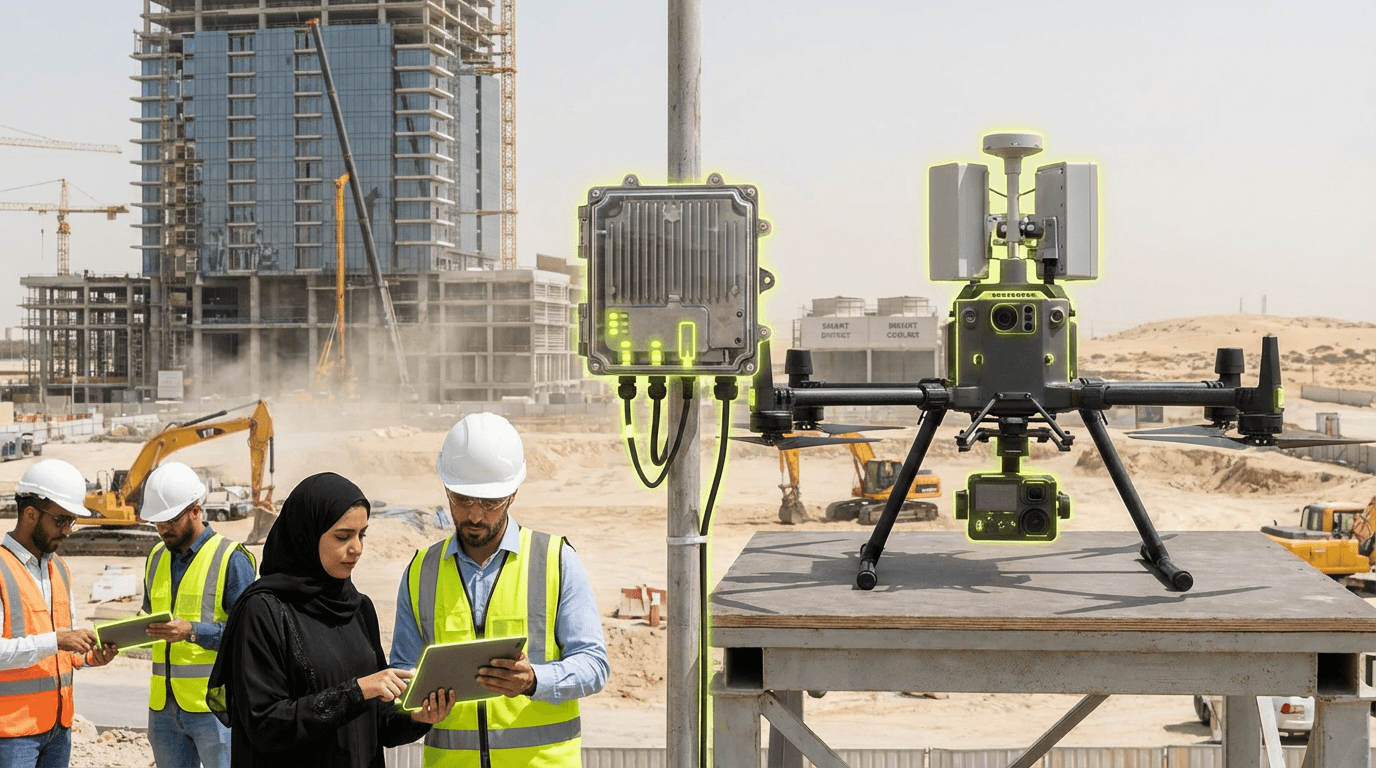
5G Urban Connectivity
The fundamental challenge 5G urban connectivity addresses is the growing mismatch between legacy network infrastructure and the demands of data-intensive, latency-sensitive urban applications. Fourth-generation networks, while adequate for consumer mobile internet, cannot support the millisecond-level response times required for autonomous vehicle coordination, the simultaneous connection of hundreds of thousands of IoT sensors per square kilometer, or the bandwidth demands of real-time urban digital twins. This infrastructure gap has constrained the deployment of smart city technologies that depend on instantaneous data exchange—from traffic management systems that must react to conditions in real time to industrial automation that requires precise synchronization across distributed systems. The transition to 5G represents not merely an incremental improvement in mobile speeds but a fundamental shift in what urban infrastructure can support, enabling applications that were previously theoretical to become operationally viable.
GCC nations have emerged as early adopters and testing grounds for 5G deployment, with UAE and Saudi Arabia achieving urban coverage rates that exceed many developed markets. This positioning reflects strategic national priorities around economic diversification and technology leadership, supported by substantial public and private investment in network densification. The technology operates through a combination of enhanced mobile broadband, ultra-reliable low-latency communications, and massive machine-type communications, each serving distinct urban functions. Early deployments indicate particular traction in port automation, where container terminals use 5G to coordinate autonomous vehicles and crane operations, and in healthcare settings where specialists conduct remote consultations with minimal lag. The Gulf's concentrated urban development patterns and greenfield smart city projects—such as NEOM and Masdar City—provide ideal conditions for testing integrated 5G applications without the constraints of retrofitting legacy infrastructure. Industry analysts note that operators continue expanding network capacity through small cell deployments and spectrum allocation, suggesting sustained commitment beyond initial rollout phases.
The implications for urban development extend beyond connectivity itself to the viability of entire service models and governance approaches. Real-time traffic optimization becomes feasible when vehicles, signals, and infrastructure communicate continuously with sub-20-millisecond latency. Autonomous transport systems gain the connectivity backbone necessary for vehicle-to-everything communication, though regulatory frameworks and safety validation remain separate challenges. For urban planners, 5G enables more granular monitoring of environmental conditions, utility consumption, and public space usage, potentially supporting evidence-based policy adjustments. However, the technology also introduces dependencies on continuous network availability and raises questions about digital equity if coverage remains concentrated in premium developments. Monitoring should focus on application adoption rates beyond pilot phases, the emergence of 5G-dependent business models in sectors like logistics and healthcare, and whether network densification extends to lower-income neighborhoods or remains concentrated in commercial districts and flagship projects.
Related Organizations

The UAE's primary telecommunications provider, aggressively rolling out 5G infrastructure for smart city applications.

Leading digital enabler in KSA, deploying IoT infrastructure for smart cities like Riyadh and NEOM.
Tonomus
Saudi Arabia · Company
The technology and digital subsidiary of NEOM, building the world's first cognitive city infrastructure.

The government office leading Dubai's blockchain strategy, including the migration of land registry and title deeds to blockchain infrastructure.

du (EITC)
United Arab Emirates · Company
UAE telecommunications provider offering the 'Dubai Pulse' platform and IoT connectivity.


Ooredoo
Qatar · Company
Qatari telecommunications provider leading the TASMU Smart Qatar initiative.

United Arab Emirates · Government Agency
The federal regulator in the UAE responsible for spectrum allocation and telecommunications standards.

Offers Webex Hologram, an augmented reality meeting solution that projects photorealistic 3D holograms of participants into the room.