Energy Performance Contracting (ESCOs)
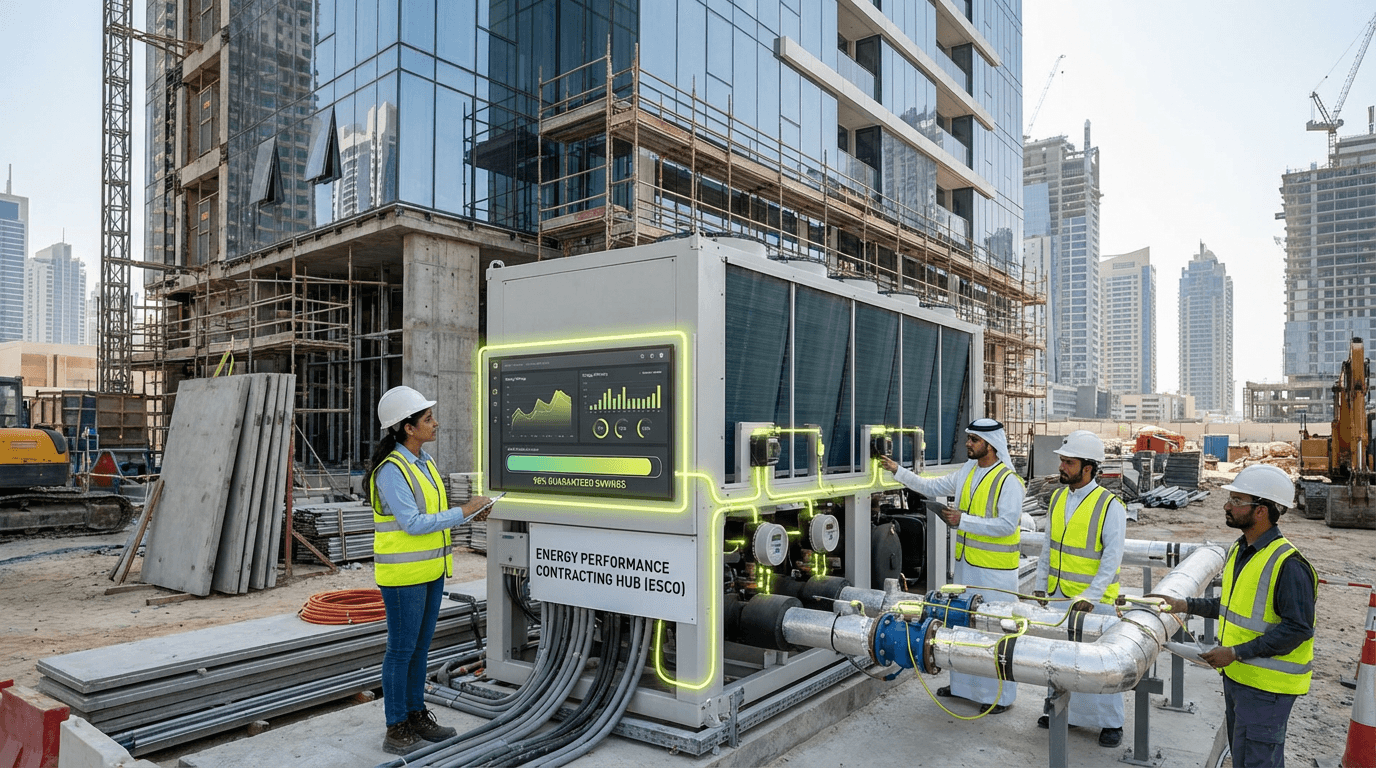
Energy Performance Contracting represents a fundamental shift in how building efficiency improvements are financed and delivered, addressing a persistent market failure: the split incentive problem where building owners lack capital or confidence to invest in energy upgrades despite clear long-term savings. ESCOs (Energy Service Companies) solve this by assuming both the financial burden and performance risk of efficiency projects, recovering their investment through a contractual share of the guaranteed energy savings they generate. This model transforms energy efficiency from a discretionary capital expense into a performance-based service, particularly critical in the Gulf where cooling loads consume 60-70% of building energy and efficiency investments face competing priorities in real estate portfolios. The signal points to the maturation of efficiency-as-a-service models that align incentives between building owners, operators, and specialized implementers.
The mechanism works through comprehensive energy audits, baseline consumption establishment, and multi-year contracts (typically 5-15 years) where ESCOs finance upfront improvements—HVAC optimization, building envelope upgrades, LED conversions, controls automation, and sometimes renewable integration—then receive payment from verified savings against the baseline. In the GCC context, government-backed Super ESCOs like UAE's Etihad ESCO and Saudi Arabia's Tarshid have pioneered large-scale public building retrofits, demonstrating 20-40% consumption reductions in schools, hospitals, and government facilities. Private ESCOs increasingly target commercial towers, hotel portfolios, and industrial facilities where cooling optimization and thermal storage offer rapid payback. The model's traction reflects both regulatory pressure (building codes tightening across GCC) and economic logic as energy subsidies decline and utility costs approach market rates. However, adoption faces friction: measurement and verification protocols remain complex, contract standardization is limited, and many building owners lack awareness of ESCO mechanisms or perceive them as relinquishing operational control.
The implications extend beyond individual buildings to systemic efficiency financing. As ESCOs aggregate projects into investment portfolios, they create asset classes attractive to institutional capital seeking stable, inflation-hedged returns from energy savings. This financialization could unlock billions in efficiency investment across GCC's aging building stock without public expenditure. Monitoring priorities include ESCO contract standardization efforts, the emergence of third-party verification platforms, and whether residential sector models develop beyond current commercial focus. The critical threshold is whether performance contracting becomes a default procurement route for major retrofits rather than a niche alternative, potentially reshaping how the region's built environment adapts to climate targets and post-subsidy energy economics.
Related Organizations

A DEWA venture established to create an energy performance contracting market in Dubai, retrofitting thousands of buildings.
The regional arm of the global energy giant, focusing on sustainable energy solutions and performance contracting.
Joint venture between Veolia and Majid Al Futtaim providing energy and facilities management.

The National Programme for Conservation and Energy Efficiency run by Kahramaa.

Offers energy performance contracting and building management systems to optimize energy use.

Johnson Controls
United States · Company
Multinational conglomerate producing HVAC and building control systems, notably the OpenBlue digital platform.

Offers the Desigo and Building X platforms for smart building automation.

Provides solar leasing and energy efficiency solutions under long-term contracts (leases/PPAs) that function similarly to ESCO models.

Provides comprehensive turnkey solar solutions in the UAE under leasing models.

An accredited ESCO in Dubai specializing in energy retrofits and management.

Integrated facilities management company with a dedicated energy division.