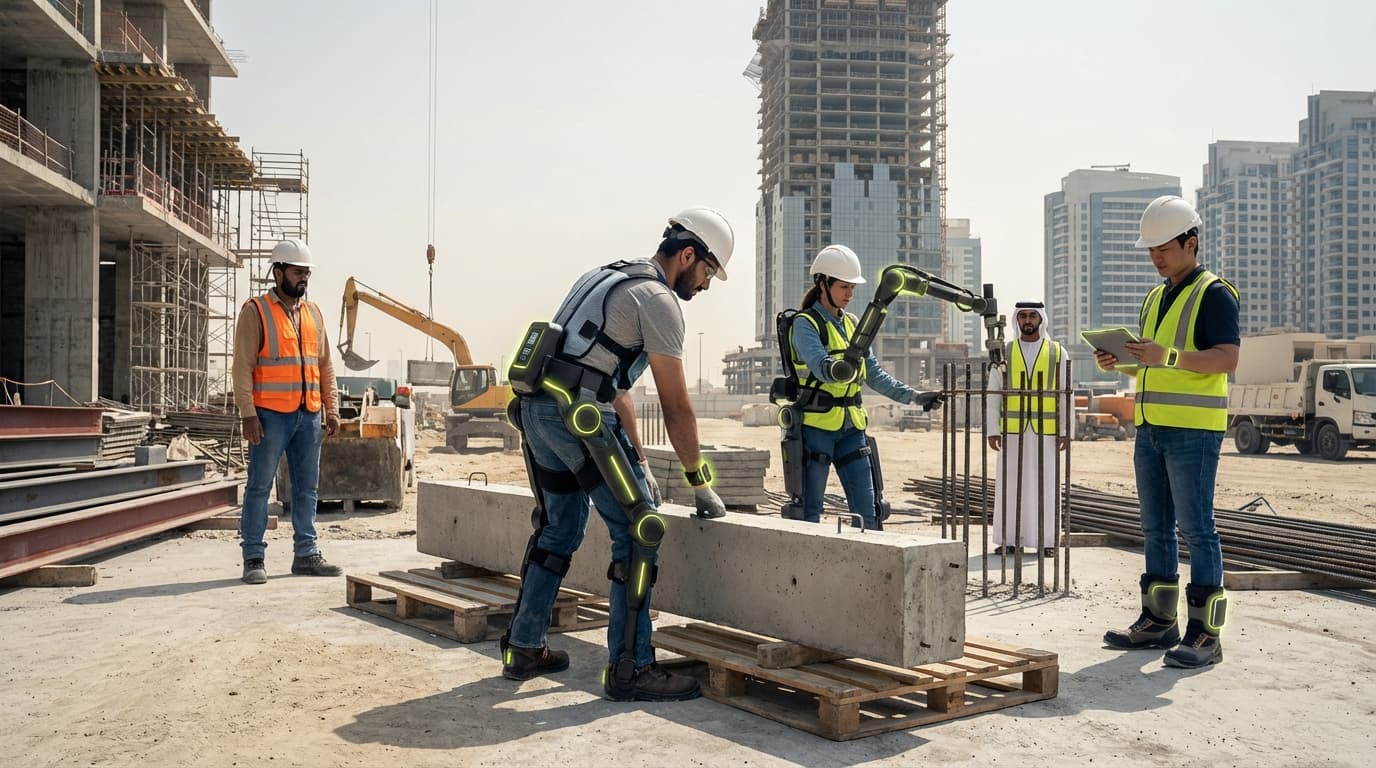
Construction Exoskeletons & Wearables
The Gulf's construction boom confronts a persistent challenge: maintaining productivity and worker safety in one of the world's harshest built environments. Summer temperatures routinely exceed 45°C, forcing work stoppages during peak heat hours and creating chronic labor productivity constraints. Simultaneously, the physical demands of construction—repetitive lifting, overhead installation, material handling—generate high injury rates and long-term musculoskeletal disorders that reduce workforce capacity. Construction exoskeletons and smart wearables represent a strategic response to these dual pressures, augmenting human capability rather than replacing workers. Powered exoskeletons provide mechanical assistance for lifting and overhead tasks, redistributing load away from vulnerable joints and muscles. Smart wearables—biometric monitors, heat stress sensors, augmented reality helmets—create real-time feedback loops between workers, supervisors, and safety systems, enabling proactive intervention before heat exhaustion or injury occurs.
Early deployments across GCC megaprojects suggest these technologies are transitioning from pilot curiosity to operational consideration. Industry observers note that major contractors, including those affiliated with national development companies, are testing passive and active exoskeletons for tasks like ceiling installation, rebar placement, and heavy tool operation. Passive systems, which use springs and counterweights rather than motors, show faster adoption due to lower cost and simpler maintenance, though they offer more modest strength augmentation. Active powered systems remain in limited trials, constrained by battery life in extreme heat, dust ingress into mechanical components, and worker training requirements. Wearable biometric systems appear further along the adoption curve, with some large projects mandating heat stress monitors that alert supervisors when core body temperature or heart rate crosses safety thresholds. These systems integrate with project management platforms, creating data streams that inform shift scheduling and hydration protocols. However, adoption remains uneven, concentrated among international contractors on high-profile projects rather than across the broader construction ecosystem.
The implications extend beyond immediate safety gains to workforce strategy and project economics. If exoskeletons and wearables enable safe work during previously prohibited heat windows, they could compress project timelines and reduce the seasonal labor fluctuations that complicate workforce planning. For aging construction workforces, these technologies may extend productive careers by reducing cumulative physical strain. Yet critical uncertainties remain: cost-effectiveness at scale, worker acceptance in cultures where technology adoption varies, and maintenance infrastructure in remote project sites. Monitoring should focus on procurement patterns among tier-one contractors, injury rate data from projects deploying these systems, and regulatory developments around mandatory wearable monitoring. The threshold to watch is whether these technologies move from flagship project experiments to standard specifications in public procurement, signaling a structural shift in how the Gulf manages construction labor in extreme conditions.
Related Organizations

IoT-enabled smart helmet solution specifically designed for construction site safety and productivity tracking in the Gulf region.

wearable device platform that predicts and prevents heat stress, overexertion, and injury.

A pioneer in the field of robotic exoskeletons for medical and industrial use.

Construction giant that acquired 'Concrete Sensors' to integrate IoT structural monitoring into their portfolio.

Produces the Cray X, a connected power suit that supports lifting movements and provides data analytics.

A global construction group with a massive Middle East presence, actively exploring 3D printing and modular techniques.
Connected safety wearables providing gas detection, fall detection, and lone worker monitoring.
Specializes in evaporative and phase change cooling vests and wearables.

Develops the Ironhand, a soft robotic muscle strengthening system for hands.

Develops highly mobile, dexterous industrial robots and exoskeletons like the Guardian XO.