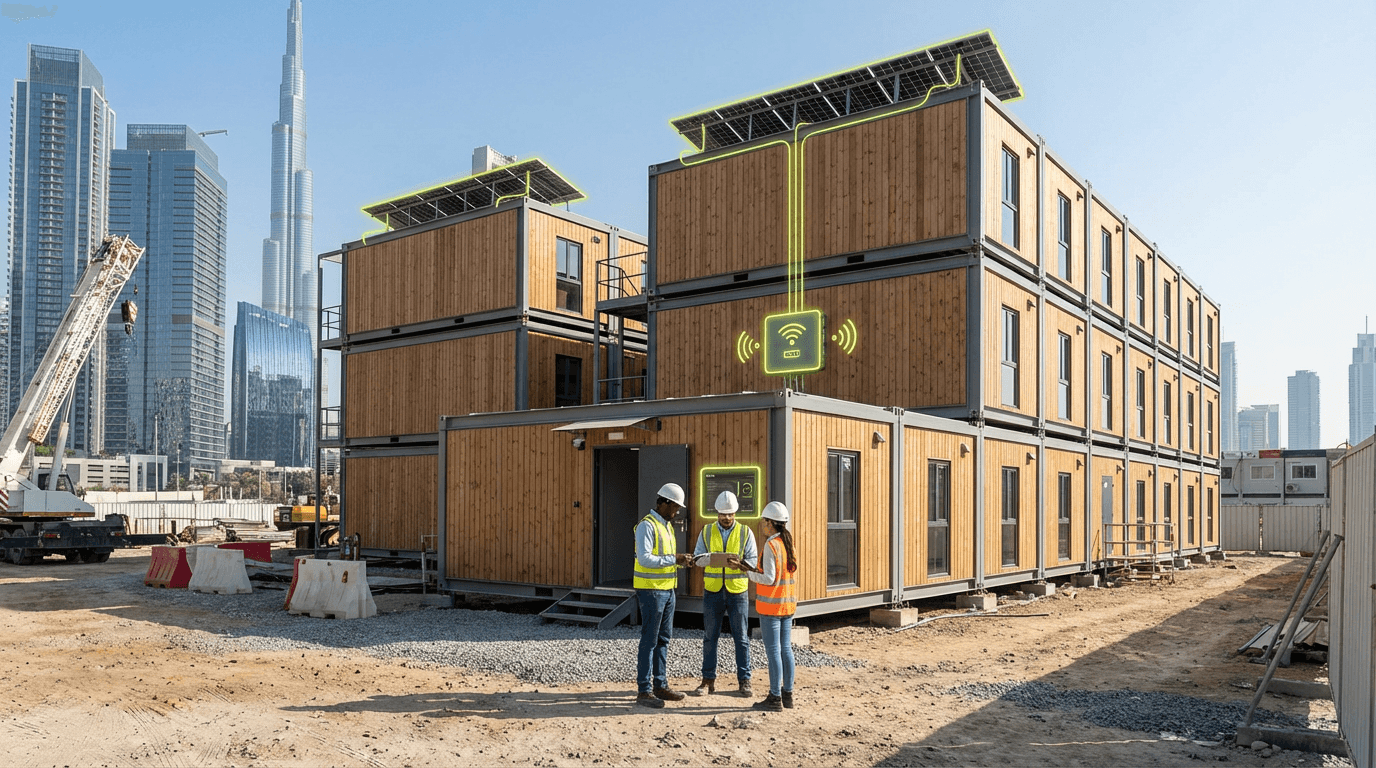
Modular Worker Housing
The Gulf's construction boom—from NEOM's linear city to Dubai's expanding metro networks—creates sustained demand for worker accommodation at unprecedented scale. Traditional labor camps, often criticized for substandard conditions and slow assembly, struggle to meet both the pace of mega-project timelines and evolving regulatory standards for worker welfare. Modular worker housing addresses this dual pressure by industrializing accommodation delivery: factory-built units arrive on-site largely complete, reducing construction time from months to weeks while embedding climate control, sanitation, and safety features during manufacturing rather than as afterthoughts. This shift matters because labor accommodation quality directly affects project execution—healthier, better-rested workers demonstrate higher productivity and lower turnover—while also serving as a visible indicator of national labor reform commitments under international scrutiny.
The technology operates through standardized steel-frame or composite modules manufactured in controlled facilities, then transported to site and assembled into multi-story configurations. Each unit typically houses four to eight workers with integrated HVAC systems designed for Gulf heat extremes, en-suite facilities, and fire-rated construction meeting updated building codes. Early deployments in UAE mega-projects demonstrate deployment timelines of 60-90 days for thousand-bed facilities, compared to 6-12 months for conventional construction. Saudi Arabia's Public Investment Fund projects and Qatar's World Cup infrastructure accelerated adoption, establishing modular housing as default for projects exceeding certain worker thresholds. Industry observers note that regulatory tightening—including mandatory inspections, minimum space allocations per worker, and cooling requirements—creates economic incentives favoring factory-built solutions that guarantee compliance through design rather than retrofit. The pattern extends beyond construction sites to hospitality sector staff housing and industrial zone accommodation, suggesting broader normalization of modular approaches for temporary workforce needs.
Implications center on how standardization reshapes labor accommodation economics and worker experience. Modular systems enable project developers to treat housing as scalable infrastructure—units can be relocated between projects or sold to secondary markets, transforming accommodation from sunk cost to redeployable asset. This flexibility may encourage higher initial investment in worker welfare if units retain residual value. However, standardization also risks creating uniform minimum-compliance solutions rather than genuinely improved living environments, particularly if cost pressures drive toward lowest-acceptable specifications. Monitoring should track whether modular adoption correlates with measurable improvements in worker health outcomes, retention rates, and satisfaction surveys, or merely accelerates deployment of adequate-but-uninspired accommodation. Key thresholds include regulatory mandates requiring modular construction for projects above certain workforce sizes, emergence of secondary markets for used modules, and potential adaptation of modular platforms for affordable permanent housing beyond temporary worker needs.
Related Organizations

A region in northwest Saudi Arabia being built as a living laboratory for future technologies.

One of the largest modular building solution providers in the UAE, specializing in rapid deployment camps.

Red Sea Global
Saudi Arabia · Company
Developer of The Red Sea and Amaala projects, implementing high-standard modular housing for construction staff.

Part of AMANA Group, specializing in offsite volumetric concrete modular construction.

Diversified industrial group with a strong focus on prefabricated buildings and labor camps.

Turkish manufacturer heavily exporting prefabricated buildings and worker camps to the GCC region.
Global provider of modular structures and logistics, with a history of supporting energy and mining camps.