Robotic On-Site Construction
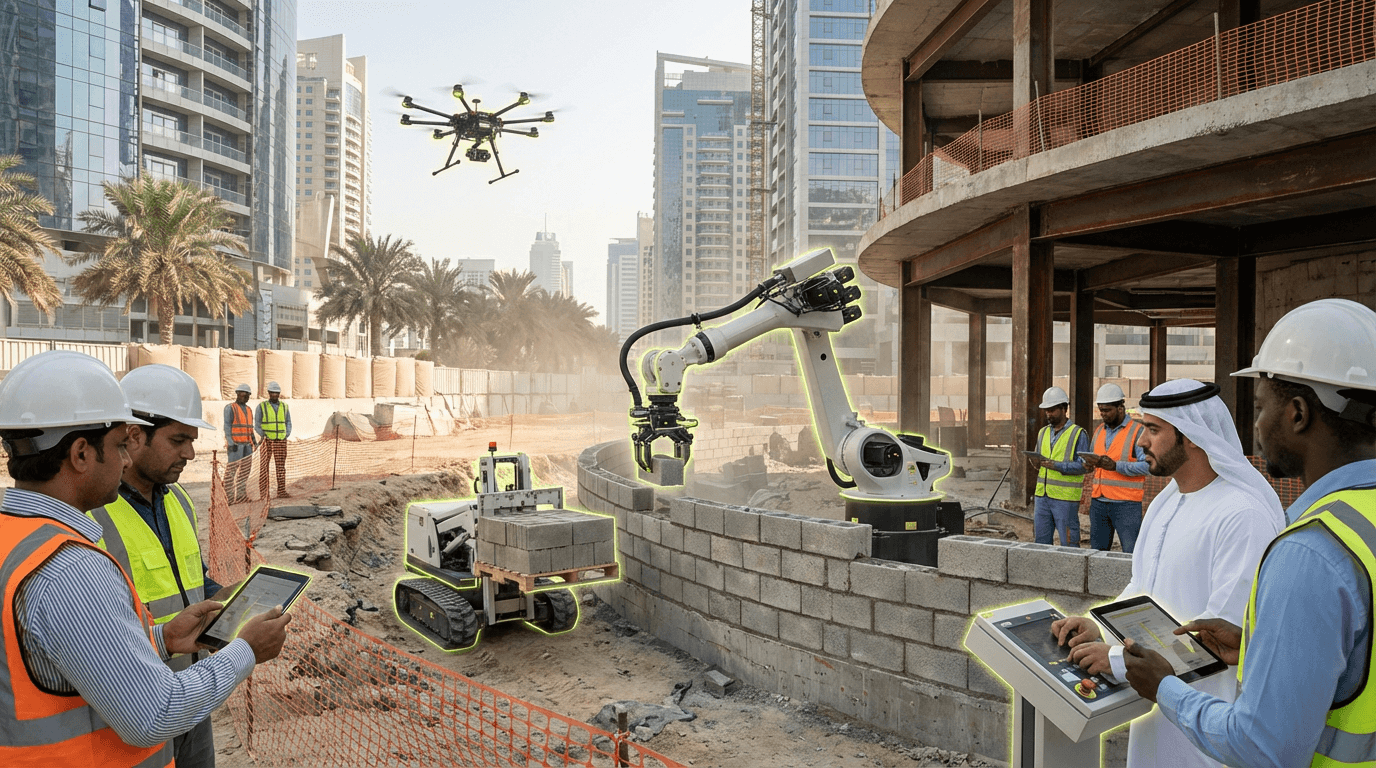
The construction industry faces mounting pressure to deliver faster, safer, and more cost-effective projects while confronting labor shortages, rising safety standards, and the physical limits of human workers in harsh environments. Robotic on-site construction addresses these challenges by deploying autonomous or semi-autonomous machines directly within active construction zones to perform repetitive, physically demanding, or hazardous tasks. Unlike prefabrication systems that manufacture components off-site, these robots operate alongside human crews in real-world conditions—laying bricks with millimeter precision, tying rebar in confined spaces, drilling anchor points, or conducting continuous site monitoring through mobile platforms equipped with sensors and cameras. In regions like the Gulf, where summer temperatures regularly exceed safe working thresholds and project scales demand relentless pace, this technology offers a pathway to maintain productivity without compromising worker welfare or project timelines.
Early deployments reveal a pattern of selective automation rather than wholesale replacement of human labor. Major contractors across the GCC have begun piloting robotic bricklayers capable of operating through night shifts, robotic arms for repetitive welding or material placement, and quadruped robots for site inspection and progress documentation. These systems rely on advances in computer vision, real-time path planning, and adaptive gripping mechanisms to navigate unstructured environments filled with debris, uneven surfaces, and dynamic obstacles. The business case centers on labor cost arbitrage in markets facing tightening visa policies, the ability to de-risk schedules by running operations around the clock, and measurable improvements in construction precision that reduce material waste and rework. However, adoption remains uneven—confined largely to mega-projects with budgets that can absorb upfront capital costs and technical integration challenges. Smaller contractors report barriers including lack of standardized interfaces, limited after-sales support, and workforce resistance rooted in job displacement concerns.
The implications extend beyond operational efficiency to reshape labor models and regulatory frameworks across Gulf construction markets. If robotic systems prove reliable at scale, they could accelerate a shift toward smaller, more skilled workforces focused on supervision, programming, and exception handling rather than manual execution. This transition may pressure governments to update building codes, safety protocols, and insurance structures to account for human-robot collaboration zones. For policymakers, the signal raises questions about retraining programs for displaced workers and whether to incentivize automation through tax breaks or procurement preferences. Monitoring adoption rates among Tier 1 contractors, the emergence of local robotics service providers, and any regulatory guidance on liability in robot-involved incidents will clarify whether this remains a niche solution for flagship projects or becomes standard practice across the region's construction pipeline.
Related Organizations

Famous for Spot and Atlas, now integrating reinforcement learning for dynamic movement.

World leader in 3D construction printing solutions, manufacturing gantry-based printers.

Developer of the Hadrian X, a truck-mounted robot capable of laying bricks autonomously.

A region in northwest Saudi Arabia being built as a living laboratory for future technologies.

Technology company offering 3D concrete printers, material, and software.

Construction giant that acquired 'Concrete Sensors' to integrate IoT structural monitoring into their portfolio.

Construction technology company using 3D printing robotics, software, and advanced materials.

Robotics company creating machines that automate drywall finishing.

Developer of the FieldPrinter, a robot that autonomously prints floor plans and layout lines directly onto concrete slabs.

Conducts advanced research in bioelectronics and the interface between biological systems and electronic circuits.