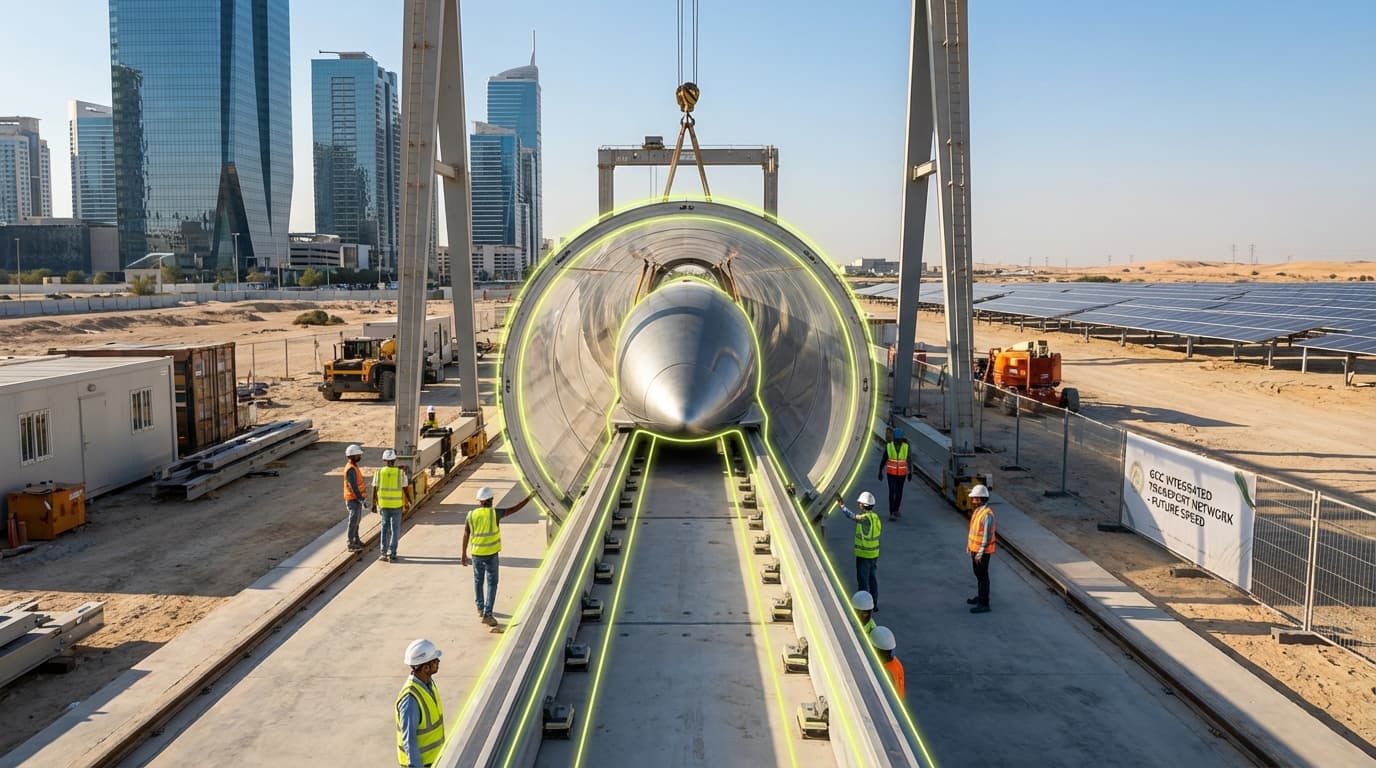
Hyperloop & High-Speed Rail
Ultra-fast ground transport systems represent a strategic signal about the Gulf's ambition to fundamentally restructure regional economic geography through connectivity infrastructure. The challenge these technologies address is the current reliance on air travel and road networks that create distinct, relatively isolated urban economies rather than integrated metropolitan regions. High-speed rail and hyperloop concepts promise to collapse travel times between major GCC cities to under an hour, potentially enabling daily commuting across what are currently separate labor markets and transforming the Gulf into a functionally integrated urban corridor. This shift matters because it could unlock new patterns of economic specialization, residential choice, and regional cooperation while reducing the carbon intensity of inter-city movement compared to aviation.
The evidence base for these systems varies significantly by technology maturity. High-speed rail follows established global precedents, with Etihad Rail's UAE network advancing toward operational phases and Saudi Arabia's planned system forming a cornerstone of Vision 2030 economic diversification. These projects face conventional infrastructure challenges around financing, land acquisition, and cross-border regulatory alignment rather than fundamental technical uncertainty. Hyperloop technology occupies a different position on the maturity spectrum. Virgin Hyperloop's 2020 passenger test demonstrated basic technical feasibility, yet the pathway from controlled demonstration to commercial-scale deployment across desert environments remains uncharted. Industry observers note that hyperloop faces substantial engineering hurdles around vacuum maintenance, emergency protocols, and cost-per-kilometer that have yet to be resolved at network scale. The signal's strength lies less in hyperloop's near-term viability than in what these ambitious proposals reveal about Gulf states' willingness to pursue transformative infrastructure as a tool of economic strategy.
The implications extend beyond transportation efficiency to questions of urban form and regional governance. If realized, these systems could enable new residential development patterns where workers live in lower-cost cities while accessing employment in major centers, potentially redistributing population growth and real estate pressure. For policymakers, the critical monitoring points include construction milestones for conventional rail projects, any shifts in hyperloop investment or timeline commitments, and early evidence of cross-border coordination mechanisms that would be essential for network operation. The more certain outcome is that high-speed rail will reshape some aspects of Gulf connectivity within the next decade; the open question is whether hyperloop transitions from aspirational signal to operational reality or remains a catalyst for conventional rail investment.
Related Organizations

The developer and operator of the UAE's national railway network.

Global logistics giant and major investor in hyperloop technology (Cargospeed).

French multinational rolling stock manufacturer, maker of the TGV.

Industrial giant offering intermodal transport solutions and MaaS platforms for transit agencies.

Crowdsourced engineering company developing hyperloop transportation systems.

Engineering and consulting group specializing in public transport and rail infrastructure.

European hyperloop technology company focusing on the European Hyperloop Center.

Spanish hyperloop company developing a scalable system with integrated propulsion.