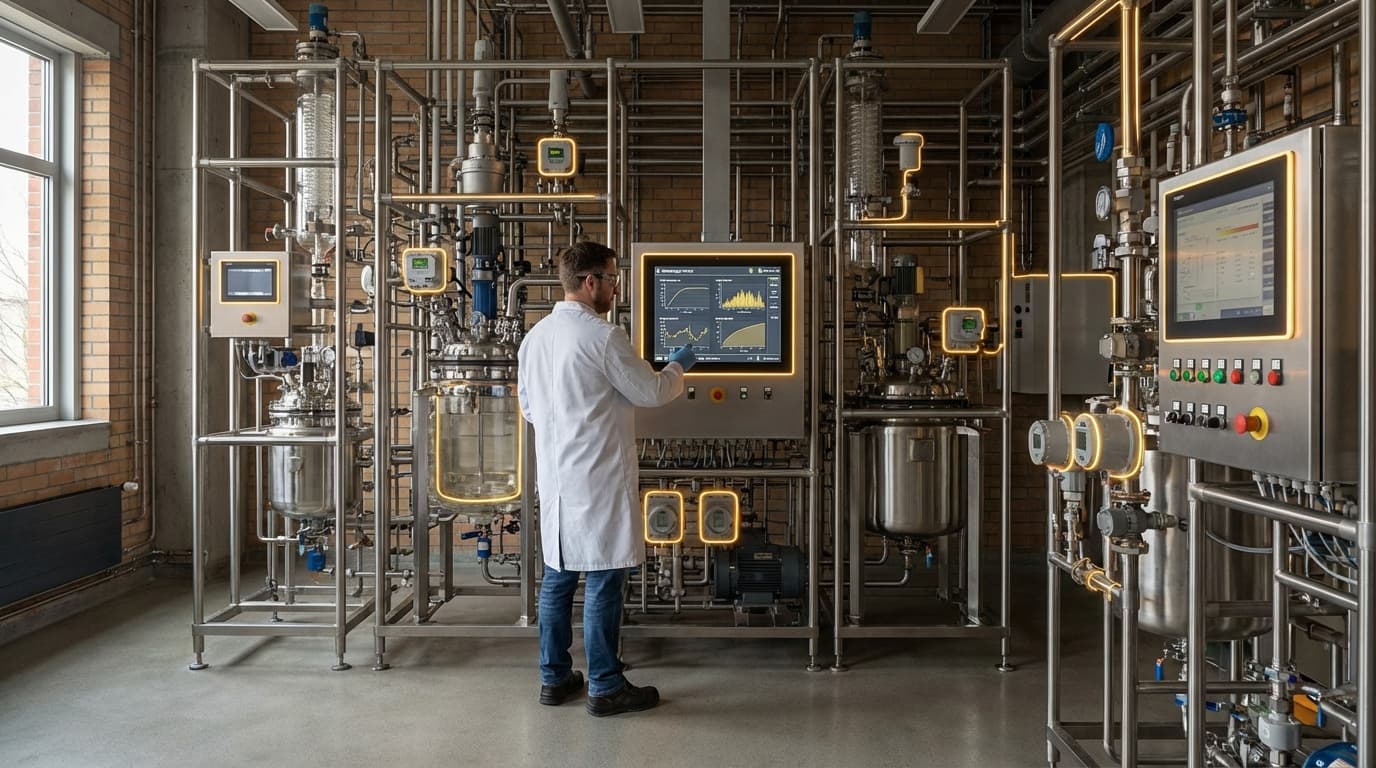
Self-Optimizing Process Plants
Industrial process plants—whether in chemicals, pharmaceuticals, energy production, or materials manufacturing—have traditionally relied on human operators and static control systems to maintain production targets. These facilities face constant pressure to balance competing objectives: maximising product yield, minimising energy consumption, ensuring worker safety, and maintaining equipment longevity. Conventional control strategies use fixed setpoints and predetermined recipes that cannot adapt quickly to changing feedstock quality, equipment degradation, or market demands. This rigidity leads to suboptimal performance, with plants typically operating well below their theoretical efficiency limits. The challenge intensifies as production processes become more complex, involving hundreds of interdependent variables that human operators struggle to optimise simultaneously. Self-optimising process plants address these limitations by deploying artificial intelligence agents that continuously monitor, analyse, and adjust operational parameters in real time, creating a dynamic system that learns and improves its own performance without constant human intervention.
At the heart of self-optimising plants lies the integration of digital twin technology with advanced sensor networks and machine learning algorithms. High-frequency sensors throughout the facility capture data on temperature, pressure, flow rates, chemical composition, and equipment vibration at millisecond intervals. This data feeds into a digital twin—a virtual replica of the physical plant that simulates process behaviour under different operating conditions. AI agents analyse patterns across this continuous data stream, identifying subtle correlations between variables that would escape human notice. When the system detects opportunities for improvement or potential safety risks, it automatically adjusts valve positions, reactor temperatures, mixing speeds, and other control parameters. The system also optimises production schedules based on real-time energy prices, equipment availability, and demand forecasts. Crucially, these adjustments occur within safety boundaries defined by process engineers, ensuring that autonomous optimisation never compromises operational integrity. The AI continuously validates its decisions against the digital twin before implementation, creating a closed-loop system that becomes more effective as it accumulates operational experience.
Early deployments in petrochemical refineries and specialty chemical plants have demonstrated measurable improvements in energy efficiency and product consistency, with some facilities reporting reductions in energy consumption while simultaneously increasing throughput. Pharmaceutical manufacturers are exploring these systems to maintain tighter quality control during batch production, where even minor variations in temperature or mixing can affect drug efficacy. Power generation facilities are implementing self-optimising controls to balance grid demands with fuel efficiency, particularly important as renewable energy sources introduce greater variability into electrical networks. The technology aligns with broader industrial trends toward Industry 4.0 and the Industrial Internet of Things, where connectivity and intelligence transform manufacturing from reactive to predictive operations. As computational power increases and machine learning models become more sophisticated, self-optimising plants represent a fundamental shift in how industrial facilities operate—moving from human-supervised systems that maintain stability to autonomous systems that actively seek continuous improvement, ultimately reshaping the economics and environmental impact of industrial production.
Related Organizations

A global technology and engineering company whose Cargo Solutions division produces real-time trackers (GO loggers).

Multinational conglomerate operating in aerospace and building technologies.

Provides the eMine portfolio, including charging infrastructure and trolley systems for electric mines.

Industrial software leader offering 'AVEVA Predictive Analytics' (formerly PRiSM) for asset performance management.

Industrial DataOps platform (Cognite Data Fusion) that contextualizes data for AI-driven maintenance applications.
Chemical giant producing Elastopave, a polyurethane binder system for stable, water-permeable stone surfaces.

Enterprise AI software provider with a dedicated suite for predictive maintenance across energy, defense, and manufacturing.

Advanced analytics software for process manufacturing data.


Supporting Evidence
Research this in Signals
Signals turns a topic into a sourced research record you can inspect and rerun. Your first scan is free, and this one starts with Self-Optimizing Process Plants already loaded, so edit it or scan as is.