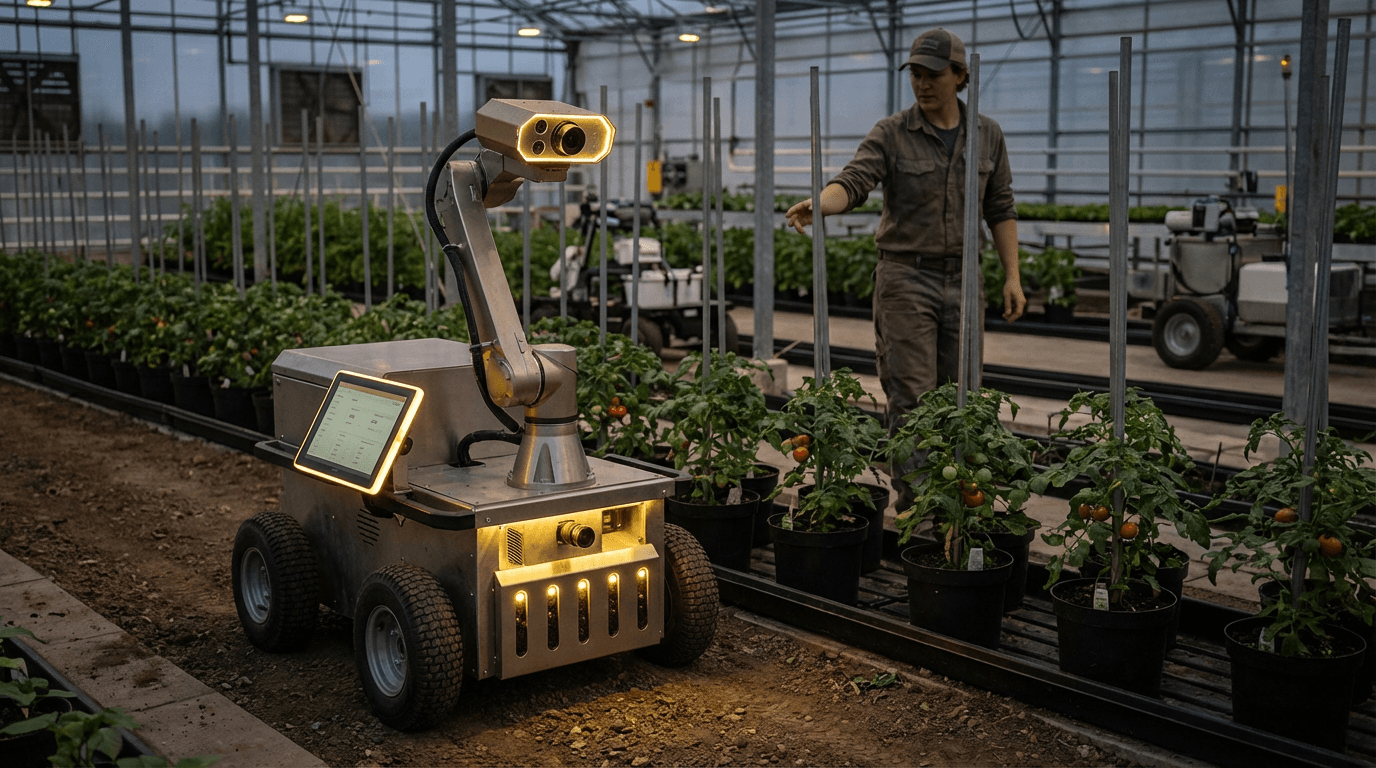
Precision Agriculture Automation
Precision Agriculture Automation represents a convergence of artificial intelligence, robotics, and advanced sensing technologies that fundamentally transforms how food is produced. At its technical core, this approach integrates computer vision systems with hyperspectral imaging sensors that capture data across hundreds of wavelengths, far beyond what the human eye can perceive. These sensors detect subtle variations in plant health, soil composition, and moisture levels, feeding real-time information into machine learning algorithms that can identify disease, nutrient deficiencies, or pest infestations at their earliest stages. Autonomous field robots equipped with GPS guidance systems and sensor fusion capabilities navigate agricultural environments with centimeter-level precision, performing tasks ranging from targeted pesticide application to selective harvesting. In controlled environments like vertical farms and automated greenhouses, integrated systems manage everything from LED lighting spectra to nutrient delivery, creating optimized growing conditions that can be adjusted dynamically based on continuous data analysis.
The agricultural sector faces mounting pressures from climate variability, resource scarcity, and the need to feed a growing global population while reducing environmental impact. Traditional farming methods often rely on uniform application of water, fertilizers, and pesticides across entire fields, leading to significant waste and environmental degradation. Precision Agriculture Automation addresses these challenges by enabling variable-rate application technologies that deliver inputs only where and when needed, potentially reducing chemical use by substantial margins while maintaining or improving yields. This granular approach to farm management also tackles labor shortages that plague many agricultural regions, as autonomous systems can operate continuously and perform physically demanding tasks. For urban and peri-urban contexts, automated vertical farming systems enable food production in spaces previously unsuitable for agriculture, reducing transportation distances and associated carbon emissions while providing fresh produce to food deserts and densely populated areas.
Commercial deployments of precision agriculture technologies are expanding beyond early pilot programs, with automated greenhouse operations now producing leafy greens and herbs at scale in urban centers across North America, Europe, and Asia. Field robotics for weeding, monitoring, and selective harvesting are seeing increased adoption in high-value crop production, while drone-based sensing systems have become relatively commonplace for large-scale crop assessment. Research institutions and agricultural technology companies continue to refine machine learning models that can predict optimal planting times, detect crop stress before visible symptoms appear, and forecast yields with increasing accuracy. As climate change intensifies weather unpredictability and water resources become more constrained, the ability to make data-driven decisions at the individual plant level rather than the field level represents a crucial evolution in agricultural practice. The trajectory points toward increasingly autonomous farming operations that combine the efficiency of industrial-scale production with the attentiveness traditionally associated with small-scale, intensive cultivation methods.
Related Organizations

Produces the Autonomous LaserWeeder, which uses AI and lasers to eliminate weeds without chemicals.

A global machinery giant that operates the Operations Center, one of the largest repositories of agronomic and machine data in the world.

Builds autonomous mechanical weeders (Vulcan) powered by AI and computer vision.

Manufacturer of smart, electric, driver-optional tractors.


Robotics company offering 'Sharpshooter' technology for farming.

Operates 'Community Notes' (formerly Birdwatch), the most prominent collaborative verification system at scale.

Builds autonomous collaborative robots that follow pickers and carry produce in vineyards and nurseries.


Develops and markets autonomous electric robots for weeding and hoeing in vegetable farming.
Supporting Evidence
Research this in Signals
Signals turns a topic into a sourced research record you can inspect and rerun. Your first scan is free, and this one starts with Precision Agriculture Automation already loaded, so edit it or scan as is.