Reinforcement Learning Process Control
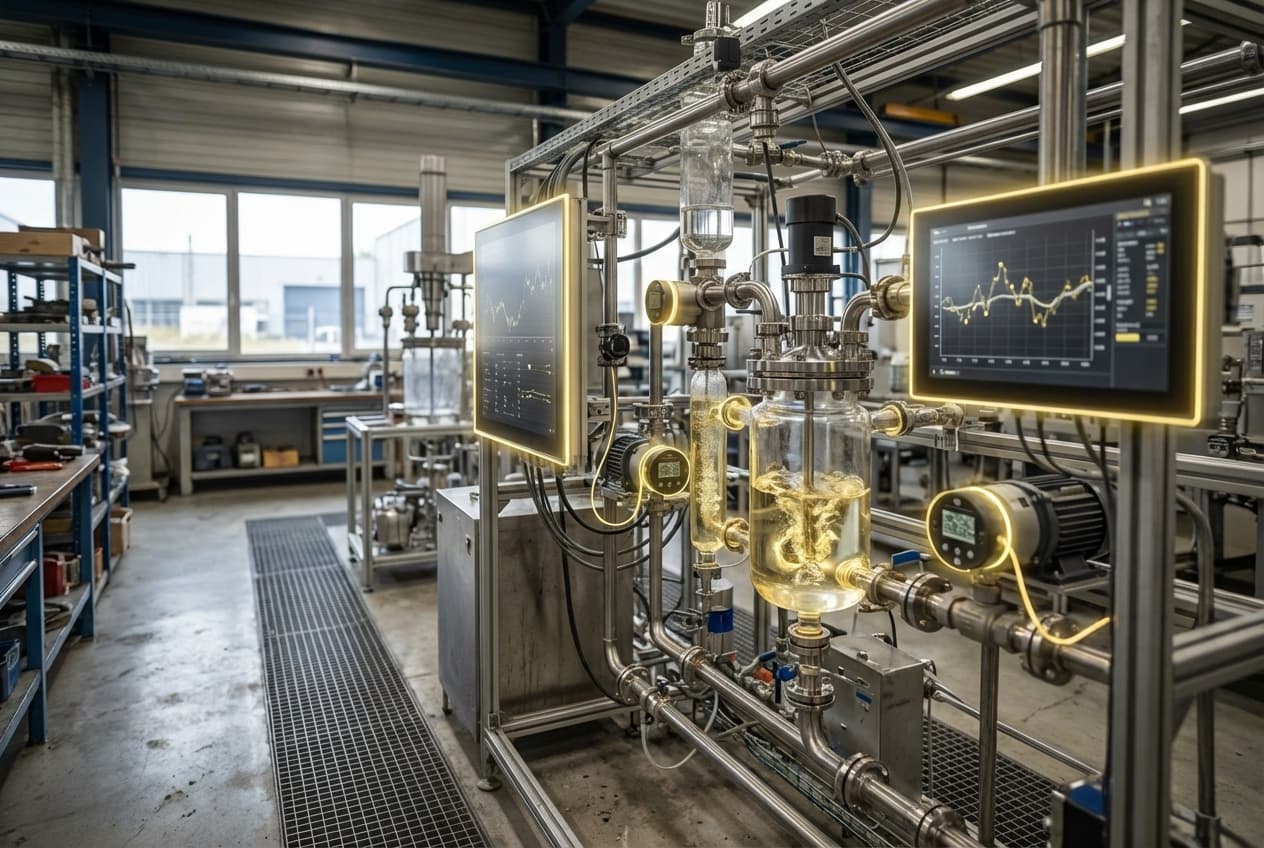
Industrial process control has long relied on classical methods such as proportional-integral-derivative (PID) controllers and model predictive control (MPC), which require extensive manual tuning and struggle with highly non-linear, time-varying systems. Reinforcement learning process control represents a paradigm shift in how industrial systems are managed, employing algorithms that learn optimal control policies through trial-and-error interaction with either simulated or real-world processes. Unlike traditional approaches that depend on explicit mathematical models of system dynamics, reinforcement learning agents can operate in both model-based and model-free configurations. In model-based approaches, the system learns a representation of the process dynamics and uses this internal model to plan control actions, while model-free methods directly learn the mapping from process states to control actions through accumulated experience. The core mechanism involves an agent receiving feedback in the form of rewards or penalties based on how well its control actions achieve desired outcomes—such as maintaining temperature within tight tolerances, maximizing throughput, or minimizing energy consumption. Through iterative learning cycles, these systems gradually discover control strategies that can handle complex interactions, non-linearities, and disturbances that confound conventional controllers.
The industrial sector faces mounting pressure to optimize operations amid increasingly complex production requirements, stringent quality standards, and the need for energy efficiency. Traditional control methods often fall short in processes characterized by significant non-linearities, multiple interacting variables, or frequent changes in operating conditions—scenarios common in chemical processing, semiconductor manufacturing, and advanced materials production. Reinforcement learning process control addresses these limitations by continuously adapting to changing conditions without requiring constant re-tuning by human experts. This capability is particularly valuable in processes where developing accurate mathematical models is prohibitively difficult or where operating conditions shift frequently enough that static control parameters become suboptimal. The technology enables manufacturers to push processes closer to operational limits safely, extracting higher yields and better product quality while reducing waste and energy consumption. Furthermore, by learning from historical plant data and simulation environments, these systems can discover non-intuitive control strategies that human operators might never consider, unlocking performance improvements that translate directly to competitive advantages.
Early industrial deployments indicate promising results in sectors ranging from chemical processing to power generation, where research groups and forward-thinking manufacturers have begun piloting reinforcement learning controllers alongside traditional systems. These implementations typically begin in simulation environments where the learning agent can safely explore different control strategies before deployment, then transition to supervised operation in actual plants where human operators can intervene if necessary. The technology shows particular promise in batch processes, where each production run provides learning opportunities, and in continuous processes with well-instrumented feedback systems. As computational capabilities continue to advance and industrial IoT infrastructure becomes more prevalent, the volume and quality of data available for training these systems will only increase. Industry analysts note that the convergence of reinforcement learning with digital twin technology—where high-fidelity virtual replicas of physical processes enable safe, accelerated learning—represents a significant opportunity for broader adoption. The trajectory suggests a future where industrial processes become increasingly autonomous, with control systems that not only maintain stability but actively optimize performance in real-time, adapting to equipment degradation, raw material variations, and changing production demands without human intervention.
Related Organizations

Developers of the Gemini family of models, which are trained from the start to be multimodal across text, images, video, and audio.

Japanese electrical engineering and software company providing industrial automation and test and measurement solutions.


A global leader in industrial software, providing solutions for asset optimization and autonomous plant operations.

AI robotics company building a universal AI brain for robots.

Specialists in Multi-Agent Reinforcement Learning (MARL) for industrial decision-making, acquired by BioNTech.
An Alphabet company building a software platform to make industrial robotics accessible and interoperable.
Industrial giant offering the 'Senseye Predictive Maintenance' suite and MindSphere IoT platform.

Japan's leading AI unicorn, which develops its own custom AI accelerator chips (MN-Core) for internal supercomputers.
Industrial automation leader offering FactoryTalk Analytics, which uses ML to identify equipment anomalies.
Supporting Evidence
Research this in Signals
Signals turns a topic into a sourced research record you can inspect and rerun. Your first scan is free, and this one starts with Reinforcement Learning Process Control already loaded, so edit it or scan as is.