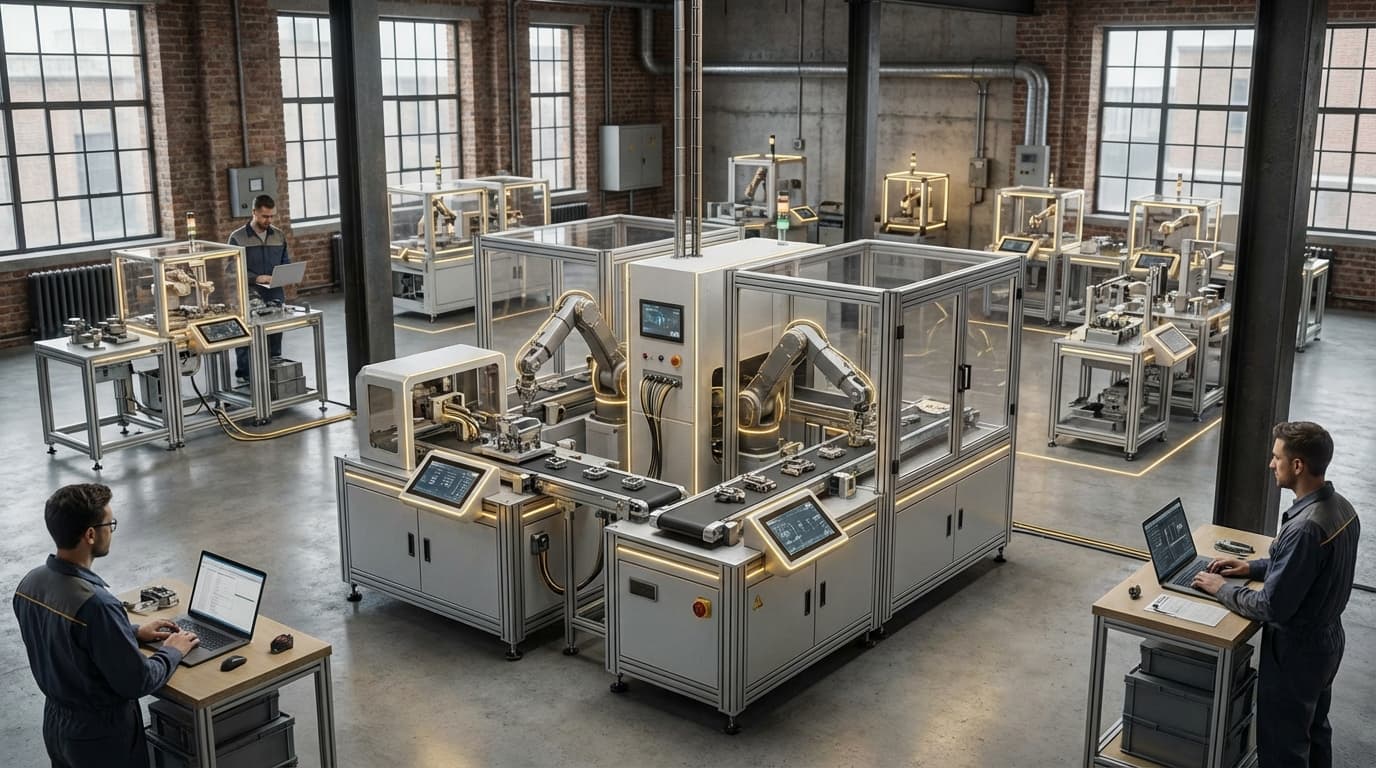
Microfactory Networks
Microfactory networks represent a fundamental shift in manufacturing architecture, moving away from centralized mass production toward distributed, localized production ecosystems. These systems consist of compact, highly automated manufacturing cells—typically occupying a fraction of the space required by traditional factories—that are equipped with advanced robotics, additive manufacturing technologies, and computer numerical control (CNC) machinery. Each microfactory operates as a self-contained production unit capable of fabricating a range of products using digital design files transmitted across a network. The underlying technical framework relies on cyber-physical systems that integrate sensors, actuators, and computational resources to enable real-time monitoring, quality control, and adaptive manufacturing processes. This modular approach allows individual production cells to be reconfigured quickly for different products, with machine learning algorithms optimizing production parameters based on local demand patterns and material availability.
The traditional manufacturing paradigm faces mounting challenges in an era of supply chain volatility, rising transportation costs, and increasing consumer demand for customization. Centralized production facilities require extensive logistics networks to distribute goods globally, creating vulnerabilities to disruption and contributing significantly to carbon emissions through long-distance freight. Microfactory networks address these limitations by positioning production capacity closer to end users, dramatically reducing the time and cost associated with shipping finished goods. This distributed model enables manufacturers to respond more rapidly to local market demands, produce customized products economically in small batches, and reduce inventory requirements through just-in-time production. The approach also lowers barriers to entry for manufacturing businesses, as the smaller capital investment required for a microfactory compared to a traditional facility makes local production viable for a broader range of entrepreneurs and communities. Furthermore, this architecture supports circular economy principles by facilitating local recycling and remanufacturing of products, as materials can be processed and reused within the same geographic area.
Early implementations of microfactory networks have emerged across various sectors, from consumer goods to automotive components, with pilot programs demonstrating the viability of localized production at commercial scale. Some urban areas have begun integrating microfactories into mixed-use developments, where production facilities coexist with retail and residential spaces, creating new models of urban manufacturing. The technology shows particular promise in producing spare parts on demand, potentially eliminating the need for extensive warehousing of replacement components across industries. As digital fabrication technologies continue to advance and become more affordable, the microfactory model aligns with broader trends toward mass customization, sustainable manufacturing, and resilient supply chains. The convergence of automation, artificial intelligence, and distributed manufacturing infrastructure suggests that microfactory networks will play an increasingly important role in reshaping industrial production for the fourth industrial revolution, enabling a future where goods are manufactured closer to where they are needed, when they are needed, and precisely as customers want them.
Related Organizations

Creator of the DAPS (Divergent Adaptive Production System), a hardware-software platform for distributed automotive manufacturing.

Uses robotic arms to form sheet metal (Robotic Blacksmithing), allowing for autonomous, mold-less manufacturing of metal parts.

German research institute actively developing exoskeleton test beds and evaluating human-machine interaction.

AI-driven marketplace connecting enterprise buyers with a global network of manufacturing service providers.

Digital manufacturing ecosystem that delivers custom parts on-demand via a vetted network of partners.

Manufacturing Automation Platform (MAP) that allows users to design, order, and deploy automated equipment.

Social platform and online collaboration system for collaborative product development and distributed manufacturing.

Manufacturer of 3D printing systems for mass production of metal parts.

Invests heavily in 'in silico' biology and microbiome digital twins to test product efficacy without animal testing.
Supporting Evidence
Research this in Signals
Signals turns a topic into a sourced research record you can inspect and rerun. Your first scan is free, and this one starts with Microfactory Networks already loaded, so edit it or scan as is.