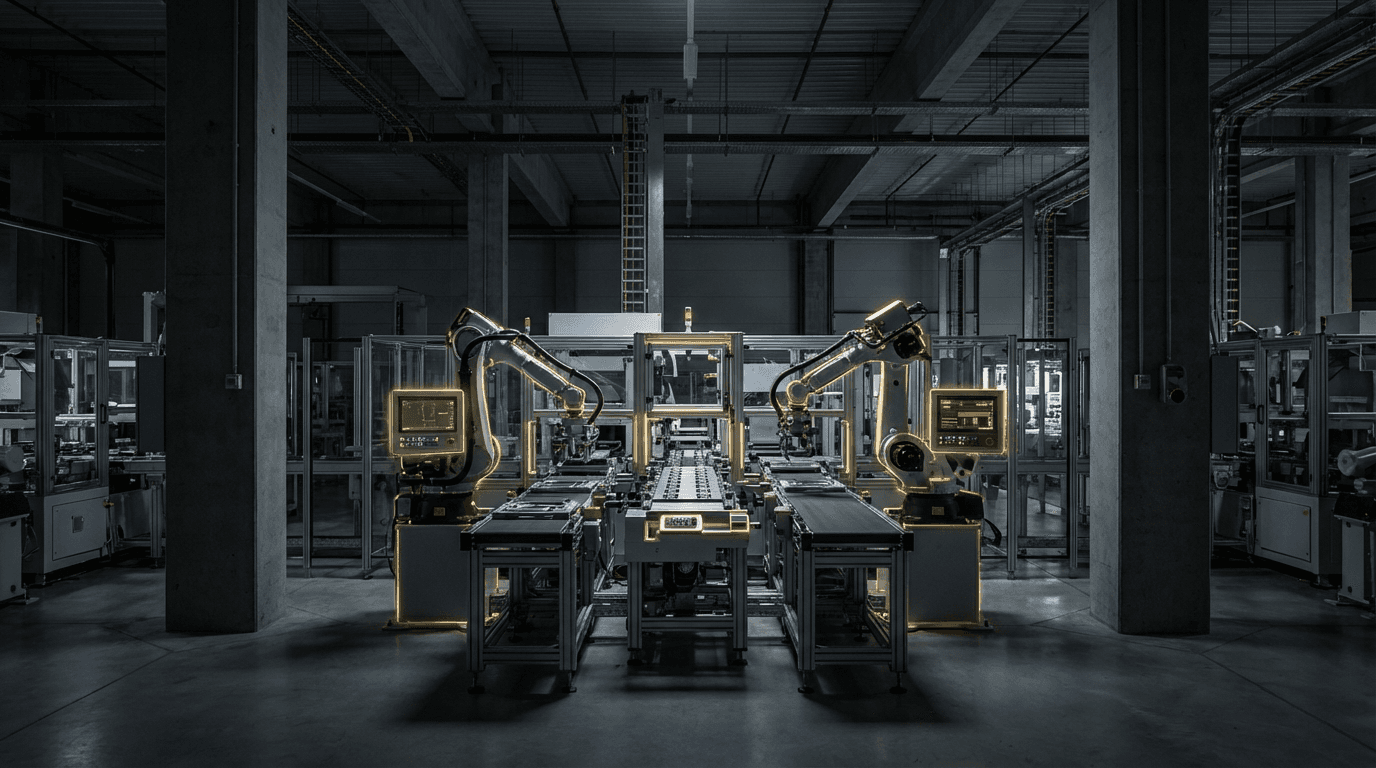
Lights-Out Manufacturing
Lights-out manufacturing represents the pinnacle of industrial automation, where production facilities operate continuously without direct human supervision or intervention. Unlike traditional factories that require human workers for oversight, quality control, and machine operation, these facilities leverage integrated networks of industrial robots, automated guided vehicles (AGVs), computer numerical control (CNC) machines, and artificial intelligence-driven control systems to manage the entire production process. The term "lights-out" refers to the literal ability to turn off the lights, as machines equipped with sensors, cameras, and other detection systems do not require illumination to function. These facilities employ sophisticated manufacturing execution systems (MES) that coordinate every aspect of production, from raw material intake and inventory management through machining, assembly, quality inspection, and final packaging. Advanced sensor arrays and machine vision systems continuously monitor production parameters, while predictive maintenance algorithms analyse equipment performance to prevent failures before they occur.
The primary challenge that lights-out manufacturing addresses is the persistent pressure on manufacturers to reduce costs, improve consistency, and maintain competitiveness in global markets where labour expenses and quality expectations vary dramatically. Traditional manufacturing faces inherent limitations in human workers' ability to maintain consistent precision over extended shifts, the costs associated with workplace safety requirements, and the constraints of operating only during standard business hours. By eliminating human presence from the production floor, these facilities overcome issues related to workplace injuries, shift scheduling, and the variability introduced by human fatigue or error. This approach enables manufacturers to achieve unprecedented levels of product consistency, as automated systems can replicate processes with micron-level precision thousands of times without deviation. Furthermore, the ability to operate continuously without breaks, shift changes, or downtime for lighting and climate control translates into significant reductions in per-unit production costs and dramatic increases in output capacity.
While fully lights-out facilities remain relatively rare, partial implementations are increasingly common across automotive, electronics, and precision manufacturing sectors. Research suggests that the technology has matured sufficiently for certain high-volume, standardised production scenarios, though most manufacturers adopt hybrid models where automated systems handle routine operations while human technicians manage exceptions, perform maintenance, and oversee system optimization. Industry analysts note that the COVID-19 pandemic accelerated interest in autonomous manufacturing as companies sought to reduce vulnerability to workforce disruptions. The trajectory points toward broader adoption as artificial intelligence capabilities improve, enabling systems to handle increasingly complex decision-making and adapt to variations in materials or specifications. As manufacturing moves toward mass customization and Industry 4.0 integration, lights-out manufacturing represents not merely a cost-reduction strategy but a fundamental reimagining of how production facilities operate, promising greater resilience, efficiency, and responsiveness in an increasingly competitive global marketplace.
Related Organizations


Develops intelligent robot controllers that enable industrial robots to perform complex picking and logistics tasks autonomously without human teaching.

Builds autonomous welding cells that use computer vision to scan parts and weld them without programming, enabling unmanned operation.

Develops autonomous manufacturing software to automate CNC machining and runs a high-tech factory.

Operates 'The Hive', a massive grid-based swarm of washing-machine-sized robots that collaborate to pack groceries.


Leading 3D printing manufacturer focusing on SLA and SLS technology.
Supporting Evidence
Research this in Signals
Signals turns a topic into a sourced research record you can inspect and rerun. Your first scan is free, and this one starts with Lights-Out Manufacturing already loaded, so edit it or scan as is.